Question
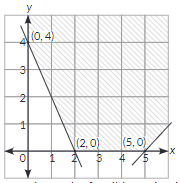
A linear programming problem (LPP) along with the graph of its constraints is shown below. The corresponding objective function is
Minimize: $Z=3 x+2 y$. The minimum value of the objective function is obtained at the corner point ( 2 , 0).
The optimal solution of the above linear programming problem $\qquad$
Image

Answer

exists as the inequality $3 x+2 y<6$ does not have any point in common with the feasible region.

Need a full question paper?

Generate a complete, print-ready paper with questions like this in minutes — across 16+ boards, with answer keys.

Start Generating Free

Similar questions

Choose the correct answer from the given four options.If $\text{P}(\text{A})=\frac{2}{5},\text{P}(\text{B})=\frac{3}{5}$ and $\text{P}(\text{A}\cap\text{B})=\frac{1}{5},$ then $\text{P}\Big(\frac{\text{A}'}{\text{B}'}\Big)\cdot\text{P}\Big(\frac{\text{B}'}{\text{A}'}\Big)$ is equas:
Find the equation of the line which passes through the point (1, 2, 3) and is parallel to the vector $3 \hat{i}+2 \hat{j}-2 \hat{k}$
$\int\frac{\text{x}^3}{\text{x}+1}$ is equal to:
  1. $\text{x}+\frac{\text{x}^2}{2}+\frac{\text{x}^3}{3}-\log|1-\text{x}|+\text{c}$
  2. $\text{x}+\frac{\text{x}^2}{2}-\frac{\text{x}^3}{3}-\log|1-\text{x}|+\text{c}$
  3. $\text{x}+\frac{\text{x}^2}{2}-\frac{\text{x}^3}{3}-\log|1+\text{x}|+\text{c}$
  4. $\text{x}+\frac{\text{x}^2}{2}+\frac{\text{x}^3}{3}-\log|1+\text{x}|+\text{c}$
The vector equation of a line which passes through the point $(2,-4,5)$ and is parallel to the line $\frac{x+3}{3}=\frac{4-y}{2}=\frac{z+8}{6}$ is :
If $\vec{\text{a}}=2\hat{\text{i}}-3\hat{\text{j}}+5\hat{\text{k}},\vec{\text{b}}=3\hat{\text{i}}-4\hat{\text{j}}+5\hat{\text{k}}$ and $\vec{\text{c}}=5\hat{\text{i}}-3\hat{\text{j}}-2\hat{\text{k}},$ then the volume of the parallelopiped with contermious edges $\vec{\text{a}}+\vec{\text{b}},\vec{\text{b}}+\vec{\text{c}},\vec{\text{c}}+\vec{\text{a}}$ is:
  1. 2
  2. 1
  3. -1
  4. 0
The existence of the unique solution of the system of equations:
x + y + z = λ
5x − y + µz = 10
2x + 3y − z = 6
depends on
  1. µ only.
  2. λ only.
  3. λ and µ both.
  4. neither λ nor µ.
If $\left|\begin{array}{lll}<\text{br}> &1 &\text{amp; } 0 &\text{amp; } 0\\ <\text{br}>&2 &\text{amp; } 3 &\text{amp; } 4\\ <\text{br}>&5 &\text{amp; } -6 &\text{amp; x}<\text{br}> \end{array}\right|=45$ then $\text{x}=$
  1. 4
  2. 7
  3. -5
  4. -7
If $\text{P(A)}=\frac{2}{5},\text{P(B)}=\frac{3}{10}$ and $\text{P}(\text{A}\cap\text{B})=\frac{1}{5},$ then, $\text{P}(\overline{\text{A}}|\overline{\text{B}}) \text{ P}(\overline{\text{B}}|\overline{\text{A}})$ is equal to
Area lying between the parabola $y^2 = 4x$ and its latus rectum is$:$
Find the minor of the element 1 in the determinant $\triangle=\begin{bmatrix}1&5\\3&8\end{bmatrix}$ is:
  1. 5
  2. 1
  3. 8
  4. 3