Question 11 Mark
For the following LPP, maximise $Z=3 x+4 y$ subject to constraints $x-y \geq-1, x \leq 3, x \geq 0, y \geq 0$ the maximum value is
AnswerGiven, $Z=3 x+4 y$
Subject to constraints, $x-y \geq-1, x \leq 3 ; x \geq 0, y \geq 0$
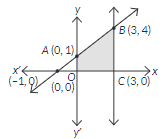
The shaded region $O A B C$ is the feasible region, where corner points are $O(0,0), A(0,1), B(3,4)$ and $C(3,0)$.
At $O(0,0), Z=3(0)+4(0)=0$
At $A(0,1), Z=3(0)+4(1)=4$
At $B(3,4), Z=3(3)+4(4)=25$
At $C(3,0), Z=3(3)+4(0)=9$
$\therefore \quad$ Maximum value of $Z$ is 25 , which occurs at $B(3,4)$. View full question & answer→Question 21 Mark
The feasible region of an LPP is given in the following figure
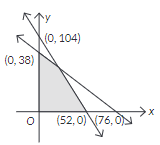
Then, the constraints of the LPP are $x \geq 0, y \geq 0$ and AnswerClearly, the pair of points given in graph, and $(0,104) ;(52,0)$ and $(0,38) ;(76,0)$ satisfy the corresponding equations given in option(b) i.e., $2 x+y \leq 104$ and $x+2 y \leq 76$.
View full question & answer→Question 31 Mark
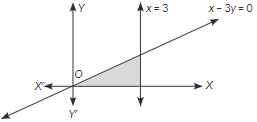
In a linear programming problem, the constraints on the decision variables $x$ and $y$ are $x-3 y \geq 0, y \geq 0$, $0 \leq x \leq 3$. The feasible region
AnswerFrom the graph, we can say that the feasible region is bounded in the first quadrant.
View full question & answer→Question 41 Mark
In the given graph, the feasible region for a LPP is shaded. The objective function $Z=2 x-3 y$, will be minimum at
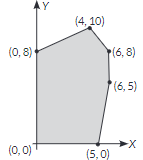
AnswerWe have,| Corner points | Value of Z=2x-3y |
| (0,0) | 2xx0-3xx0=0 |
| (0,8) | 2xx0-3xx8=-24 (Minimum) |
| (4,10) | 2xx4-3xx10=-22 |
| (6,8) | 2xx6-3xx8=-12 |
| (6,5) | 2xx6-3xx5=-3 |
| (5,0) | 2xx5-3xx0=10 |
$\therefore \quad$ Value of $Z$ is minimum at $(0,8)$. View full question & answer→Question 51 Mark
Based on the given shaded region as the feasible region in the graph, at which point(s) is the objective function $Z=3 x+9 y$ maximum?
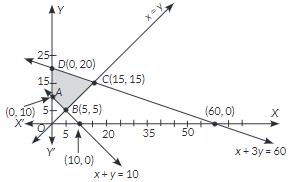
AnswerWe have,| Corner points | Value of Z=3x+9y |
| A(0,10) | 3xx0+9xx10=90 |
| B(5,5) | 3xx5+9xx5=60 |
| C(15,15) | 3xx15+9xx15=180 (Maximum) |
| D(0,20) | 3xx0+9xx20=180 (Maximum) |
$\because \quad Z$ is maximum at $C(15,15)$ and $D(0,20)$.
$\therefore \quad Z$ is maximum at every point on the line joining $C D$. View full question & answer→Question 61 Mark
The maximum value of $Z=3 x+4 y$ subject to the constraints $x \geq 0, y \geq 0$ and $x+y \leq 1$ is
AnswerWe have to maximise $Z=3 x+4 y$
Subject to constraints, $x \geq 0, y \geq 0$ and $x+y \leq 1$
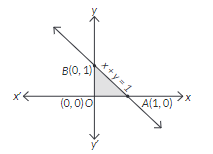
The shaded portion $O A B$ is the feasible region, where $O(0,0), A(1,0)$ and $B(0,1)$ are the corner points.
At $O(0,0), Z=3 \times 0+4 \times 0=0$
At $A(1,0), Z=3 \times 1+4 \times 0=3$
At $B(0,1), Z=3 \times 0+4 \times 1=4$
$\therefore \quad$ Maximum value of $Z$ is 4 , which occurs at $B(0,1)$. View full question & answer→Question 71 Mark
If the corner points of the feasible region of an LPP are $(0,3),(3,2)$ and $(0,5)$, then the minimum value of $z=11 x+7 y$ is
AnswerGiven, $Z=11 x+7 y$
At $(0,3), Z=11 \times 0+7 \times 3=21$
At $(3,2), Z=11 \times 3+7 \times 2=47$
At $(0,5), Z=11 \times 0+7 \times 5=35$
Thus, $Z$ is minimum at $(0,3)$ and minimum value of $Z$ is 21 .
View full question & answer→Question 81 Mark
The number of solutions of the system of inequations $x+2 y \leq 3,3 x+4 y \geq 12, x \geq 0, y \geq 1$ is
AnswerGiven,
$x+2 y \leq 3,3 x+4 y \geq 12, x \geq 0, y \geq 1$
The graph of given constraints is shown here.
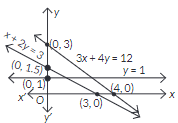
Since, there is no common region, so, no solution exists. View full question & answer→Question 91 Mark
For an objective function $Z=a x+b y$, where $a, b>0$; the corner points of the feasible region determined by a set of constraints (linear inequalities) are $(0,20),(10,10),(30,30)$ and $(0,40)$. The condition on $a$ and $b$ such that the maximum $Z$ occurs at both the points $(30,30)$ and $(0,40)$ is
AnswerAs, $Z$ is maximum at $(30,30)$ and $(0,40)$.
$\Rightarrow \quad 30 a+30 b=40 b \Rightarrow b-3 a=0$
View full question & answer→Question 101 Mark
A linear programming problem is as follows:
Minimize $Z=30 x+50 y$
Subject to the constraints,
$3 x+5 y \geq 15$
$2 x+3 y \leq 18$
$x \geq 0, y \geq 0$
In the feasible region, the minimum value of $Z$ occurs at
AnswerHere, the feasible region is shaded.
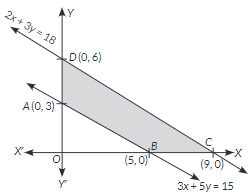
| Corner points |
Value of $Z=30 x+50 y$ |
| $A(0,3)$ |
$30 xx0+50 xx3=150 ($ Minimum $)$ |
| $B(5,0)$ |
$30 xx5+50 xx0=150$ quad $($ Minimum $)$ |
| $C(9,0)$ |
$30 xx9+50 xx0=270$ |
| $D(0,6)$ |
$30 xx0+50 xx6=300$ |
Since, minimum value of $Z$ occurs at both $A$ and $B$. So, $Z$ is minimum at every point on the line joining $A B$. So, minimum value of $Z$ occurs at infinitely many points. View full question & answer→Question 111 Mark
If the minimum value of an objective function $Z=a x+$ by occurs at two points $(3,4)$ and $(4,3)$ then
AnswerSince, minimum value of $Z=a x+b y$ occurs at two points $(3,4)$ and $(4,3)$.
$\therefore \quad 3 a+4 b=4 a+3 b \Rightarrow a=b$
View full question & answer→Question 121 Mark
The feasible region for an LPP is shown below: Let $z=3 x-4 y$ be the objective function. Minimum of $z$ occurs at
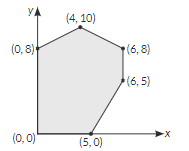
AnswerWe know that minimum of objective function occurs at corner points.
| Corner points | Value of z=3x-4y |
| (0,0) | 0 |
| (5,0) | 15 |
| (6,5) | -2 |
| (6,8) | -14 |
| (4,10) | -28 |
| (0,8) | -32 larr Minimum |
View full question & answer→Question 131 Mark
The corner points of the feasible region determined by the system of linear inequalities are (0, 0), (4, 0), (2, 4) and (0, 5). If the maximum value of z = ax + by, where a, b > 0 occurs at both (2, 4) and (4, 0), then:
Answer
- a = 2b
Solution:
4a + 0b = 2a + 4b
4a = 2a + 4b
4a - 2a = 4b
2a = 4b
a = 2b
View full question & answer→Question 141 Mark
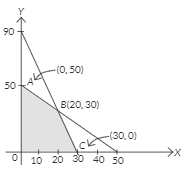
The maximum value of $Z=4 x+y$ for a $L.P.P.$ whose feasible region is given below is:
AnswerWe have, Max. $Z=4 x+y$
The corner points of feasible region are $O, A, B$ and $C$. Thus,
$Z_{(0,0\rangle}=0 ;$
$Z_{\langle 0,50\rangle}=50 ;$
$Z_{\langle 20,30\rangle}=20 \times 4+30=110 ;$
$Z_{\{30,0\rangle}=4 \times 30=120$
$\therefore M a x Z=4 x+y$ is $120 .$
View full question & answer→Question 151 Mark
The common region determined by all the constraints of a linear programming problem is called:
Question 161 Mark
A linear programming problem (LPP) along with the graph of its constraints is shown below. The corresponding objective function is
Minimize: $Z=3 x+2 y$. The minimum value of the objective function is obtained at the corner point ( 2 , 0).
The optimal solution of the above linear programming problem $\qquad$
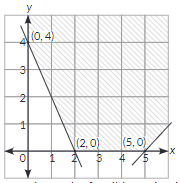
Answerexists as the inequality $3 x+2 y<6$ does not have any point in common with the feasible region.
View full question & answer→Question 171 Mark
The feasible region of a linear programming problem is bounded. The corresponding objective function is $Z=6 x-7 y$.
The objective function attains $\qquad$ in the feasible region.
View full question & answer→Question 181 Mark
The feasible region corresponding to the linear constraints of a Linear Programming Problem is given below
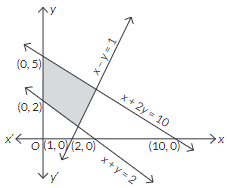
Which of the following is not a constraint to the given Linear Programming Problem?
AnswerWe observe, $(0,0)$ does not satisfy the inequality
$x-y \geq 1$
So, the half plane represented by the above inequality will not contain origin therefore, it will not contain the shaded feasible region.
View full question & answer→Question 191 Mark
The corner points of the bounded feasible region determined by a system of linear constraints are $(0,3),(1,1)$ and $(3,0)$. Let $Z=p x+q y$, where $p, q>0$,. The condition on $p$ and $q$ so that the minimum of $Z$ occurs at $(3,0)$ and $(1,1)$ is
Answer| Corner point | Value of Z=px+qy;p,q > 0 |
| (0,3) | p xx0+q xx3=3q |
| (1,1) | p xx1+q xx1=p+q |
| (3,0) | p xx3+q xx0=3p |
The minimum of $Z$ occurs at $(3,0)$ and $(1,1)$
$
\therefore p+q=3 p \Rightarrow p=\frac{q}{2}
$ View full question & answer→Question 201 Mark
The number of corner points of the feasible region determined by the constraints $x-y \geq 0,2 y \leq x+2$, $x \geq 0, y \geq 0$ is:
AnswerWe have, $x-y \geq 0,2 y \leq x+2, x \geq 0$ and $y>0$. Let us draw the graph of given constraints, we get $x-y=0$and 2y = x + 2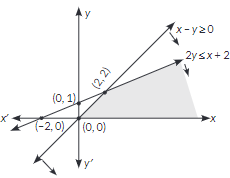
The feasible region is unbounded.
$\therefore \quad$ There are two corner points as $(0,0)$ and $(2,2)$. View full question & answer→Question 211 Mark
The corner points of the bounded feasible region of an LPP are $O(0,0), A(250,0), B(200,50)$ and $C(0,175)$. If the maximum value of the objective function $Z=2 a x+$ by occurs at the points $A(250,0)$ and $B(200,50)$, then the relation between $a$ and $b$ is:
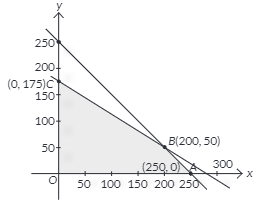
AnswerGiven, $Z=2 a x+b y$.........(i)
Putting $x=250$ and $y=0$ in (i), we get
$Z_{\max }=2 a(250)+b(0)=500 a$.........(ii)
Putting $x=200$ and $y=50$ in (i), we get
$Z_{\max }=2 a(200)+b(50)=400 a+50 b$..........(iii)
From (ii) and (iii), we get $500 a=400 a+50 b$
$\Rightarrow \quad 100 a=50 b \Rightarrow 2 a=b$
View full question & answer→Question 221 Mark
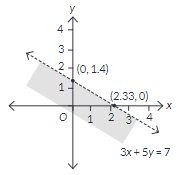
The solution set of the inequation $3 x+5 y<7$ is
View full question & answer→Question 231 Mark
The point which lies in the half-plane $2 x+y-4 \leq 0$ is:
AnswerSubstitute $x=1$ and $y=1$ in $2 x+y \leq 4$
$\Rightarrow 2(1)+1 \leq 4 \Rightarrow 3 \leq 4$ which is true.
So, $(1,1)$ lies in the half plane $2 x+y-4 \leq 0$
View full question & answer→Question 241 Mark
The corner points of the feasible region in the graphical representation of a linear programming problem are $(2,72),(15,20)$ and $(40,15)$. If $z=18 x+9 y$ be the objective function, then:
AnswerThe objective function is given as $z=18 x+9 y$
The corner points are given as $(2,72),(15,20)$ and $(40,15)$
At $(2,72), z=18 \times 2+9 \times 72=36+648=684$
At $(15,20), z=18 \times 15+9 \times 20=270+180=450$
At $(40,15)=z=18 \times 40+9 \times 15=720+135=855$
$\therefore \quad z$ is maximum at $(40,15)$ and minimum at $(15,20)$.
View full question & answer→Question 251 Mark
Which of the following points satisfies both the inequations $2 x+y \leq 10$ and $x+2 y \geq 8$ ?
View full question & answer→Question 261 Mark
The solution set of the inequality $3 x+5 y<4$ is
AnswerThe strict inequality represents an open half plane and it contains the origin, as $(0,0)$ satisfies it.
View full question & answer→Question 271 Mark
The corner points of the shaded unbounded feasible region of an LPP are $(0,4),(0.6,1.6)$ and $(3,0)$ as shown in the figure. The minimum value of the objective function $Z=4 x+6 y$ occurs at
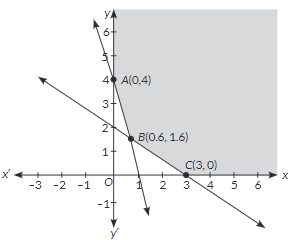
AnswerThe minimum value of the objective function occurs at two adjacent corner points $(0.6,1.6)$ and $(3,0)$ and there is no point in the half plane $4 x+6 y<12$ in common with the feasible region.
So, the minimum value occurs at every point of the linesegment joining the two points.
View full question & answer→Question 281 Mark
The objective function of an LPP is
AnswerA linear function to be optimized is called an objective function
View full question & answer→Question 291 Mark
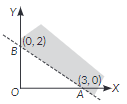
The graph of the inequality $2 x+3 y>6$ is
AnswerFrom the graph of inequality $2 x+3 y>6$. It is clear that it does not contain the origin nor the points of the line $2 x+3 y=6$
View full question & answer→Question 301 Mark
The corner points of the feasible region determined by the system of linear inequalities are $(0,0),(4,0)$, $(2,4)$ and $(0,5)$. If the maximum value of $z=a x+b y$, where $a, b>0$ occurs at both $(2,4)$ and $(4,0)$, then
AnswerSince, maximum value of $z=a x+b y$ occurs at both
$(2,4)$ and $(4,0)$.
$
\therefore \quad 2 a+4 b=4 a+0 \Rightarrow 4 b=2 a \Rightarrow 2 b=a$
View full question & answer→Question 311 Mark
In an LPP, if the objective function $z=a x+$ by has the same maximum value on two corner points of the feasible region, then the number of points at which $z_{\max }$ occurs is
AnswerIn an LPP, if the objective function $z=a x+b y$ has the same maximum value on two corner points of the feasible region, then the number of points at which $z_{\max }$ occurs is infinite.
View full question & answer→Question 321 Mark
The solution set of the inequation 3x + 2y > 3 is:
Answer
- Half plane not containing the origin
View full question & answer→Question 331 Mark
Which of the following statements is correct?
Answer
- If a LPP admits two optimal solution it has an infinite number of optimal solutions
Solution:
Optimal solution of LPP has three types.
- Unique
- Infinite
- Does not exist.
Hence, it has infinite solution if it admits two optimal solution.
View full question & answer→Question 341 Mark
The optimal value of the objective function is attained at the points
Answer
- given by corner points of the feasible region
Solution:
It is known that the optimal value of the objective function is attained at any of the corner point.
Thus, the potimal value of the objective function is attined at the points given by corner points of the feasible region.
View full question & answer→Question 351 Mark
In transportation models designed in linear programming, points of demand is classified as:
Answer
- Destinations
Solution:
In linear programming, transportation modeltransportation model are applied to problems related to the study of efficient transportation routes.
i.e., how effectively the available resources are transported to different destinations with minimum cost.
Therefore, the points of demand is classified as destinations.
View full question & answer→Question 361 Mark
The corner point of the feasible region determined by the system of linear constraints are (0, 0), (0, 40), (20, 40), (60, 20), (60, 0). The objective function is Z = 4x + 3y. Compare the quantity in Column A and Column B.
|
Column A
|
Column B
|
|
Maximum of Z
|
325
|
Answer
- The quantity in column B is greater.
View full question & answer→Question 371 Mark
Objective function of a LPP is:
Answer
- a function to be optimized
Solution:
The objective function of a linear programming problem is either to be maximized or minimized i.e. objective function is to be optimized.
View full question & answer→Question 381 Mark
The given table shows the number of cars manufactured in four different colours on a particular day. Study it carefully and answer the question.
|
|
Number of cars manufactured
|
|
Colour
|
Vento
|
Creta
|
Wagonr
|
|
Red
|
65
|
88
|
93
|
|
White
|
54
|
42
|
80
|
|
Black
|
66
|
52
|
88
|
|
Sliver
|
37
|
49
|
74
|
Which car was twice the number of silver Vento?
Answer
- Silver WagonR
Solution:
The number of silver Vento car = 37 (from the table)
Twice the number of silver Vento cars = 2 × 37 = 74
Now from table we can see that silver WagonR is only car type having 74 cars
View full question & answer→Question 391 Mark
The solution set of the inequation 2x + y > 5 is:
Answer
- open half plane not containing the origin
Solution:
On putting x = 0, y = 0 in the given inequality, we get 0 > 5, which is absurd.
Therefore, the solution set of the given inequality does not include the origin.
Thus, the solution set of the given inequality consists of the open half plane not containing the origin.
View full question & answer→Question 401 Mark
The first step in formulating an LP problem is:
Answer
- Understand the managerial problem being faced.
Solution:
The first step in formulating an linear programming problem is to understand the managerial problem being faced i.e., determine the quantities that are needed to solve the problem.
View full question & answer→Question 411 Mark
Linear programming model which involves funds allocation of limited investment is classified as:
Answer
- Capital budgeting models
Solution:
In linear programming, Capital budgeting models to minimize the total capital cost.
The solutions from the model are used to decide the best combination of capital resources and best times to start and finish projects and to determine the net capital cost.
View full question & answer→Question 421 Mark
Which of the following statements about an LP problem and its dual is false?
Answer
- The dual problem might have an optimal solution, even though the primal has no (bounded) optimum.
Solution:
If one of the problems (primal, dual) is infeasible then the other problem is infeasible.
View full question & answer→Question 431 Mark
Answer
- A function to be optimized
Solution:
The objective of Linear Programming Problems (LPP) is to minimize or maximize the function.
View full question & answer→Question 441 Mark
What is the solution of $\text{x}\leq4,\text{y}\geq0$ and $\text{x}\leq-4,\text{y}\geq0$?
Answer
- $\text{x}\leq-4,\text{y}=0$
Solution:
$\text{x}\leq4$ and $\text{x}\leq-4$
$\Rightarrow\text{x}\leq-4$
Also, $\text{y}\geq0$ and $\text{y}\leq0$
$\Rightarrow\text{y}=0$
Hence the solutione is $\text{x}\leq-4,\text{y}=0.$ View full question & answer→Question 451 Mark
The problem associated with LPP is:
Answer
- Single objective function
Solution:
The problem associated with LLP is single objective.
View full question & answer→Question 461 Mark
Choose the correct answer from the given four options.
Corner points of the feasible region for an LPP are (0, 2), (3, 0), (6, 0), (6, 8) and (0, 5).
Let F = 4x + 6y be the objective function.
The Minimum value of F occurs at.
Answer
- Any point on the line segment joining the points (0, 2) and (3, 0).
Solution:
|
Corner points
|
Corresponding value of F = 4x + 6y
|
|
(0, 2)
|
12 (Minimum)
|
|
(3, 0)
|
12 (Minimum)
|
|
(6, 0)
|
24
|
|
(6, 8)
|
72 (Maxmimum)
|
|
(0, 5)
|
30
|
View full question & answer→Question 471 Mark
While plotting constraints on a graph paper, terminal points on both the axes are connected by a straight line because:
Answer
- The constraints are linear equations or inequalities.
Solution:
The graph of the linear equation is a straight line.
If the terminal points are connected by a straight line then the given constraints are linear equations which may include inequalities.
View full question & answer→Question 481 Mark
Choose the most correct of the following statements relating to primal - dual linear programming problems:
Answer
- All of the above.
Solution:
From the primal - dual relationship, The shadow prices of resources in the primal are optimal values of the dual variables.
If one of the problems has an optimal feasible solution then the other problem also has an optimal feasible solution.
The optimal objective function value is same for both primal and dual problems.
If one problem has an unbounded solution then the other problem is infeasible.
View full question & answer→Question 491 Mark
Linear programming used to optimize mathematical procedure and is:
Answer
- Subset of mathematical programming
Solution:
Linear programming is an extremely powerful tool for addressing a wide range of applied optimization problems.
A short list of application areas is resource allocation, production scheduling, warehousing, layout, transportation scheduling, facility location, flight crew scheduling, portfolio optimization, parameter estimation.
So, linear programming is used to subset mathematical programming.
View full question & answer→Question 501 Mark
The objective function Z = 4x + 3y can be maximised subjected to the constraints $ 3\text{x}+4\text{y}\leq24,$ $8\text{x}+6\text{y}\leq48,$ $\text{x}\leq5,\text{y}\leq6;\text{x},\text{y}\leq0.$
Answer
- At an infinite number of points.
View full question & answer→