MCQ
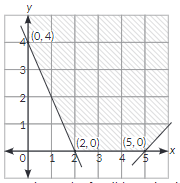
A linear programming problem (LPP) along with the graph of its constraints is shown below. The corresponding objective function is
Minimize: $Z=3 x+2 y$. The minimum value of the objective function is obtained at the corner point ( 2 , 0).
The optimal solution of the above linear programming problem $\qquad$
Image
  • A
    does not exist as the feasible region is unbounded.
  • B
    does not exist as the inequality $3 x+2 y<6$ does not have any point in common with the feasible region.
  • C
    exists as the inequality $3 x+2 y>6$ has infinitely many points in common with the feasible region.
  • exists as the inequality $3 x+2 y<6$ does not have any point in common with the feasible region.

Answer

Correct option: D.
exists as the inequality $3 x+2 y<6$ does not have any point in common with the feasible region.

Need a full question paper?

Generate a complete, print-ready paper with questions like this in minutes — across 16+ boards, with answer keys.

Start Generating Free

Similar questions

The equation of the plane through the intersection of the planes x + 2y + 3z = 4 and 2x + y - z = -5 and perpendicular to the plane 5x + 3y + 6z + 8 = 0 is:
If $A=\left[a_{i j}\right]$ is a skew-symmetric matrix of order $n$, then
Evaluate : $\int_0^2 e^{3-4 x} d x$
The graphs of $f (x) = x^2 \,\& \,g(x) = cx^3 \,\, (c > 0)$ intersect at the points $(0, 0) \& \left( {\frac{1}{c},\,\,\frac{1}{{{c^2}}}} \right)$. If the region which lies between these graphs & over the interval $[0, 1/c]$ has the area equal to $2/3$ then the value of $c$ is
$a\,.\,[(b+c)\times (a+b+c)]$ is equal to
The parabola $y^2=4 x+1$ divides the disc $x^2+y^2 \leq 1$ into two regions with areas $A_1$ and $A_2$. Then, $\left|A_1-A_2\right|$ equals
List $I$ List $II$
$P.$ Let $y(x)=\cos \left(3 \cos ^{-1} x\right), x \in[-1,1], x \neq \pm \frac{\sqrt{3}}{2}$. Then $\frac{1}{y(x)}\left\{\left(x^2-1\right) \frac{d^2 y(x)}{d x^2}+x \frac{d y(x)}{d x}\right\}$ equals $1.$ $1$
$Q.$ Let $A_1, A_2, \ldots \ldots, A_n(n>2)$ be the vertices of a regular polygon of $n$ sides with its centre at the origin. Let $\vec{a}_k$ be the position vector of the point $A_k, k=1,2, \ldots, n$. If $\left|\sum_{k=1}^{n-1}\left(\overrightarrow{a_k} \times \overrightarrow{a_{k+1}}\right)\right|=\left|\sum_{k=1}^{n-1}\left(\overrightarrow{a_k} \cdot \overrightarrow{a_{k+1}}\right)\right|$, then the minimum value of $n$ is $2.$ $2$
$R.$ If the normal from the point $P(h, 1)$ on the ellipse $\frac{x^2}{6}+\frac{y^2}{3}=1$ is perpendicular to the line $x+y=8$, then the value of $h$ is $3.$ $8$
$S.$ Number of positive solutions satisfying the equation $\tan ^{-1}\left(\frac{1}{2 x+1}\right)+\tan ^{-1}\left(\frac{1}{4 x+1}\right)=\tan ^{-1}\left(\frac{2}{x^2}\right)$ is $4.$ $9$

Codes: $ \quad P \quad Q \quad R \quad S $

Let $A=\left[\begin{array}{ccc}2 & 1 & 0 \\ 1 & 2 & -1 \\ 0 & -1 & 2\end{array}\right]$. If $|\operatorname{adj}(\operatorname{adj}(\operatorname{adj} 2 A))|=(16)^{ n }$, then $n$ is equal to
The work done in moving an object along the vector $3i + 2j - 5k,$ if the applied force is $\overrightarrow F = 2i - j - k$, is
Give the correct order of initials $T$ or $F$ for following statements. Use $T$ if statement is true and $F$ if it is false.

Statement$-1$ If $f R \rightarrow R$ and $c \in R$ is such that $f$ is increasing in $(c - \delta , c)$ and $f$ is decreasing in $(c, c + \delta )$ then $f$ has a local maximum at $c$. Where $\delta$ is a sufficiently small positive quantity.

Statement $-2$ Let $f (a, b) \rightarrow \,R, c \in (a, b)$. Then $f$ can not have both a local maximum and a point of inflection at $x = c.$

Statement $-3 $ The function $f (x) = x^2 | x |$ is twice differentiable at $x = 0.$

Statement $-4$ Let $f [c - 1, c + 1] \rightarrow [a, b]$ be bijective map such that $f$ is differentiable at $c$ then $f^{-1}$ is also differentiable at $f (c)$.