Question
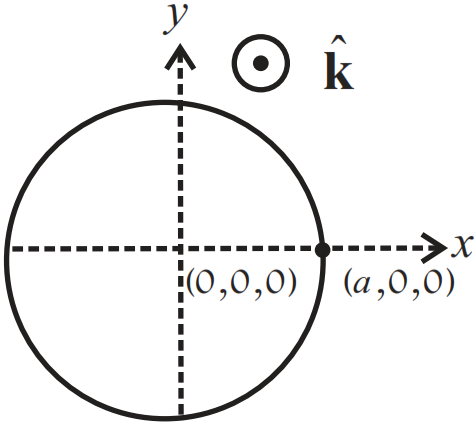
A magnetic field in a certain region is given by $\text{B}=\text{B}_0\cos(\omega\text{t})\hat{\text{k}}$ and a coil of radius a with resistance R is placed in the x-y plane with its centre at the origin in the magnetic field (see Fig). Find the magnitude and the direction of the current at (a, 0, 0) at $\text{t}=\frac{\pi}{2\omega},\text{t}=\frac{\pi}{\omega} \text{ and }\text{t}=\frac{3\pi}{2\omega}$.
Answer

Key concept:
First law: When ever the number of magnetic lines of force(magnetic flux) passing through a circuit changes, an emf is produced in the circuit called induced emf. The induced emf persists only as long as there is a change or cutting of flux.
Second law: The induced emf is given by the rate of change of magnetic flux linked with the circuit, i.e., $\text{e}=-\frac{\text{d}\phi}{\text{dt}}$. For n Turns $\text{e}=-\frac{\text{N d}\phi}{\text{dt}}$; Negative sign indicates that induced emf (e) apposes the change of flux.
First we need to find out the flux passing through the rign at any instant and that is given by
$\phi_\text{m}-\vec{\text{B}}.\vec{\text{A}}=\text{BA}\cos\theta$
And as we know both $\vec{\text{A}}$ (area vector) and $\vec{\text{B}}$ (magnetic field vector) are directed along z-axis. So, angle between them is 0.
So, $\cos\theta=1\ (\because\ \theta=0)$
$\Rightarrow\ \phi_\text{m}=\text{BA}$
Area of coil of radius $\text{a}=\pi\text{a}^2$
$\in=\text{B}_0(\pi\text{a}^2)\cos\omega\text{t}$
By Faraday's law of eletromagnetic induction,
Magnitude of induced emf is given by
$\in=\text{B}_0(\pi\text{a}^2)\omega\sin\omega\text{t}$
This causes flow of induced emf is given by
$\text{I}=\frac{\text{B}_0(\pi\text{a}^2)\omega\sin\omega\text{t}}{\text{R}}$
Now, the value of current at different instants,
  1. $\text{t}=\frac{\pi}{2\omega}$
$\text{I}=\frac{\text{B}_0(\pi\text{a}^2)\omega}{\text{R}}\text{ along}\hat{\text{j}}$

Because $\sin\omega\text{t}=\sin\Big(\omega\frac{\pi}{2\omega}\Big)=\sin\frac{\pi}{2}=1$
  1. $\text{t}=\frac{\pi}{\omega},\text{I}=\frac{\text{B}_0(\pi\text{a}^2)\omega}{\text{R}}=0$
$\sin\omega\text{t}=\sin\Big(\omega\frac{\pi}{\omega}\Big)=\sin{\pi}=0$
  1. $\text{t}=\frac{3}{2}\frac{\pi}{\omega}$
$\text{I}=\frac{\text{B}(\pi\text{a}^2)\omega}{\text{R}}\text{along}-\hat{\text{j}}$

$\sin\omega\text{t}=\sin\Big(\omega.\frac{3\pi}{2\omega}\Big)=\sin\frac{3\pi}{2}=-1$

Need a full question paper?

Generate a complete, print-ready paper with questions like this in minutes — across 16+ boards, with answer keys.

Start Generating Free

Similar questions

What is rivetted galvanometer? What is the function of shunt in a galvanometer?
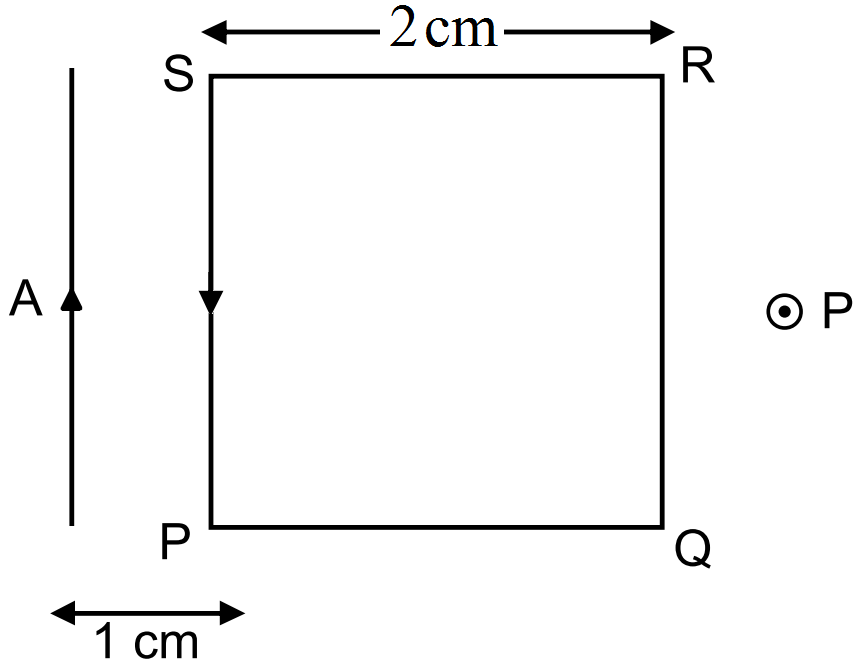
A square loop PQRS carrying a current of 6.0A is placed near a long wire carrying 10A as shown in figure.
  1. Show that the magnetic force acting on the part PQ is equal and opposite to that on the part RS.
  2. Find the magnetic force on the square loop.
A point object is placed at a distance of 15cm from a convex lens. The image is formed on the other side at a distance of 30cm from the lens. When a concave lens is placed in contact with the convex lens, the image shifts away further by 30cm. Calculate the focal lengths of the two lenses.
Radiation coming from transition n = 2 to n = 1 of hydrogen atoms falls on helium ions in n = 1 and n = 2 states. What are the possible transitions of helium ions as they absorbs energy from the radiation?
The time constant of an LR circuit is 40ms. The circuit is connected at t = 10 and the steady-state current is found to be 2.0A. Find the current at:
  1. t = 10ms
  2. t = 20ms
  3. t = 100ms
  4. t = 1s.
Answer the following question:
If the earth did not have an atmosphere, would its average surface temperature be higher or lower than what it is now?
By giving example of bar magnet, explain its basic properties.
Mrs. Rashmi Singh broke her reading glasses. When she went to the shopkeeper to order new spects, he suggested that she should get spectacles with plastic lenses instead of glass lenses. On getting the new spectacles, she found that the new ones were thicker than the earlier ones. She asked this question to the shopkeeper but he could not offer satisfactory explanation for this. At home, Mrs. Singh raised the same question to her daughter Anuja who explained why plastic lenses were thicker.
  1. Write two qualities displayed each by Anuja and her mother.
  2. How do you explain this fact using lens maker's formula?
A block of mass 2.0kg kept at rest on an inclined plane of inclination 37° is pulled up the plane by applying a constant force of 20N parallel to the incline. The force acts for one second.
  1. Show that the work done by the applied force does not exceed 40J.
  2. Find the work done by the force of gravity in that one second if the work done by the applied force is 40J.
  3. Find the kinetic energy of the block at the instant the force ceases to act. Take $g = 10m/s^2.$
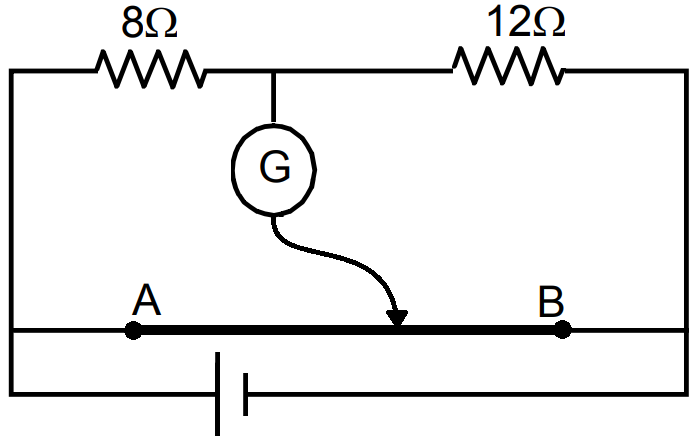
The potentiometer wire AB shown in the figure. is 40cm long. Where should the free end of the galvanometer be connected on AB so that the galvanometer may show zero deflection?