Question
Answer the following question:
If the earth did not have an atmosphere, would its average surface temperature be higher or lower than what it is now?
Answer

In the absence of an atmosphere, there would be no greenhouse effect on the surface of the Earth. As a result, the temperature of the Earth would decrease rapidly, making it chilly and difficult for human survival.

Need a full question paper?

Generate a complete, print-ready paper with questions like this in minutes — across 16+ boards, with answer keys.

Start Generating Free

Similar questions

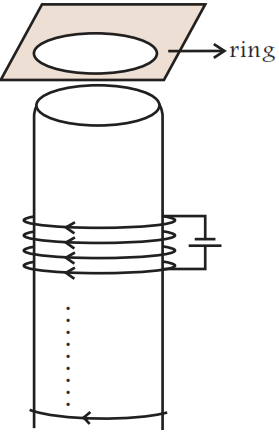
Consider a metal ring kept on top of a fixed solenoid (say on a carboard) (Fig). The centre of the ring coincides with the axis of the solenoid. If the current is suddenly switched on, the metal ring jumps up. Explain.
The resistance of an iron wire and a copper wire at 20°C are $3.9\Omega$ and $4.1\Omega,$ respectively. At what temperature will the resistance be equal? Temperature coefficient of resistivity for iron is $5.0\times10^{-3}\text{K}^{-1}$ and for copper, it is $4.0\times10^{-3}\text{K}^{-1}.$ Neglect any thermal expansion.
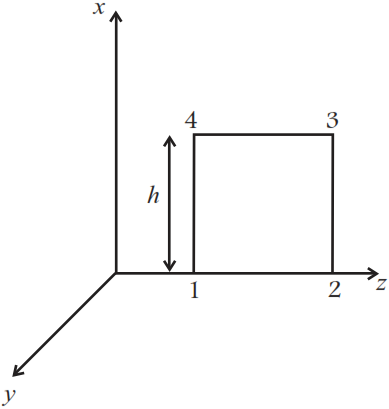
A plane EM wave travelling in vacuum along z direction is given by $\text{E}=\text{E}_0\sin(\text{kz}-\omega\text{t})\hat{\text{i}}\text{ and }\text{B}=\text{B}_0\sin(\text{kz}-\omega\text{t})\hat{\text{j}}$.
  1. Evaluate $\oint\text{E.dl}$ over the rectangular loop 1234 shown in Fig.
  2. Evaluate $\int\text{B.ds}$ over the surface bounded by loop 1234.
  3. Use equation $\oint\text{E.dl}=\frac{-\text{d}\phi_\text{B}}{\text{dt}}$ to prove $\frac{\text{E}_0}{\text{B}_0}=\text{c}$.
  4. By using similar process and the equation $\oint\text{B.dl}=\mu_0\text{I}+\in_0\frac{\text{d}\phi_\text{E}}{\text{dt}}$, prove that $\text{c}=\frac{1}{\sqrt{\mu_0\in_0}}$.
​​​​​​​
A hemispherical portion of the surface of a solid glass sphere $(\mu=1.5)$ of radius r is silvered to make the inner side reflecting. An object is placed on the axis of the hemisphere at a distance 3r from the centre of the sphere. The light from the object is refracted at the unsilvered part, then reflected from the silvered part and again refracted at the unsilvered part. Locate the final image formed.
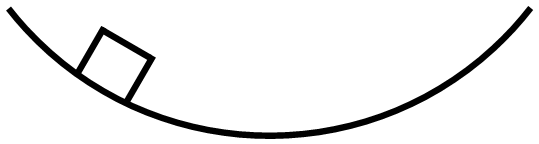
A small block oscillates back and forth on a smooth concave surface of radius R figure. Find the time period of small oscillation.
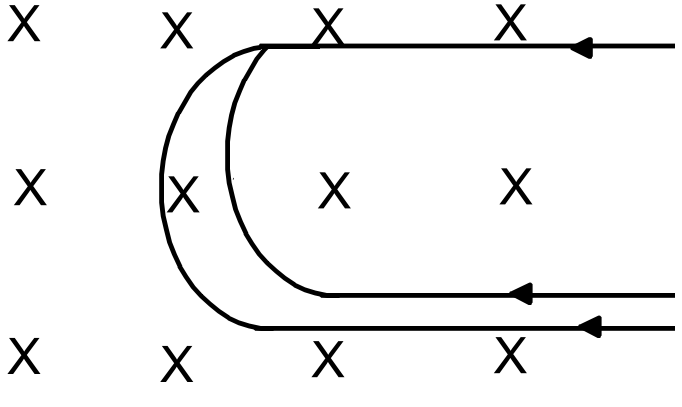
A narrow beam of singly-charged carbon ions, moving at a constant velocity of $6.0 \times 10^4m s^{-1}$, is sent perpendicularly in a rectangular region of uniform magnetic field B = 0.5T It is found that two beams emerge from the field in the backward direction, the separations from the incident beam being 3.0cm and 3.5cm. Identify the isotopes present in the ion beam. Take the mass of an ion $= A(1.6 \times 10^{-27})kg$, where A is the mass number.
A student is studying a book placed near the edge of a circular table of radius R. A point source of light is suspended directly above the centre of the table. What should be the height of the source above the table so as to produce maximum illuminance at the position of the book?
In a plane electromagnetic wave, the electric field oscillates sinusoidally at a frequency of $2.0 \times 10^{10} $Hz and amplitude $48\ V\ m^{-1}.$
  1. What is the wavelength of the wave?
  2. What is the amplitude of the oscillating magnetic field?
  3. Show that the average energy density of the E field equals the average energy density of the B field. $[c = 3 \times 10^8\ m\ s^{-1}.]$
An object is placed at a distance of 30cm from a converging lens of focal length 15cm. A normal eye (near point 25cm, far point infinity) is placed close to the lens on the other side.
  1. Can the eye see the object clearly?
  2. What should be the minimum separation between the lens and the eye so that the eye can clearly see the object?
  3. Can a diverging lens, placed in contact with the converging lens, help in seeing the object clearly when the eye is close to the lens?
A rectangular conducting loop consists of two wires on two opposite sides of length l joined together by rods of length d. The wires are each of the same material but with cross-sections differing by a factor of 2. The thicker wire has a resistance R and the rods are of low resistance, which in turn are connected to a constant voltage source $V_0.$ The loop is placed in uniform a magnetic field B at 45° to its plane. Find $\tau$, the torque exerted by the magnetic field on the loop about an axis through the centres of rods.