MCQ
A magnetic field
  • A
    Always exerts a force on a charged particle
  • B
    Never exerts a force on a charged particle
  • Exerts a force, if the charged particle is moving across the magnetic field lines
  • D
    Exerts a force, if the charged particle is moving along the magnetic field lines
Answer

Correct option: C.
Exerts a force, if the charged particle is moving across the magnetic field lines
c
(c)$\overrightarrow F = q\overrightarrow {v\,} \times \overrightarrow B $

Need a full question paper?

Generate a complete, print-ready paper with questions like this in minutes — across 16+ boards, with answer keys.

Start Generating Free

Similar questions

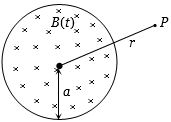
A uniform but time-varying magnetic field $B(t)$ exists in a circular region of radius a and is directed into the plane of the paper, as shown. The magnitude of the induced electric field at point $P$ at a distance $r$ from the centre of the circular region
A thin ring of $10\, cm$ radius carries a uniformly distributed charge. The ring rotates at a constant angular speed of $40\,\pi \,rad\,{s^{ - 1}}$ about its axis, perpendicular to its plane. If the magnetic field at its centre is $3.8 \times {10^{ - 9}}\,T$, then the charge carried by the ring is close to $\left( {{\mu _0} = 4\pi  \times {{10}^{ - 7}}\,N/{A^2}} \right)$
Which of the following semi-conductor diodes is reverse biased
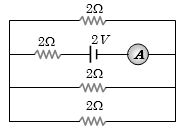
The reading of the ammeter as per figure shown is
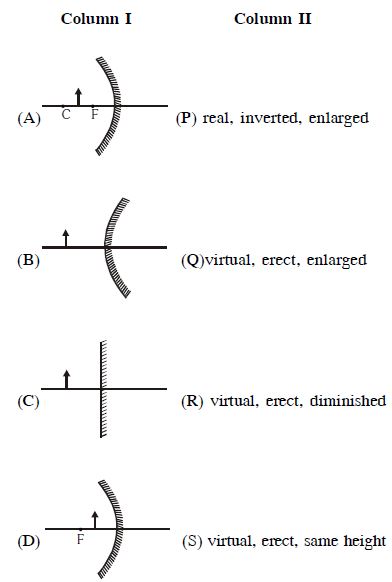
Column $-I$ contains a list of mirrors and position of object. Match this with Column $-II$ describing the nature of image
The resistance of a wire is $R$. It is bent at the middle by $180^o$ and both the ends are twisted together to make a shorter wire. The resistance of the new wire is
In a photoelectric experiment ultraviolet light of wavelength $280\, {nm}$ is used with lithium cathode having work function $\phi=2.5\, {eV}$. If the wavelength of incident light is switched to $400\, {nm}$, find out the change in the stopping potential (in ${V}$).

$\left({h}=6.63 \times 10^{-34}\, {J} \cdots\right.$, $\left.{c}=3 \times 10^{8} \,{ms}^{-1}\right)$ 

The critical angle for total internal reflection of light going from medium $I$ to medium $II$ is given by the relation tan $i_C=\frac {5}{9}$ . The refractive index of the medium $I$ with respect to the medium $II$ is
Unpolarised light is incident on the boundary between two dielectric media, whose dielectric constants are $2.8$ (medium -1) and $6.8$ (medium $2)$, respectively. To satisfy the condition, so that the reflected and refracted rays are perpendicular to each other, the angle of incidence should be $\tan ^{-1}\left(1+\frac{10}{\theta}\right)^{\frac{1}{2}}$ the value of $\theta$ is $.............$ (Given for dielectric media, $\mu_{ r }=1$ )
The eye can detect  $5 ×10^4$ photons per square metre per sec of green light ($\lambda$ $= 5000\ \mathop A\limits^o $) while the ear can detect ${10^{ - 13}}\,(W/{m^2})$. The factor by which the eye is more sensitive as a power detector than the ear is close to