Question
A man borrows $Rs.6500$ at $10\%$ per annum compound interest payable half$-$yearly. He repays $Rs.2000$ at the end of every six months. Calculate the amount outstanding at the end of the third payment. Give your answer to the nearest rupee.
Answer

For $1^{\text {st }}$ half year: $P=R s, 6500, R=10 \%$ and $T=\frac{1}{2}$ year
Interest $=\text { Rs. } \frac{6500 \times 10 \times 1}{100 \times 2}$
$=\text { Rs. } 325$
Amount
$=\text { Rs. } 6500+\text { Rs. } 325$
$=\text { Rs. } 6825$
Money paid at the end of $1^{st}$ half year $= Rs. 2000$
Balance money for $2^{\text {nd }}$ half year
$=\text { Rs. } 6825-\text { Rs. } 2000$
$=\text { Rs. } 4825$
For $2^{\text {nd }}$ half year : $P=$ Rs. $4825 ; R=10 \%$ and $T=\frac{1}{2}$ year
$\text { Interest }=\text { Rs. } \frac{4825 \times 10 \times 1}{100 \times 2}$
$=\text { RS. } 241.25$
Amount
$=\text { Rs. } 4825+\text { Rs. } 241.25$
$=\text { Rs. } 5066.25$
Money paid at the end of $2^{\text {nd }}$ half year $=Rs. 2000$
Balance money for $3^{\text {rd }}$ half year
$=\text { Rs. } 5066.25-\text { Rs. } 2000$
$=\text { Rs. } 3066.25$
For $3^{\text {rd }}$ half year: $P=R s .3066 .25 ; R=10 \%$ and $T=\frac{1}{2}$ year
$\text { Interest }=\text { Rs. } \frac{3066.25 \times 10 \times 1}{100 \times 2}$
$=\text { Rs. } 153.3125$
Amount
$=\text { Rs. } 3066.25+\text { Rs. } 153.3125$
$=\text { Rs. } 3219.5625$
Money paid at the end of $3^{\text {rd }}$ half year $= Rs. 2000$
Amount outstanding at the end of $3^{\text {rd }}$ payment
$=\text { Rs. } 3219.5625-\text { Rs. } 2000$
$=\text { Rs. } 1219.5625$
$=\text { Rs. } 1220($nearest rupee$)$

Need a full question paper?

Generate a complete, print-ready paper with questions like this in minutes — across 16+ boards, with answer keys.

Start Generating Free

Similar questions

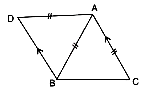
In the given figure, $A D=A B=A C, B D$ is parallel to $C A$ and angle $\text{ACB}$
$=65^{\circ}$. Find $\angle DAC.$

 
Solve :$11(x - 5) + 10(y - 2) + 54 = 0;7(2x - 1) + 9(3y - 1) = 25$
Two numbers are in the ratio $4:5$. If $30$ is subtracted from each of the numbers, the ratio becomes $1:2.$ Find the numbers.
Image
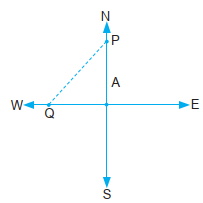
Case Study : An aeroplane (P) leaves an airport (A) and flies towards north at $400 km / h$. At the same time another aeroplane (Q) leaves the same airport and flies towards west at $300 km / h$.
Based on the above information, answer the following questions:
1. Distance covered by aeroplane $P$ in 1.5 hours is:
(a) 600 km
(b) 650 km
(c) 700 km
(d) 800 km
2. Distance covered by aeroplane $Q$ in 1.5 hours is:
(a) 600 km
(b) 550 km
(c) 500 km
(d) 450 km
3. The distance between the two aeroplanes after a certain period of time is represented by the line segment:
(a) AP
(b) AQ
(c) PQ
(d) AS
4. After 1.5 hours, which aeroplane travelled longer distance and by how much?
(a) $P , 150 km$
(b) Q, 150 km
(c) P, 600 km
(d) $Q , 450 km$
5. After 1.5 hours, the distance between the two aeroplanes is :
(a) 600 km
(b) 650 km
(c) 700 km
(d) 750 km
If a square in inscribed in a circle, find the ratio of the areas of the circle and the square.
A shopkeeper fixes the selling price of his goods at $60\%$ above the cost price. He sells half of this stock at this price, a quarter of his stock at a discount of $25\%$ on the original selling price, and the rest at a discount of $50\%$ on the original selling price. Find the gain percent altogether.
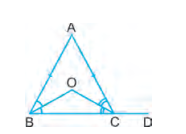
In the given figure, $AB = AC$. If BO and CO , the bisectors of $\angle B$ and $\angle C$ respectively meet at O and BC is produced to D , prove that $\angle BOC =\angle ACD$.
Image
Prove that the bisectors of opposite angles of a parallelogram are parallel.