Question
A mass attached to a spring is free to oscillate, with angular velocity $\omega,$ in a horizontal plane without friction or damping. It is pulled to a distance x0 and pushed towards the centre with a velocity $\upsilon_0$ at time t = 0. Determine the amplitude of the resulting oscillations in terms of the parameters $\omega,$ x0 and $\upsilon_0.$ [Hint: Start with the equation $\text{x}=\text{a}\cos(\omega\text{t}+\theta)$ and note that the initial velocity is negative.]
Answer

The displacement rquation for an oscillating mass is given by:

$\text{x}=\text{A}\cos(\omega\text{t}+\theta)$

where,

A is the amplitude

x is the displacement

$\theta$ is the phase constant

Velcoity, $\text{v}=\frac{\text{dx}}{\text{dt}}=-\text{A}\omega\sin(\omega\text{t}+\theta)$

At, t = 0, x = x0

$\text{x}_0=\text{A}\cos\theta=\text{x}_0\ .....(\text{i})$

and, $\frac{\text{dx}}{\text{dt}}=-v_0=\text{A}\omega\sin\theta$

$\text{A}\sin\theta=\frac{v_0}{\omega}\ ....(\text{ii})$

Squaring and adding equations (i) and (ii), we get:

$\text{A}^2(\cos^2\theta+\sin^2\theta)=\text{x}_0^2+\Big(\frac{v_0^2}{\omega^2}\Big)$

$\therefore\ \text{A}=\sqrt{\text{x}_0^2+\Big(\frac{v_0}{\omega}\Big)^2}$

Hence, the amplitude of the resulting oscillation is $\text{x}_0^2+\Big(\frac{v_0}{\omega}\Big)^2.$

Need a full question paper?

Generate a complete, print-ready paper with questions like this in minutes — across 16+ boards, with answer keys.

Start Generating Free

Similar questions

Prove that closed argon pipe produced only odd harmonics whereas both odd and even harmonic are produced in an open argon pipe.
A rod of negligible heat cafacity has length 20cm, area of cross section 1.0cm and thermal conductivity 200Wm-1°C-1. The temperature of one end is maintained at 0°C and that of the other end is slowly and linearly varied from 0°C to 60°C in 10 minutes. Assuming no loss of heat through the sides, find the total heat transmitted through the rod in these 10 minutes.
Explain linear simple harmonic motion by taking an example. Find the expression for its period and explain its dependence.
What is simple pendulum? Show that the motion of the pendulum is S.H.M. and hence deduce an expression for the time period of pendulum. Also define second's pendulum.
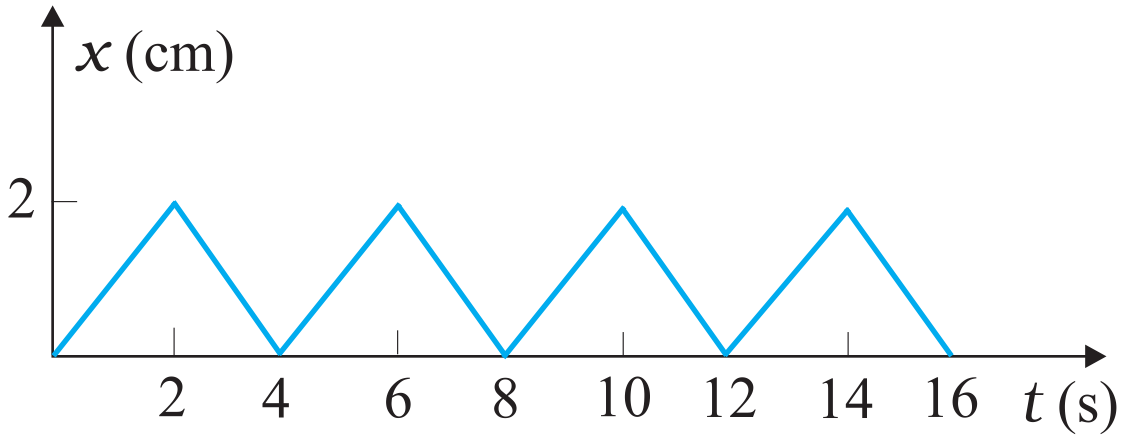
Figure 5.17 shows the position-time graph of a body of mass 0.04kg. Suggest a suitable physical context for this motion. What is the time between two consecutive impulses received by the body? What is the magnitude of each impulse?

Given $\vec{a}+\vec{b}+\vec{c}+\vec{d}=0$, which of the following statements are correct:
i. $\vec{a}, \vec{b}, \vec{c}$, and $\vec{d}$ must each be a null vector.
ii. The magnitude of $(\vec{a}+\vec{c})$ equals the magnitude of $(\vec{b}+\vec{d})$.
iii. The magnitude of ' $\vec{a}$ ' can never be greater than the sum of the magnitudes of $\vec{b}, \vec{c}$, and $\vec{d}$.
iv. $\vec{b}+\vec{c}$ must lie in the plane of $\vec{a}$ and $\vec{d}$ if $\vec{a}$ and $\vec{d}$ are not collinear, and in the line of $\vec{a}$ and $\vec{d}$, if they are collinear?
What do you mean by elastic collision? For an elastic head on collision, find expressions for final velocities of the bodies after collision.
A point particle of mass 0.1kg is executing S.H.M. of amplitude of 0.1m. When the particle passes through the mean position, its kinetic energy is 8 × 10⁻³ joule. Obtain the equation of motion of this particle if the initial phase of oscillation is 45°
Establish the following vector inequalities geometrically or otherwise:
$|\text{a}+\text{b}|\le|\text{a}|+|\text{b}|$
When does the equality sign above apply?
Show that a function
$\text{y}(\text{x, t})=\text{A}\sin(\text{kx}-\omega\text{t})+\text{B}\cos(\text{kx}-\omega\text{t})$
represents a progressive wave. What is the amplitude, wavelength, velocity and initial phase angle of the wave?