Question
Explain linear simple harmonic motion by taking an example. Find the expression for its period and explain its dependence.
Answer

SELF

Need a full question paper?

Generate a complete, print-ready paper with questions like this in minutes — across 16+ boards, with answer keys.

Start Generating Free

Similar questions

During summers in India, one of the common practice to keep cool is to make ice balls of crushed ice, dip it in flavoured sugar syrup and sip it. For this a stick is inserted into crushed ice and is squeezed in the palm to make it into the ball. Equivalently in winter, in those areas where it snows, people make snow balls and throw around. Explain the formation of ball out of crushed ice or snow in the light of P–T diagram of water.
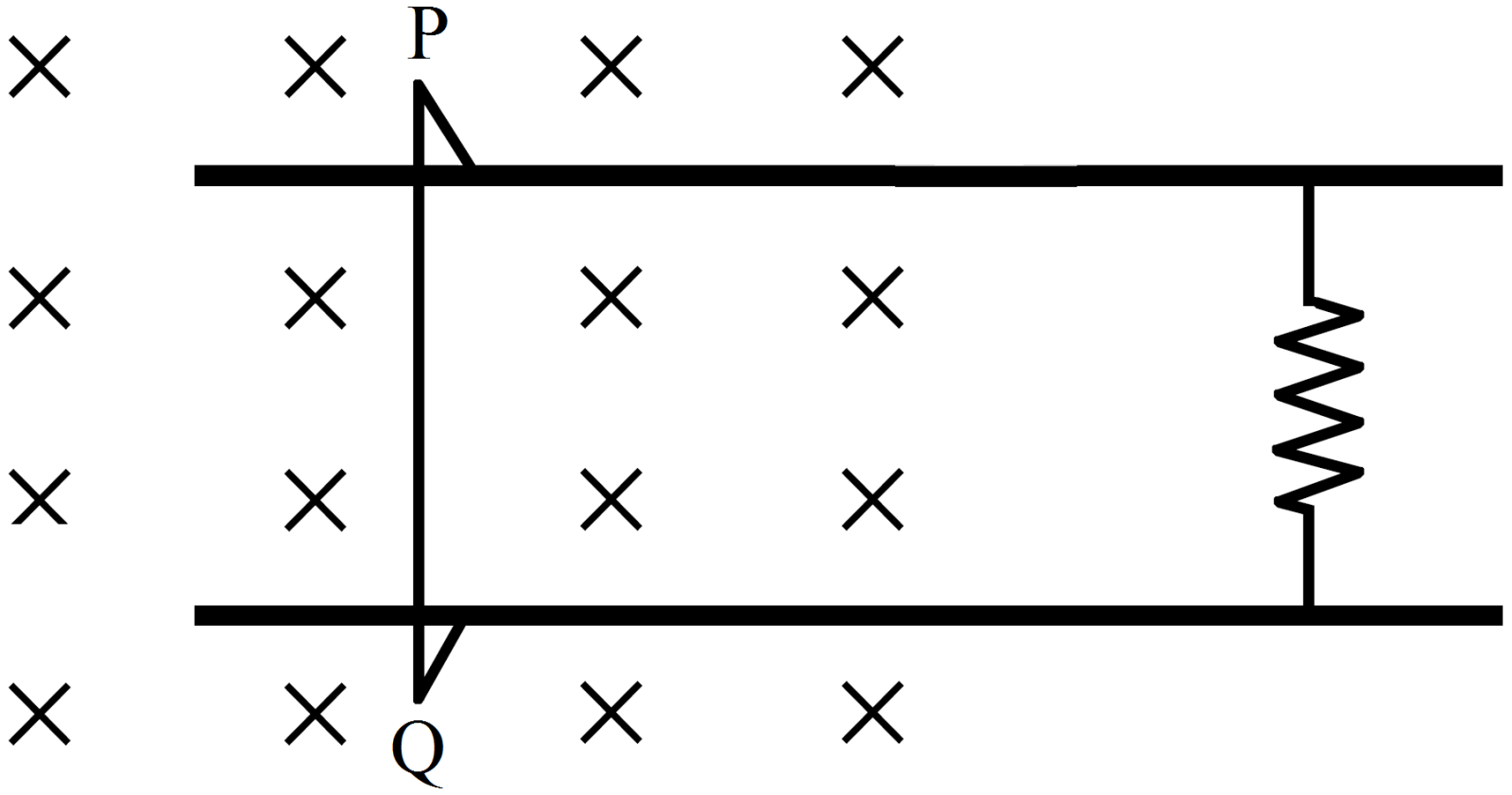
Consider the situation shown in figure. The wire PQ has mass m, resistance r and can slide on the smooth, horizontal parallel rails separated by a distance l. The resistance of the rails is negligible. A uniform magnetic field B exists in the rectangular region and a resistance R connects the rails outside the field region. At t = 0, the wire PQ is pushed towards right with a speed v0. Find

  1. The current in the loop at an instant when the speed of the wire PQ is v.
  2. The acceleration of the wire at this instant.
  3. The velocity vas a functions of x.
  4. The maximum distance the wire will move.

A body weighs 63N on the surface of the earth. What is the gravitational force on it due to the earth at a height equal to half the radius of the earth?
Define molar specific heat capacities at constant volume and pressure. Considering thermodynamical process in a cylinder with parameters P, V and T, derive the Mayer's relation.
Three moles of an ideal gas of 300K are isothermally expanded to five times its volume and heated at this constant volume so that the pressure is raised to its initial value before expansion. In the whole process 83.14 kJ heat is required. Calculate the ratio $\frac{\text{C}_\text{P}}{\text{C}_\text{V}}$ of gas $(\log_\text{e}5=1.61).$
Explain Doppler effect in sound. Obtain an expression for apparent frequency of sound when source and listener are approaching each other.
A convex lens has a focal length of 10cm. Find the location and nature of the image if a point object is placed on the principal axis at a distance of:
  1. 9.8cm
  2. 10.2cm from the lens.
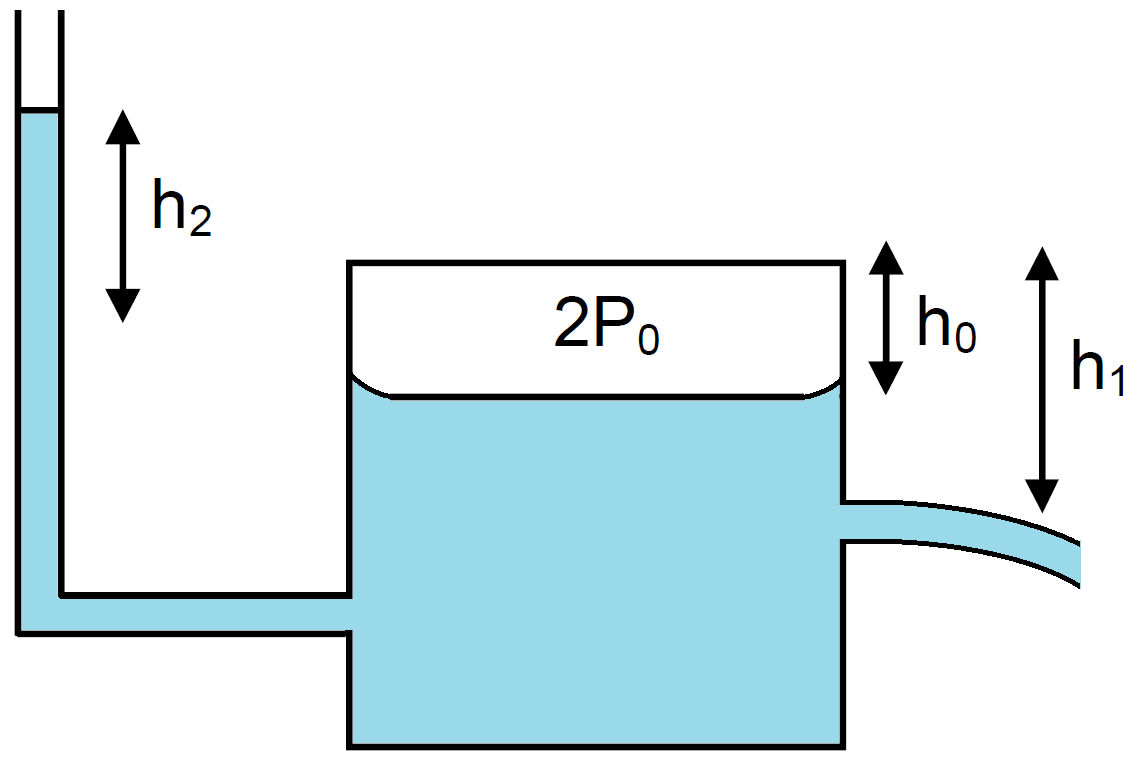
Figure. shows a large closed cylindrical tank containing water. Initially the air trapped above the water surface has a height h0 and pressure 2p0 where p0 is the atmospheric pressure. There is a hole in the wall of the tank at a depth h1 below the top from which water comes out. A long vertical tube is connected as shown.
  1. Find the height h2 of the water in the long tube above the top initially.
  2. Find the speed with which water comes out of the hole.
  3. Find the height of the water in the long tube above the top when the water stops coming out of the hole.

A mica strip and a polysterene strip are fitted on the two slits of a double slit apparatus. The thickness of the strips is 0.50mm and the separation between the slits is 0.12cm. The refractive index of mica and polysterene are 1.58 and 1.55 respectively for the light of wavelength 590nm which is used in the experiment. The interference is observed on a screen a distance one meter away.
  1. What would be the fringe-width?
  2. At what distance from the centre will the first maximum be located?
The left end of a copper rod (length = 20cm area of cross section = 0.20cm) is maintained at 20°C and the right end is maintained at 80°C. Neglecting any loss of heat through radiation, find,
  1. The temperature at a point 11cm from the left end
  2. The heat current through the rod. Thermal conductivity of copper $=385\text{Wm}^{-1}{^{\circ}}\text{C}^{-1}.$