Question
A mass is projected horizontally with a velocity u from a tower. Find the horizontal length it will cover from the foot of the tower?

Answer

If h is the height of the tower, the time taken to reach the ground is $\text{t}=\sqrt{\frac{2\text{h}}{\text{g}}}.$ Since the horizontal velocity u is same everywhere, the distance covered is $\text{ut}=\text{u}\sqrt{\frac{2\text{h}}{\text{g}}}.$

Need a full question paper?

Generate a complete, print-ready paper with questions like this in minutes — across 16+ boards, with answer keys.
Start Generating Free

Similar questions

If the initial velocity of a particle is u and collinear acceleration at any time t is $\text{a}\propto\text{t}.$ calculate the final velocity of the particle after time t.
A vertical cylinder of height 100cm contains air at a constant temperature. The top is closed by a frictionless light piston. The atmospheric pressure is equal to 75cm of mercury. Mercury is slowly poured over the piston. Find the maximum height of the mercury column that can be put on the piston.
A vertical off-shore structure is built to withstand a maximum stress of $109$ Pa. Is the structure suitable for putting up on top of an oil well in the ocean? Take the depth of the ocean to be roughly $3km$, and ignore ocean currents.
What is the pressure inside the drop of mercury of radius $3.00mm$ at room temperature? Surface tension of mercury at that temperature ($20°C$) is $4.65 \times 10^{–1}N m^{–1}$. The atmospheric pressure is $1.01 × 10⁵Pa$. Also give the excess pressure inside the drop.
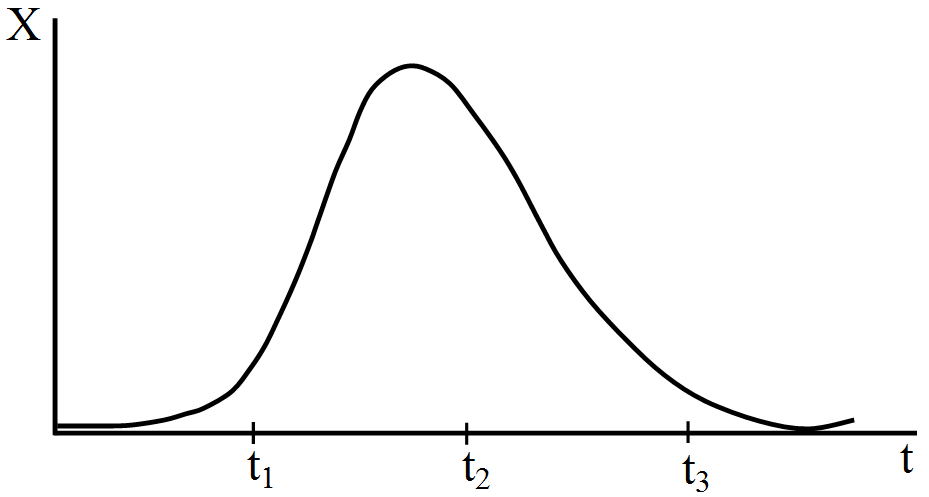
Figure shows the $x$ coordinate of a particle as a function of time. Find the signs of $v_x$ and $a_x$ at $t = t_1, t = t_2$ and $t = t_3$.
Asolid disc and a ring, both of radius 10cm are placed on a horizontal table simultaneously, with initial angular speed equal to $10\pi\  rad\  s^{-1}?.$ Which of the two will start to roll earlier? The coefficient of kinetic friction is
A body is moving in a straight line along $x-$axis. Its distance from the origin is given by the equation $x = at^2 - bt^3$, where $x$ is in metre and $t$ is in second. Find :
  1. The average speed of the body in the interval $t = 0$ and $t = 2s$.
  2. its instantaneous speed at $t = 2s$.
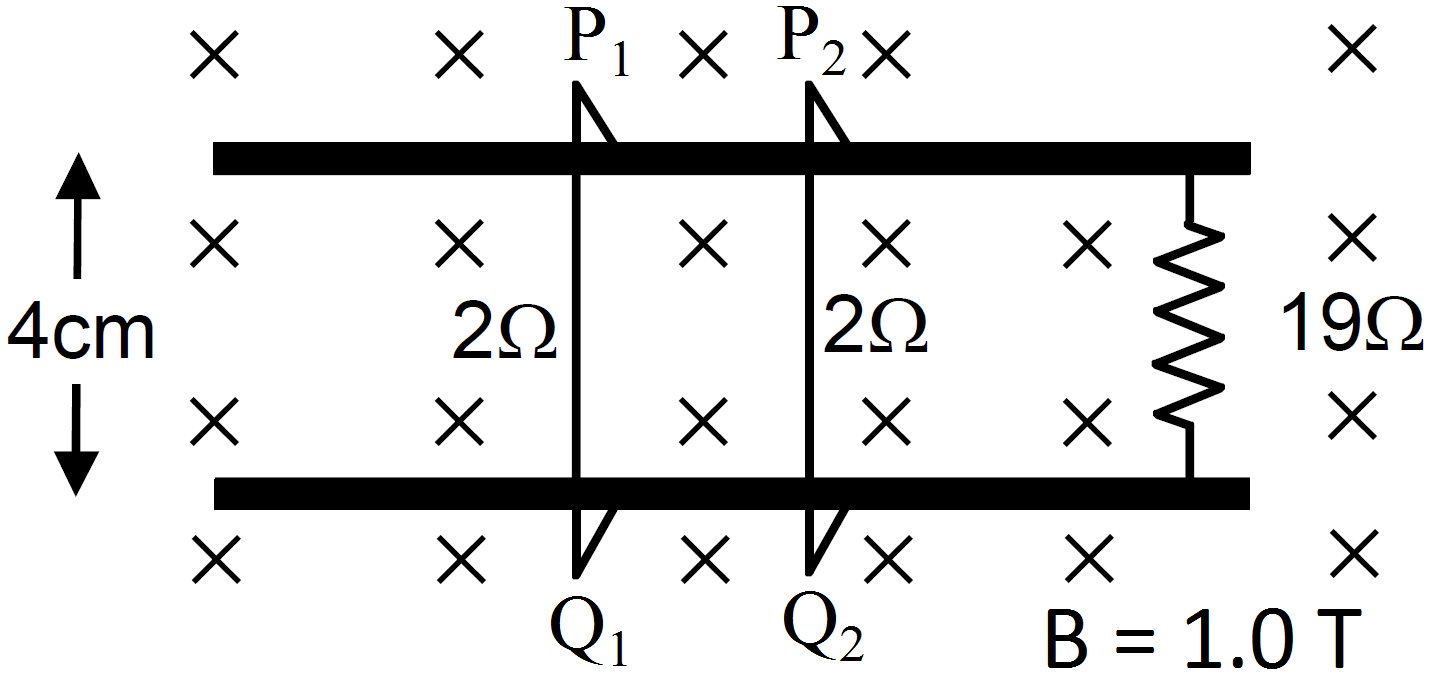
Consider the situation shown in figure. The wires $P_1Q_1$ and $P_2Q_2$ are made to slide on the rails with the same speed $5\ cm/s$. Find the electric current in the $19\Omega$ resistor if:
  1. Both the wires move towards right.
  2. If $P_1Q_1$ moves towards left but $P_2Q_2$ moves towards right.
Calculate the energy that can be obtained from $1 kg$ of water through the fusion reaction
${ }^2 \mathrm{H}+{ }^2 \mathrm{H} \rightarrow{ }^3 \mathrm{H}+\text { p. }$
Assume that $1.5 \times 10^{-2} \%$ of natural water is heavy water $\mathrm{D}_2 \mathrm{O}$ (by number of molecules) and all the deuterium is used for fusion.
Prove that the coefficient of static friction is “tangent” of the angle of repose.