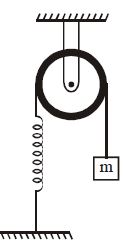
A mass $m = 8\,kg$ is attahced to a spring as shown in figure and held in position so that the spring remains unstretched. The spring constant is $200\,N/m$. The mass $m$ is then released and begins to undergo small oscillations. The maximum velocity of the mass will be ..... $m/s$ $(g = 10\,m/s^2)$
Medium


Download our appand get started for free
Experience the future of education. Simply download our apps or reach out to us for more information. Let's shape the future of learning together!No signup needed.*
Similar Questions
- 1If the length of a clock pendulum increases by $0.2 \%$ due to atmospheric temperature rise, then the loss in time of clock per day is ........... $s$View Solution
- 2${T}_{0}$ is the time period of a simple pendulum at a place. If the length of the pendulum is reduced to $\frac{1}{16}$ times of its initial value, the modified timeView Solution
- 3The displacement of a particle executing $SHM$ is given by $y=0.25 \sin 200 t$ $cm$. The maximum speed of the particle is $.........cm s^{-1}$View Solution
- 4Which of the following expressions corresponds to simple harmonic motion along a straight line, where $x$ is the displacement and $a, b, c$ are positive constants?View Solution
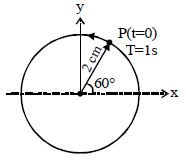
- 5Figure shows the circular motion of a particle. The radius of the circle, the period, sense of revolution and the initial position are indicated in the figure. The simple harmonic motion of the $x-$ projection of the radius vector of the rotating particle $P$ isView Solution
- 6A particle performs $SHM$ on $x-$ axis with time period of $0.5\,sec,$ such that it's velocity is zero at $x = -3\,cm$ and at $x = 9\,cm$. It was located at $x = 0$ and moving in negative $'x'$ at $t = 0$. The equation of $SHM$ of the particle isView Solution
- 7The $K.E.$ and $P.E.$ of a particle executing $SHM$ with amplitude $A$ will be equal when its displacement is-View Solution
- 8A particle is subjected to two mutually perpendicular simple harmonic motions such that its $x$ and $y$ coordinates are given by ?View Solution
$ x = 2 \sin \omega t \,;$ $ y = 2 \sin \left( {\omega t + \frac{\pi }{4}} \right)$
The path of the particle will be :
- 9View SolutionTwo mutually perpendicular simple harmonic vibrations have same amplitude, frequency and phase. When they superimpose, the resultant form of vibration will be
- 10A rectangular block of mass $m$ and area of cross-section $A$ floats in a liquid of density $\rho $. If it is given a small vertical displacement from equilibrium it undergoes with a time period $T,$ thenView Solution