${T}_{0}$ is the time period of a simple pendulum at a place. If the length of the pendulum is reduced to $\frac{1}{16}$ times of its initial value, the modified time
JEE MAIN 2021, Easy
Download our app for free and get started
Time period of a simple pendulum
${T}_{0}=2 \pi \sqrt{\frac{\ell}{{g}}}$
New time period ${T}=\sqrt[2 \pi]{\frac{\ell / 16}{{g}}}=\frac{2 \pi}{4} \sqrt{\frac{\ell}{{g}}}$
${T}=\frac{{T}_{0}}{4}$

Download our appand get started for free
Experience the future of education. Simply download our apps or reach out to us for more information. Let's shape the future of learning together!No signup needed.*
Similar Questions
- 1If particle is executing simple harmonic motion with time period $T$, then the time period of its total mechanical energy is ...........View Solution
- 2Two particles are executing $SHM$ of the same amplitude $A$ and frequency $\omega $ along the $x-$ axis. Their mean position is separated by $X_0$ (where $X_0 > A$ ). If maximum separation between them is $X_0 + 2A$ , then the phase difference between their motion isView Solution
- 3If the particle repeats its motion after a fixed time interval of $8 \,s$ then after how much time its maximum value of $PE$ will be attained after attaining its minimum value is ........... $s$View Solution
- 4A particle performs simple harmonic motion with a period of $2$ second. The time taken by the particle to cover a displacement equal to half of its amplitude from the mean position is $\frac{1}{ a } s .$ The value of $'a'$ to the nearest integer is.........View Solution
- 5A particle of mass $m$ undergoes oscillations about $x=0$ in a potential given by $V(x)-\frac{1}{2} k x^2-V_0 \cos \left(\frac{x}{a}\right)$, where $V_0, k, a$ are constants. If the amplitude of oscillation is much smaller than $a$, the time period is given byView Solution
- 6A spring whose unstretched length is $\ell $ has a force constant $k$. The spring is cut into two pieces of unstretched lengths $\ell_1$ and $\ell_2$ where, $\ell_1 = n\ell_2$ and $n$ is an integer. The ratio $k_1/k_2$ of the corresponding force constants, $k_1$ and $k_2$ will beView Solution
- 7An object of mass $m$ is suspended at the end of a massless wire of length $L$ and area of cross$-$section, $A$. Young modulus of the material of the wire is $Y$. If the mass is pulled down slightly its frequency of oscillation along the vertical direction isView Solution
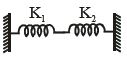
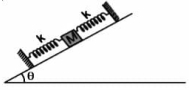
- 8View SolutionIn the adjacent figure, if the incline plane is smooth and the springs are identical, then the period of oscillation of this body is
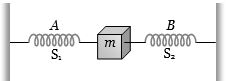
- 9In the figure, ${S_1}$ and ${S_2}$ are identical springs. The oscillation frequency of the mass $m$ is $f$. If one spring is removed, the frequency will becomeView Solution
- 10View SolutionThe effective spring constant of two spring system as shown in figure will be