A mass $m$ attached to a spring oscillates with a period of $3\,s$. If the mass is increased by $1\,kg$ the period increases by $1\,s$. The initial mass $m$ is
Diffcult


Download our appand get started for free
Experience the future of education. Simply download our apps or reach out to us for more information. Let's shape the future of learning together!No signup needed.*
Similar Questions
- 1Acceleration of a particle, executing $SHM$, at it’s mean position isView Solution
- 2View SolutionA particle is moving in a circle with uniform speed. Its motion is
- 3The equation of motion of a particle is $x = a\,cos (\alpha\, t)$ . The motion isView Solution
- 4The height of a swing changes during its motion from $0.1\, m$ to $2.5\, m$. The minimum velocity of a boy who swings in this swing is ..... $m/s$View Solution
- 5Which graph represents the difference between total energy and potential energy of a particle executing $SHM$ Vs it's distance from mean position?View Solution
- 6A mass $M$ is suspended from a spring of negligible mass. The spring is pulled a little and then released so that the mass executes simple harmonic oscillations with a time period $T$. If the mass is increased by m then the time period becomes $\left( {\frac{5}{4}T} \right)$. The ratio of $\frac{m}{{M}}$ isView Solution
- 7A horizontal platform with an object placed on it is executing $S.H.M$. in the vertical direction. The amplitude of oscillation is $3.92 \times {10^{ - 3}}m$. What must be the least period of these oscillations, so that the object is not detached from the platformView Solution
- 8A block with mass $M$ is connected by a massless spring with stiffiess constant $k$ to a rigid wall and moves without friction on a horizontal surface. The block oscillates with small amplitude $A$ about an equilibrium position $x_0$. Consider two cases: ($i$) when the block is at $x_0$; and ($ii$) when the block is at $x=x_0+A$. In both the cases, a perticle with mass $m$ is placed on the mass $M$ ?View Solution
($A$) The amplitude of oscillation in the first case changes by a factor of $\sqrt{\frac{M}{m+M}}$, whereas in the second case it remains unchanged
($B$) The final time period of oscillation in both the cases is same
($C$) The total energy decreases in both the cases
($D$) The instantaneous speed at $x_0$ of the combined masses decreases in both the cases
- 9View SolutionTo make the frequency double of a spring oscillator, we have to
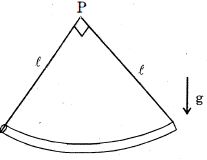
- 10A circular arc of mass $m$ is connected with the help of two massless strings as shown in the figuw in vertical plane. About point $P$, small oscillations are given in the plane of the arc. Time period of the oscillations of $SHM$ will beView Solution