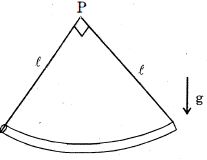
A circular arc of mass $m$ is connected with the help of two massless strings as shown in the figuw in vertical plane. About point $P$, small oscillations are given in the plane of the arc. Time period of the oscillations of $SHM$ will be
Diffcult


Download our appand get started for free
Experience the future of education. Simply download our apps or reach out to us for more information. Let's shape the future of learning together!No signup needed.*
Similar Questions
- 1A particle executes a simple harmonic motion of time period $T$. Find the time taken by the particle to go directly from its mean position to half the amplitudeView Solution
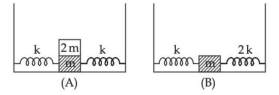
- 2In figure $(A),$ mass ' $2 m$ ' is fixed on mass ' $m$ ' which is attached to two springs of spring constant $k$. In figure $(B),$ mass ' $m$ ' is attached to two spring of spring constant ' $k$ ' and ' $2 k$ '. If mass ' $m$ ' in $(A)$ and $(B)$ are displaced by distance ' $x$ ' horizontally and then released, then time period $T_{1}$ and $T_{2}$ corresponding to $(A)$ and $(B)$ respectively follow the relation.View Solution
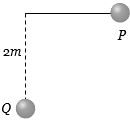
- 3A pendulum of length $2\,m$ lift at $P$. When it reaches $Q$, it losses $10\%$ of its total energy due to air resistance. The velocity at $Q$ is .... $m/sec$View Solution
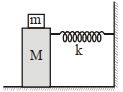
- 4In the given figure, a mass $M$ is attached to a horizontal spring which is fixed on one side to a rigid support. The spring constant of the spring is $k$. The mass oscillates on a frictionless surface with time period $T$ and amplitude $A$. When the mass is in equilibrium position, as shown in the figure, another mass $m$ is gently fixed upon it. The new amplitude of oscillation will beView Solution
- 5The force-deformation equation for a nonlinear spring fixed at one end is $F =4x^{1/ 2}$ , where $F$ is the force (expressed in newtons) applied at the other end and $x$ is the deformation expressed in metersView Solution
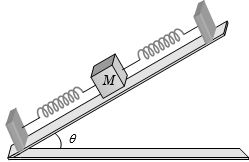
- 6On a smooth inclined plane, a body of mass $M$ is attached between two springs. The other ends of the springs are fixed to firm supports. If each spring has force constant $K$, the period of oscillation of the body (assuming the springs as massless) isView Solution
- 7A particle is executing $S.H.M.$ with total mechanical energy $90 \,J$ and amplitude $6 \,cm$. If its energy is somehow decreased to $40 \,J$ then its amplitude will become ........ $cm$View Solution
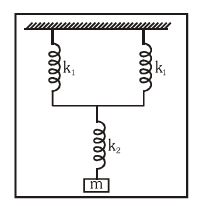
- 8View SolutionThe total spring constant of the system as shown in the figure will be
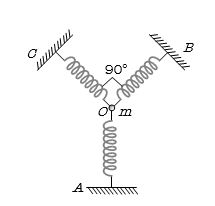
- 9A particle of mass $m$ is attached to three identical springs $A, B$ and $C$ each of force constant $ k$ a shown in figure. If the particle of mass $m$ is pushed slightly against the spring $A$ and released then the time period of oscillations isView Solution
- 10View SolutionWhen the displacement is half the amplitude, the ratio of potential energy to the total energy is