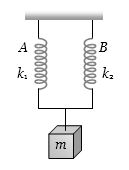
A mass $m$ is suspended by means of two coiled spring which have the same length in unstretched condition as in figure. Their force constant are $k_1$ and $k_2$ respectively. When set into vertical vibrations, the period will be
Easy
Download our app for free and get started
(d) Given spring system has parallel combination, so
${k_{eq}} = {k_1} + {k_2}$ and time period $T = 2\pi \sqrt {\frac{m}{{({k_1} + {k_2})}}} $
${k_{eq}} = {k_1} + {k_2}$ and time period $T = 2\pi \sqrt {\frac{m}{{({k_1} + {k_2})}}} $

Download our appand get started for free
Experience the future of education. Simply download our apps or reach out to us for more information. Let's shape the future of learning together!No signup needed.*
Similar Questions
- 1The period of oscillation of a simple pendulum of length $L$ suspended from the roof of a vehicle which moves without friction down an inclined plane of inclination $\alpha$, is given byView Solution
- 2A simple pendulum with length $100\,cm$ and bob of mass $250\,g$ is executing S.H.M. of amplitude $10\,cm$. The maximum tension in the string is found to be $\frac{x}{40}\,N$. The value of $x$ is $..........$.View Solution
- 3Two bodies $M$ and $N $ of equal masses are suspended from two separate massless springs of force constants $k_1$ and $k_2$ respectively. If the two bodies oscillate vertically such that their maximum velocities are equal, the ratio of the amplitude $M$ to that of $N$ isView Solution
- 4A cylindrical block of wood (density $= 650\, kg\, m^{-3}$), of base area $30\,cm^2$ and height $54\, cm$, floats in a liquid of density $900\, kg\, m^{-3}$ . The block is depressed slightly and then released. The time period of the resulting oscillations of the block would be equal to that of a simple pendulum of length ..... $cm$ (nearly)View Solution
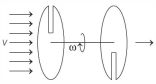
- 5Two parallel discs are connected by a rigid rod of length $L=0.5 \,m$ centrally. Each disc has a slit oppositely placed as shown in the figure. A beam of neutral atoms are incident on one of the discs axially at different velocities $v$, while the system is rotated at angular speed of $600 \,rev / second$, so that atoms only with a specific velocity emerge at the other end. Calculate the two largest speeds (in metre/second) of the atoms that will emerge at the other end.View Solution
- 6A particle is executing $S.H.M.$ with time period $T^{\prime}$. If time period of its total mechanical energy is $T$ then $\frac{T^{\prime}}{T}$ is ........View Solution
- 7A weightless spring of length $60\, cm$ and force constant $200\, N/m$ is kept straight and unstretched on a smooth horizontal table and its ends are rigidly fixed. A mass of $0.25\, kg$ is attached at the middle of the spring and is slightly displaced along the length. The time period of the oscillation of the mass isView Solution
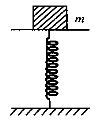
- 8A mass of $2.0\, kg$ is put on a flat pan attached to a vertical spring fixed on the ground as shown in the figure. The mass of the spring and the pan is negligible. When pressed slightly and released the mass executes a simple harmonic motion. The spring constant is $200\, N/m.$ What should be the minimum amplitude of the motion so that the mass gets detached from the pan (take $g = 10 m/s^2$).View Solution
- 9At a given point of time the value of displacement of a simple harmonic oscillator is given as $y = A \cos \left(30^{\circ}\right)$. If amplitude is $40\,cm$ and kinetic energy at that time is $200\, J$, the value of force constant is $1.0 \times 10^{ x }\,Nm ^{-1}$. The value of $x$ is ......View Solution
- 10A particle executes $SHM$ of period $1.2\, sec$ and amplitude $8\, cm.$ Find the time it takes to travel $3\,cm$ from the positive extremity of its oscillation. ..... $\sec$View Solution