A cylindrical block of wood (density $= 650\, kg\, m^{-3}$), of base area $30\,cm^2$ and height $54\, cm$, floats in a liquid of density $900\, kg\, m^{-3}$ . The block is depressed slightly and then released. The time period of the resulting oscillations of the block would be equal to that of a simple pendulum of length ..... $cm$ (nearly)
JEE MAIN 2015, Medium


Download our appand get started for free
Experience the future of education. Simply download our apps or reach out to us for more information. Let's shape the future of learning together!No signup needed.*
Similar Questions
- 1A body is in simple harmonic motion with time period half second $(T\, = 0.5\, s)$ and amplitude one $cm\, (A\,= 1\, cm)$. Find the average velocity in the interval in which it moves form equilibrium position to half of its amplitude .... $cm/s$View Solution
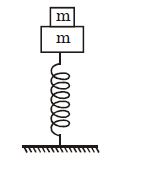
- 2A block of mass $m$ is at rest on an another block of same mass as shown in figure. Lower block is attached to the spring, then the maximum amplitude of motion so that both the block will remain in contact isView Solution
- 3View SolutionFor a particle executing simple harmonic motion, which of the following statements is not correct
- 4The motion of a particle varies with time according to the relation $y = a(\sin \omega \,t + \cos \omega \,t)$, thenView Solution
- 5View SolutionThe frequency at which its kinetic energy change into potential energy is
- 6The displacement of a particle varies according to the relation $x$ = $3 sin100t + 8cos^2 50t$. Which of the following is $INCORRECT$ about this motionView Solution
- 7A particle executes a simple harmonic motion of time period $T$. Find the time taken by the particle to go directly from its mean position to half the amplitudeView Solution
- 8View SolutionWhich of the following equation does not represent a simple harmonic motion
- 9Out of the following functions representing motion of a particle which represents $SHM$View Solution
$(A)\;y= sin\omega t-cos\omega t$
$(B)\;y=sin^3\omega t$
$(C)\;y=5cos\left( {\frac{{3\pi }}{4} - 3\omega t} \right)$
$(D)\;y=1+\omega t+{\omega ^2}{t^2}$
- 10A particle executing $S.H.M.$ of amplitude 4 cm and $T = 4 \,sec.$ The time taken by it to move from positive extreme position to half the amplitude is ..... $\sec$View Solution