A mass $M$ is suspended from a spring of negligible mass. The spring is pulled a little and then released so that the mass executes $S.H.M.$ of time period $T$. If the mass is increased by m, the time period becomes $5T/3$. Then the ratio of $m/M$ is
AIEEE 2003,AIIMS 2016, Medium


Download our appand get started for free
Experience the future of education. Simply download our apps or reach out to us for more information. Let's shape the future of learning together!No signup needed.*
Similar Questions
- 1The angular velocity and the amplitude of a simple pendulum is $\omega $ and $a$ respectively. At a displacement $X$ from the mean position if its kinetic energy is $T$ and potential energy is $V$, then the ratio of $T$ to $V$ isView Solution
- 2A pendulum suspended from the ceiling of a train oscillates with a time period $2\,second$, when the train is accelerating at $10\,ms^{-2}$. What will be its time period when the train retards at $10\,ms^{-2}$ ? ..... $\sec$View Solution
- 3Two simple pendulum first of bob mass $M_1$ and length $L_1$ second of bob mass $M_2$ and length $L_2$. $M_1 = M_2$ and $L_1 = 2L_2$. If these vibrational energy of both is same. Then which is correctView Solution
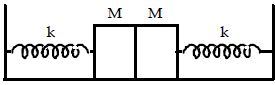
- 4View SolutionAn assembly of identical spring-mass systems is placed on a smooth horizontal surface as shown. Initially the springs are relaxed. The left mass is displaced to the left while the right mass is displaced to the right and released. The resulting collision is elastic. The time period of the oscillations of the system is :-
- 5A particle of mass $1\, {kg}$ is hanging from a spring of force constant $100\, {Nm}^{-1 .}$ The mass is pulled slightly downward and released so that it executes free simple harmonic motion with time period ${T}$. The time when the kinetic energy and potential energy of the system will become equal, is $\frac{{T}}{{x}}$. The value of ${x}$ is ..... .View Solution
- 6The maximum velocity of a particle, executing simple harmonic motion with an amplitude $7\ mm$, is $4.4\ m/s$. The period of oscillation is .... $sec$View Solution
- 7A point mass oscillates along the x-axis according to the law $x=x_0cos$$\left( {\omega t - \frac{\pi }{4}} \right)$ If the acceleration of the particle is written as $a=Acos$$\left( {\omega t + \delta } \right)$ thenView Solution
- 8View SolutionWhat effect occurs on the frequency of a pendulum if it is taken from the earth surface to deep into a mine
- 9A simple pendulum consisting of a ball of mass $m$ tied to a thread of length $l$ is made to swing on a circular arc of angle $\theta $ in a vertical plane. At the end of this arc, another ball of mass $m$ is placed at rest. The momentum transferred to this ball at rest by the swinging ball isView Solution
- 10In a linear simple harmonic motion $(SHM)$View Solution
$(A)$ Restoring force is directly proportional to the displacement.
$(B)$ The acceleration and displacement are opposite in direction.
$(C)$ The velocity is maximum at mean position.
$(D)$ The acceleration is minimum at extreme points.
Choose the correct answer from the options given below :