A mass $m$ is vertically suspended from a spring of negligible mass; the system oscillates with a frequency $n$. What will be the frequency of the system if a mass $4 m$ is suspended from the same spring
AIPMT 1998, Medium
Download our app for free and get started
(c)$n = \frac{1}{{2\pi }}\sqrt {\frac{k}{m}} $
$\Rightarrow n \propto \frac{1}{{\sqrt m }} $
$\Rightarrow \frac{{{n_1}}}{{{n_2}}} = \sqrt {\frac{{{m_2}}}{{{m_1}}}} $
$ \Rightarrow \frac{n}{{{n_2}}} = \sqrt {\frac{{4m}}{m}}$
$4\Rightarrow {n_2} = \frac{n}{2}$

Download our appand get started for free
Experience the future of education. Simply download our apps or reach out to us for more information. Let's shape the future of learning together!No signup needed.*
Similar Questions
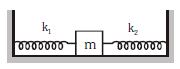
- 1A block of mass $m$ is attached to two springs of spring constants $k_1$ and $k_2$ as shown in figure. The block is displaced by $x$ towards right and released. The velocity of the block when it is at $x/2$ will beView Solution
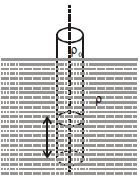
- 2A solid cylinder of density $\rho_0$, cross-section area $A$ and length $l$ floats in a liquid $\rho(> \rho_0)$ with its axis vertical, as shown. If it is slightly displaced downward and released, the time period will beView Solution
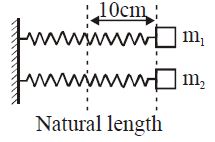
- 3The drawing shows a top view of a frictionless horizontal surface, where there are two indentical springs with particles of mass $m_1$ and $m_2$ attached to them. Each spring has a spring constant of $1200\ N/m.$ The particles are pulled to the right and then released from the positions shown in the drawing. How much time passes before the particles are again side by side for the first time if $m_1 = 3.0\ kg$ and $m_2 = 27 \,kg \,?$View Solution
- 4Two particles are in $SHM$ on same straight line with amplitude $A$ and $2A$ and with same angular frequency $\omega .$ It is observed that when first particle is at a distance $A/\sqrt{2}$ from origin and going toward mean position, other particle is at extreme position on other side of mean position. Find phase difference between the two particlesView Solution
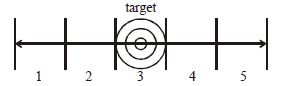
- 5View SolutionA shooting game involves using a gun that fires by itself at random times. The player can only point the gun in a fixed direction while the target moves from side to side with simple harmonic motion, as shown. At which of the given region should the player aim in order to score the greatest number of hits?
- 6A particle executes simple harmonic motion represented by displacement function as $x(t)=A \sin (\omega t+\phi)$View Solution
If the position and velocity of the particle at $t=0\, {s}$ are $2\, {cm}$ and $2\, \omega \,{cm} \,{s}^{-1}$ respectively, then its amplitude is $x \sqrt{2} \,{cm}$ where the value of $x$ is ..... .
- 7The periodic time of a simple pendulum of length $1\, m $ and amplitude $2 \,cm $ is $5\, seconds$. If the amplitude is made $4\, cm$, its periodic time in seconds will beView Solution
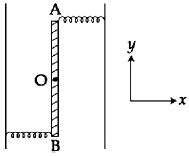
- 8Two light identical springs of spring constant $k$ are attached horizontally at the two ends of a uniform horizontal rod $AB$ of length $l$ and mass $m$. the rod is pivoted at its centre $‘O’$ and can rotate freely in horizontal plane. The other ends of the two springs are fixed to rigid supports as shown in figure. The rod is gently pushed through a small angle and released. The frequency of resulting oscillation isView Solution
- 9A body is executing Simple Harmonic Motion. At a displacement $x$ its potential energy is ${E_1}$ and at a displacement y its potential energy is ${E_2}$. The potential energy $E$ at displacement $(x + y)$ isView Solution
- 10A pendulum is suspended in a lift and its period of oscillation when the lift is stationary is $T_0$. What must be the acceleration of the lift for the period of oscillation of the pendulum to be $T_0/2$ ?View Solution