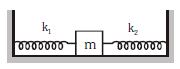
A block of mass $m$ is attached to two springs of spring constants $k_1$ and $k_2$ as shown in figure. The block is displaced by $x$ towards right and released. The velocity of the block when it is at $x/2$ will be
Medium


Download our appand get started for free
Experience the future of education. Simply download our apps or reach out to us for more information. Let's shape the future of learning together!No signup needed.*
Similar Questions
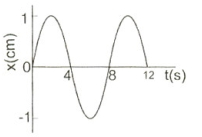
- 1The $x$-t graph of a particle undergoing simple harmonic motion is shown below. The acceleration of the particle at $t=4 / 3 \mathrm{~s}$ isView Solution
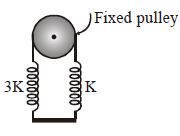
- 2A bar of mass $m$ is suspended horizontally on two vertical springs of spring constant $k$ and $3k$ . The bar bounces up and down while remaining horizontal. Find the time period of oscillation of the bar (Neglect mass of springs and friction everywhere).View Solution
- 3View SolutionMark the wrong statement
- 4A mass $M$, attached to a horizontal spring, executes S.H.M. with amplitude $A_1$. When the mass $M$ passes through its mean position then a smaller mass $m$ is placed over it and both of them move together with amplitude $A_2$. The ratio of $\frac{{{A_1}}}{{{A_2}}}$ isView Solution
- 5Time period of a particle executing $SHM$ is $8\, sec.$ At $t = 0$ it is at the mean position. The ratio of the distance covered by the particle in the $1^{st}$ second to the $2^{nd}$ second is :View Solution
- 6A simple pendulum, suspended from the ceiling of a stationary van, has time period $T$. If the van starts moving with a uniform velocity the period of the pendulum will beView Solution
- 7Two masses ${m_1}$ and ${m_2}$ are suspended together by a massless spring of constant k. When the masses are in equilibrium, ${m_1}$ is removed without disturbing the system. Then the angular frequency of oscillation of ${m_2}$ isView Solution
- 8A particle performs $S.H.M.$ of amplitude $A$ with angular frequency $\omega$ along a straight line. Whenit is at a distance $\frac{{\sqrt 3 }}{2}$ $A$ from mean position, its kinetic energy gets increased by an amount $\frac{1}{2}m{\omega ^2}{A^2}$ due to an impulsive force. Then its new amplitude becomesView Solution
- 9Two particles are executing S.H.M. The equation of their motion are ${y_1} = 10\sin \left( {\omega \,t + \frac{{\pi T}}{4}} \right),$ ${y_2} = 25\sin \,\left( {\omega \,t + \frac{{\sqrt 3 \pi T}}{4}} \right)$. What is the ratio of their amplitudeView Solution
- 10For a particle executing $S.H.M.$ the displacement $x$ is given by $x = A\cos \omega t$. Identify the graph which represents the variation of potential energy $(P.E.)$ as a function of time $t$ and displacement $x$View Solution
