Question
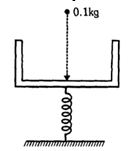
A massless platform is kept on a light elastic spring as shown in fig. When a sand particle of mass $0.1\; kg$ is dropped on the pan from a height of $0.24 \;m$, the particle strikes the pan and spring is compressed by $0.01\; m$.

From what height should the particle be dropped to cause a compression of $0.04\; m$.
Answer

$mg ( h + x )=\frac{1}{2} kx$

mg(0.24+0.01)= $\frac{1}{2} k (0.01)^2$

$mg ( h +0.04)=\frac{1}{2} k (0.04)^2$

$\frac{ h +0.04}{0.24+0.01}=\frac{16}{1}$

$\therefore h +0.4=16 \times 0.25=4$

$h =3.96 \;m$

Need a full question paper?

Generate a complete, print-ready paper with questions like this in minutes — across 16+ boards, with answer keys.

Start Generating Free

Similar questions

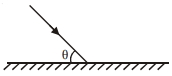
A ball of mass $m$ moving with speed $u$ collides with a smooth horizontal surface at angle $\theta$ with it as shown in figure. The magnitude of impulse imparted to surface by ball is [Coefficient of restitution of collision is $e$]
Time taken by light to travel in two different materials $A$ and $B$ of refractive indices $\mu_{A}$ and $\mu_{B}$ of same thickness is $t_{1}$ and $t_{2}$ respectively. If $t_{2}-t_{1}=5 \times 10^{-10}$ s and the ratio of $\mu_{A}$ to $\mu_{B}$ is $1: 2$. Then the thickness of material, in meter is: (Given $v_{A}$ and $v_{B}$ are velocities of light in $A$ and $B$ materials respectively).
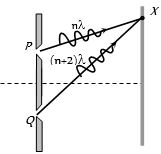
The figure shows a double slit experiment $P$ and $Q$ are the slits. The path lengths $PX $ and $ QX $ are $n\lambda $ and $(n + 2)\lambda $ respectively, where $n $ is a whole number and $\lambda $ is the wavelength. Taking the central fringe as zero, what is formed at $X$
A plate oscillated with time period $‘T’$. Suddenly, another plate put on the first plate, then time period
A carbon resistor has colour strips as violet, yellow brown and golden. The resistance is .............. $\Omega$
The displacement time equation of a particle executing $SHM$ is : $x = A \,sin\,(\omega t + \phi )$. At time $t = 0$ position of the particle is $x = A/2$ and it is moving along negative $x-$ direction. Then the angle $\phi $ can be
The variation of magnetic susceptibility $(\chi )$with temperature for a diamagnetic substance is best represented by
A metal sphere of radius $r$ and specific heat $S$ is rotated about an axis passing through its centre at a speed of $f$ rotations per second. It is suddenly stopped at $50\%$ of its energy is used in increasing its temperature. Then the rise in temperature of the sphere is
When a ball is thrown up vertically with velocity ${V_o}$, it reaches a maximum height of '$h$'. If one wishes to triple the maximum height then the ball should be thrown with velocity
Consider the two idealised systems $(i)$ a parallel plate capacitor with large plates and small separation and $(ii)$ a long solenoid of length $L >> R$, radius of cross-section. In $(i)\, E$ ideally treated as a constant between plates and zero outside. In $(ii)$ magnetic field is constant inside the solenoid and zero outside. These idealised assumptions, however, contradict fundamental laws as below