A metal wire of specific resistance $64 \times {10^{ - 6}}\,ohm - cm$ and length $198\, cm$ has a resistance of $7\, ohm$, the radius of the wire will be ............. $cm$
Easy
Download our app for free and get started
(c) $R = \rho \frac{l}{A} \Rightarrow 7 = \frac{{64 \times {{10}^{ - 6}} \times 198}}{{\frac{{22}}{7} \times {r^2}}}$ $\Rightarrow $ $r = 0.024\,cm$

Download our appand get started for free
Experience the future of education. Simply download our apps or reach out to us for more information. Let's shape the future of learning together!No signup needed.*
Similar Questions
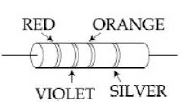
- 1View SolutionA resistance is shown in the figure. Its value and tolerance are given respectively by
- 2A battery of $3.0\, V$ is connected to a resistor dissipating $0.5\, W$ of power. If the terminal voltage of the battery is $2.5\, V$ the power dissipated within the internal resistance is$.......W$View Solution
- 3$A$ total charge $Q$ flows across a resistor $R$ during a time interval $= T$ in such a way that the current vs. time graph for $0 \rightarrow T$ is like the loop of a sin curve in the range $0 \rightarrow \pi$ . The total heat generated in the resistor isView Solution
- 4By a cell a current of $0.9\, A$ flows through $2\, ohm$ resistor and $0.3\,A$ through $7\, ohm$ resistor. The internal resistance of the cell is ............ $\Omega$View Solution
- 5A rectangular parallelopiped is measured as $1\,cm \times 1\,cm \times 100\,cm$. If its specific resistance is $3 \times 10^{-7}\,\Omega\,m$, then the resistance between its two opposite rectangular faces will be $..........x^{-7} \Omega$.View Solution
- 6A cell of internal resistance $r$ drives current through an external resistance $R$ . The power delivered by the cell to the external resistance will be maximum when:View Solution
- 7View SolutionA thick wire is stretched so that its length become two times. Assuming that there is no change in its density, then what is the ratio of change in resistance of wire to the initial resistance of wire
- 8The resistivity $(\rho)$ of semiconductor varies with temperature. Which of the following curve represents the correct behaviourView Solution
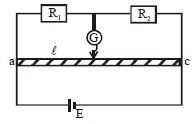
- 9Fig. shows rough sketch of meter bridge. $(G)$ deflects zero at length $\ell \, cm$. Now $R_1$ and $R_2$ are interchanged then balancing length increases by $25\, cm$. Find $R_1/R_2$View Solution
- 10If the resistance of a conductor is $5\,\Omega\,\,$ at $\,50\,^oC$ and $7\, \Omega\,$ at $\,100\,^oC$ then the mean temperature coefficient of resistance of the material is ............... $^oC$View Solution