If the resistance of a conductor is $5\,\Omega\,\,$ at $\,50\,^oC$ and $7\, \Omega\,$ at $\,100\,^oC$ then the mean temperature coefficient of resistance of the material is ............... $^oC$
Medium
Download our app for free and get started
Using ${R_{{T_2}}} = {R_{{T_1}}}[1 + \alpha ({T_2} - {T_1})]$
$ \Rightarrow $ ${R_{100}} = {R_{50}}[1 + \alpha (100 - 50)]$
$ \Rightarrow $ $7 = 5\,[1 + (\alpha \times 50)]$ $ \Rightarrow $ $ \propto \, = \,\frac{{(7 - 5)}}{{250}} = 0.008\,{^o}C$

Download our appand get started for free
Experience the future of education. Simply download our apps or reach out to us for more information. Let's shape the future of learning together!No signup needed.*
Similar Questions
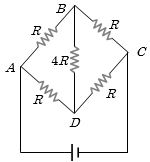
- 1Five resistors of given values are connected together as shown in the figure. The current in the arm $BD$ will beView Solution
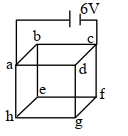
- 2Twelve wires each having resistance $2 \Omega$ are joined to form a cube. A battery of $6 \mathrm{~V}$ emf is joined across point $\mathrm{a}$ and $\mathrm{c}$. The voltage difference between $e$ and $f$ is.______.V.View Solution
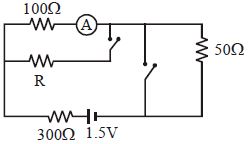
- 3In the circuit shown, the reading of the ammeter (ideal) is the same with both switches open as with both closed find the value of resistance $R$ in $ohm$ . ................ $\Omega$View Solution
- 4Two wires $A$ and $B$ of same material and mass have their lengths in the ratio $1 : 2$. On connecting them to the same source, the rate of heat dissipation in $B$ is found to be $5\,W$. The rate of heat dissipation in $A$ is............ $W$View Solution
- 5The resistance ofeach arm of the Wheatstone's bridge is $10\; ohm$. A resistance of $10 \;ohm$ is connected in series with a galvanometer then the equivalent resistance across the battery will beView Solution
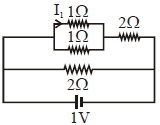
- 6The current $I_{1}$ (in $A$) flowing through $1\; \Omega$ resistor in the following circuit is:View Solution
- 7A wire of resistance $R_{1}$ is drawn out so that its length is increased by twice of its original length.The ratio of new resistance to original resistance is.View Solution
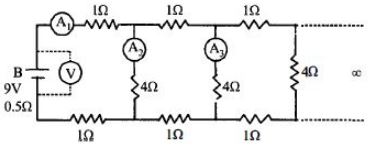
- 8A $9\, V$ battery with internal resistance of $0.5\,\Omega $ is connected across an infinite network as shown in the figure. All ammeters $A_1 , A_2, A_3$ and voltmeter $V$ are ideal. Choose correct statementView Solution
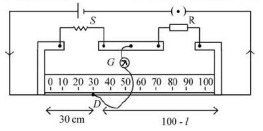
- 9In meter bridge experiment for measuring unknown resistance ' $S$ ', the null point is obtained at a distance $30 cm$ from the left side as shown at point $D$. If $R$ is $5.6 k \Omega$, then the value of unknown resistance ' $S$ ' will be $\Omega .$View Solution
- 10The two ends of a uniform conductor are joined to a cell of $e.m.f.$ $E$ and some internal resistance. Starting from the midpoint $P$ of the conductor, we move in the direction of current and return to $P$. The potential $V$ at every point on the path is plotted against the distance covered $(x)$. Which of the following graphs best represents the resulting curveView Solution