Question
A metallic loop is placed in a nonuniform magnetic field. Will an emf be induced in the loop?

Answer

As the magnetic field is non uniform thus it will induce only small electric field in different directions so there would be no net current in the loop.

Need a full question paper?

Generate a complete, print-ready paper with questions like this in minutes — across 16+ boards, with answer keys.
Start Generating Free

Similar questions

A photodiode is an optoelectronic device in which current carriers are generated by photons through photo $-$ excitation i.e., photo conduction by light. It is a $p-n$ junction fabricated from a photosensitive semiconductor and provided with a transparent window so as allow light to fall on its function. A photodiode can turn its current $ON$ and $\text{OFF}$ in nanoseconds. So, it can be used as a fastest photo $-$ detector.
  1. A $p-n$ photodiode is fabricated from a semiconductor with a band gap of $2.5\ eV$. It can detect a signal of wavelength:
  1. $4000\ nm.$
  2. $6000\ nm.$
  3. $4000Â.$
  4. $6000Â.$
  1. Three photo diodes $D_1 ,D_2$ and $D_3$ are made of semiconductors having band gap of $2.5\ eV, 2\ eV,$ and $3 \ eV ,$ respectively. Which one will be able to detect light of wavelength $6000Â$?
  1. $D_1$
  2. $D_2$
  3. $D_3$
  4. $D_1$ and $D_2$ both.
  1. Photodiode is a device:
  1. Which is always operated in reverse bias.
  2. Which of always operated in forward bias.
  3. In which photo current is independent of intensity of incident radiation.
  4. Which may be operated in forward or reverse bias.
  1. To detect light of wavelength $500\ nm,$ the photodiode must be fabricated from a semiconductor of minimum bandwidth of:
  1. $1.24\ eV$
  2. $0.62\ eV$
  3. $2.48\ eV$
  4. $3.2eV$
  1. Photodiode can be used as a photodetector to detect :
  1. Optical signals.
  2. Electrical signals.
  3. Both $(a)$ and $(b)$.
  4. None of these.
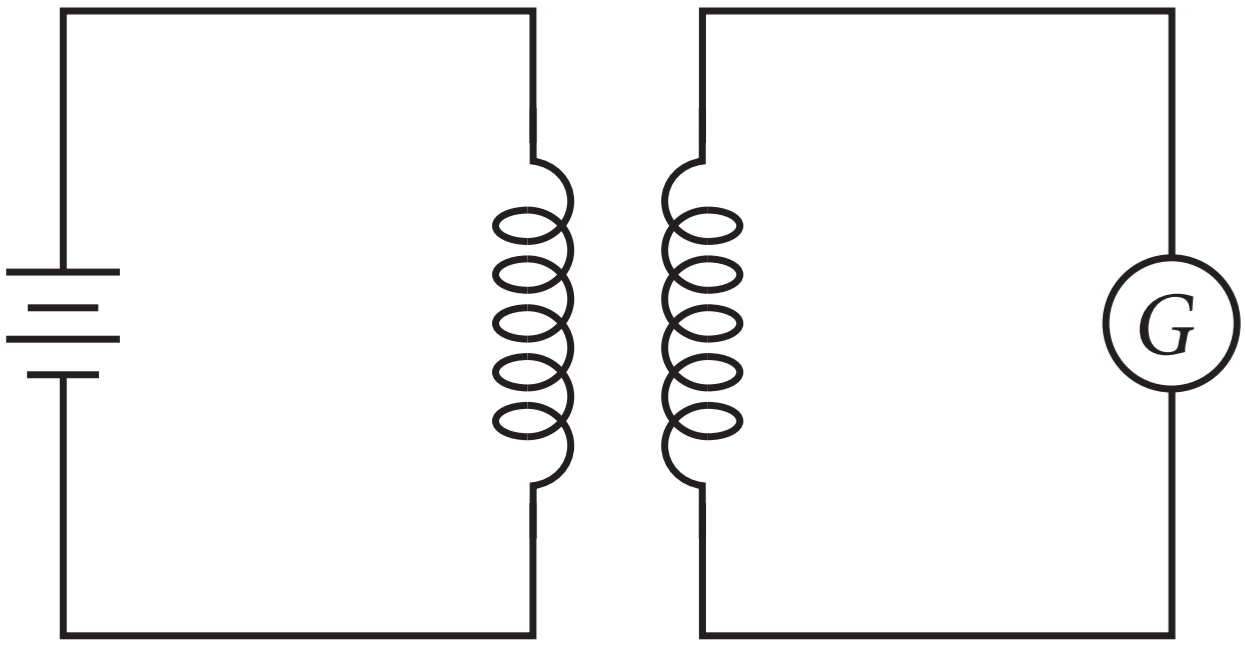
Mutual inductance is the phenomenon of inducing emfina coil, due to a change of current in the neighbouring coil. The amount of mutual inductance that links one coil to another depends very much on the relative positioning of the two coils, their geometry and relative separation between them. Mutual inductance between the two coils increases ft, times if the coils are wound over an iron core of relative permeability.
  1. A short solenoid of radius a, number of turns per unit length $n_1,$ and length $L$ is kept coaxially inside a very long solenoid of radius $b,$ number of turns per unit length $n_2.$ What is the mutual inductance of the system?
  1. $\ce{\mu_0\pi\text{b}^2\text{n}_1\text{n}_2\text{L}}$
  2. $\ce{\mu_0\pi\text{a}^2\text{n}_1\text{n}_2\text{L}^2}$
  3. $\ce{\mu_0\pi\text{a}^2\text{n}_1\text{n}_2\text{L}}$
  4. $\ce{\mu_0\pi\text{b}^2\text{n}_1\text{n}_2\text{L}^2}$
  1. If a change in current of $0.01A$ in one coil produces a change in magnetic flux of $2 \times 10^{-2}$ weber in another coil, then the mutual inductance between coils is:
  1. $0$
  2. $0.5H$
  3. $2H$
  4. $3H$
  1. Mutual inductance of two coils can be increased by:
  1. Decreasing the number of turns in the coils.
  2. Increasing the number of turns in the coils.
  3. Winding the coils on wooden cores.
  4. None of these.
  1. When a sheet of iron is placed in between the two co$-$axial coils, then the mutual inductance between the coils will:
  1. Increase.
  2. Decrease.
  3. Remains same.
  4. Cannot be predicted.
  1. The $SJ$ unit of mutual inductance is:
  1. $\ce{Ohm}.$
  2. $\ce{Mho}.$
  3. Henry.
  4. None of these.
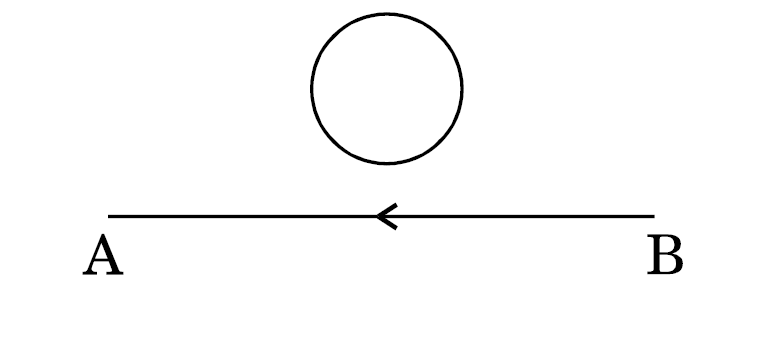
The electric current flowing in a wire in the direction from B to A is decreasing. Find out the direction of the induced current in the metallic loop kept above the wire as shown.
Explain how the image is formed by thin convex lens and derive
$-\frac{1}{u}+\frac{1}{v}=\left(n_{21}-1\right)\left[\frac{1}{R_1}-\frac{1}{ R _2}\right]$
Derive lens maker's formula for thin convex lens.
Write the rule of finding the direction of magnetic force acting on a positive charge particle moving with velocity 'v' and making an angle 0 with the magnetic field(B).
A charge particle is in motion, making an angle $\theta\left(0^{\circ}<\theta<90^{\circ}\right)$ with uniform magnetic field. Obtain the formula for time period and pitch. Draw labeled diagram representing the helical motion of the charged particle.
A uniformly charged conducting sphere of 2.4 m diameter has a surface charge density of$80.0 \mu C / m ^2$.
(a) Find the charge on the sphere.
(b) What is the total electric flux leaving the sur-face of the sphere?
Explain Bohr's atomic model.
###
State three postulates of Bohr's atomic model.
A charge is a property associated with the matter due to which it experiences and produces an electric and magnetic field. Charges are scalar in nature and they add up like real numbers. Also, the total charge of an isolated system is always conserved. When the objects rub against each other charges acquired by them must be equal and opposite.
Image
(i) The cause of charging is:
(a) the actual transfer of atoms
(b) the actual transfer of protons
(c) the actual transfer of electrons
(d) the actual transfer of neutrons

(ii) Pick the correct statement.
i. The glass rod gives protons to silk when they are rubbed against each other.
ii. The glass rod gives electrons to silk when they are rubbed against each other.
iii. The glass rod gains protons from silk when they are rubbed against each other.
iv. The glass rod gains electrons when they are rubbed against each other.
(a) Option (i) (b) Option (iv) (c) Option (iii) (d) Option (ii)

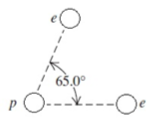
(iii) If two electrons are each $1.5 \times 10^{-10} m$ from a proton, as shown in Figure, magnitude of the net electric force they will exert on the proton is
Image

(a) $1.97 \times 10^{-8} N$
(b) $3.83 \times 10^{-8} N$
(c) $4.63 \times 10^{-8} N$
(d) $2.73 \times 10^{-8} N$

(iv) A charge is a property associated with the matter due to which it produces and experiences:
(a) electric effects only
(b) magnetic effects only
(c) both electric and magnetic effects
(d) non magnetic effects only

OR

The cause of quantization of electric charges is:
(a) transfer of an integral number of electrons
(b) transfer of an integral number of neutrons
(c) transfer of an integral number of protons
(d) transfer of an integral number of Atom
Two blocks of unequal masses are tied by a spring. The blocks are pulled stretching the spring slightly and the system is released on a frictionless horizontal platform. Are the forces due to the spring on the two blocks equal and opposite? If yes, is it an example of Newton's third law?
Complete the following table:
Car Model
Driver $X$
Reaction time $0.20s$
Driver $Y$
Reaction time $0.30s$
$A ($deceleration on hard braking $= 6.0m/s^2)$
Speed $= 54\ km/h$
Braking distance
$a = ...$
Total stopping distance
$b = ...$
Speed $= 72\ km/h$
Braking distance
$c = ...$
Total stopping distance
$d = ...$
$B ($deceleration on hard braking $= 7.5m/s^2)$
Speed $= 54\ km/h$
Breaking distance
$e = ...$
Total stopping distance
$f = ...$
Speed $72\ km/h$
Braking distance
$g = ...$
Total stopping distance
$h = ...$