Question
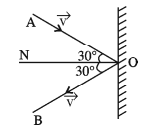
A molecule in a gas container hits a horizontal wall with speed $200 ms^{-1}$ and angle $30^{\circ}$ with the normal, and rebounds with the same speed. Is momentum conserved in the collision? Is the collision elastic or inelastic?
Answer

Momentum is always conserved in all collisions, hence momentum will be conserved in the given situations
also. Therefore, the molecular speed is the same before and after the collision, hence the kinetic energy will also be conserved. Thus this collison is elastic. If the mass of gas molecule is m and mass of wall is M then total kinetic energy after elasticity is
$\begin{array}{l} E _2=\frac{1}{2} m(200)^2+\frac{1}{2} M \times(0)^2 \\ E _2=2 \times 10^4 m J\end{array}$
 Image
Kinetic energy of the molecule before the collison,
$
\begin{array}{l}
E_1=\frac{1}{2} m(200)^2=2 \times 10^4 m J \\
E_1=E_2
\end{array}
$
Hence, the collision is elastic.

Need a full question paper?

Generate a complete, print-ready paper with questions like this in minutes — across 16+ boards, with answer keys.

Start Generating Free

Similar questions

What is the true weight of an object in a geostationary satellite that weighed exactly 10.0N at the north pole?
A SONAR (sound navigation and ranging) uses ultrasonic waves to detect and locate objects under water. In a submarine equipped with a SONAR, the time delay between generation of a probe wave and the reception of its echo after reflection from an enemy submarine is found to be 77.0s. What is the distance of the enemy submarine? (Speed of sound in water = 1450m s–1).
A vessel containing one mole of a monatomic ideal gas (molecular weight = 20gmol-1) is moving on a floor at a speed of 50ms-1. The vessel is stopped suddenly. Assuming that the mechanical energy lost has gone into the internal energy of the gas, find the rise in its temperature.
It is a well known fact that during a total solar eclipse the disk of the moon almost completely covers the disk of the sun. The distance of moon (rME) and sun (rSE) from the earth surface is 3.84 × 10⁸m and 1.496 × 10¹¹m while the diameter of Sun is 1.390 × 109m. Determine the approximate diameter of the moon.
A body oscillates with SHM according to the equation (in SI unit)

$\text{x}=5\cos\Big[2\pi\text{t}+\frac{\pi}{4}\Big]$

At t = 1.5 second, calculate (i) displecement, (ii) speed.
Define a uniform circular motion. For uniform circular motion, prove that:
Linear velocity $\text{v}=\text{r}\omega.$
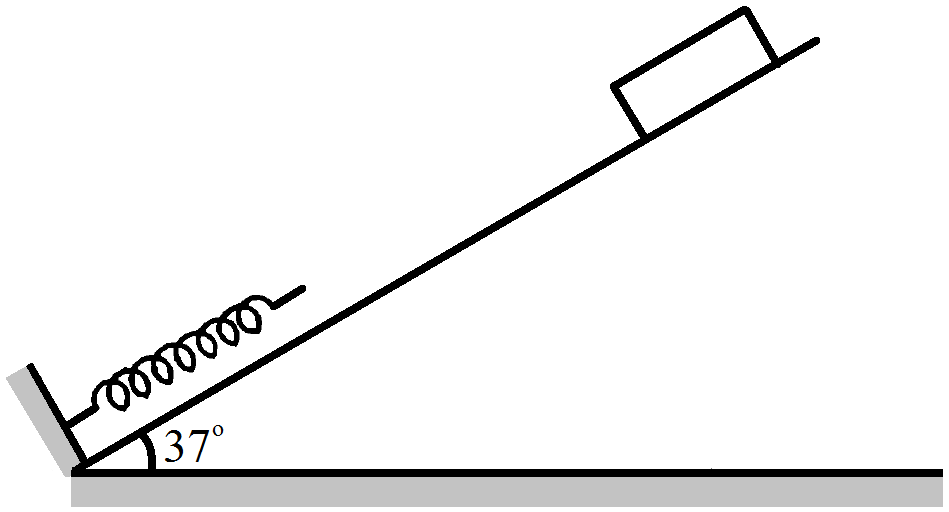
Figure shows a spring fixed at the bottom end of an incline of inclination 37°. A small block of mass 2kg starts slipping down the incline from a point 4.8m away from the spring. The block compresses the spring by 20cm, stops momentarily and then rebounds through a distance of 1m up the incline. Find.
  1. The friction coefficient between the plane and the block.
  2. The spring constant of the spring. Take g = 10m/s2.

In dealing with motion of projectile in air, we ignore effect of air resistance on motion. This gives trajectory as a parabola as you have studied. What would the trajectory look like if air resistance is included? Sketch such a trajectory and explain why you have drawn it that way.
What is meant by parallax? How can we find the distance of a nearby star by parallax method?

OR

Given measurement a1, a2, a3 ________ an. With the help of these, explain absolute error, relative error and percent -age error.

Does focal length of a lens depend on the colour of the light used? Does focal length of a mirror depend on the colour?