Question
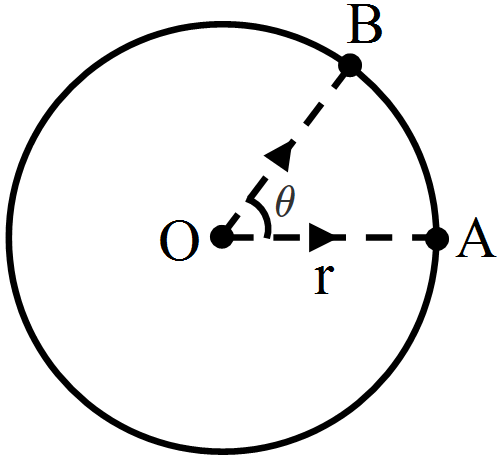
Define a uniform circular motion. For uniform circular motion, prove that:
Linear velocity $\text{v}=\text{r}\omega.$
Answer

If the speed of the particle in circular path remains constant, the motion is uniform circular motion. We know, the arc length x covered with an angular displacement $\theta$ is $\text{x}=\text{r}\theta.$

Differentiating,

$\frac{\text{dx}}{\text{dt}}=\text{r}\frac{\text{d}\theta}{\text{dt}}$

$\because$ r is constant,

$\therefore\ \text{v}=\text{r}\omega.$

Need a full question paper?

Generate a complete, print-ready paper with questions like this in minutes — across 16+ boards, with answer keys.

Start Generating Free

Similar questions

What are the energies involved in streamline flow of ideal liquid? Explain briefly.
If the earth has a mass nine times and radius twice that of the planet Mars, calculate the maximum velocity required by a rocket to pull out of the gravitational force of Mars. Given escape velocity on the surface of earth is 11.2km/sec.
An average emf of 20V is induced in an inductor when the current in it is changed from 2.5A in one direction to the same value in the opposite direction in 0.1s. Find the self-inductance of the inductor.
The radius of curvature of a concave mirror, measured by a spherometer is given by:
$\text{R}=\frac{\text{l}^2}{6\text{h}}+\frac{\text{h}}{2}$
The value of l and h are 4.0cm and 0.065cm respectively where l is measured by a metre scale and h by the spherometer. Find the relative error in the measurement of R.
The magnitude of gravitational field at distances r1 and r2 from the centre of a uniform sphere of radius R and mass M are I1 and I2 respectively. Find the ratio of $\Big(\frac{\text{I}_1}{\text{I}_2}\Big)$ if r1 > R and r2 < R.
A pan filled with hot food cools from 94 °C to 86 °C in 2 minutes when the room temperature is at 20 °C. How long will it take to cool from 71 °C to 69 °C?
The equation of trajectory of an oblique projectile is,
$\text{y}=\sqrt{3}\text{x}-\frac{\text{gx}^2}{2}$
What is the initial velocity and the angle of projection of the projectile?
A body is released at a distance r from the centre of the earth. Prove that the velocity v of the body when it strikes the surface of the earth is given by, $\text{v}=\text{R}\Big[2\text{g}\Big(\frac{1}{\text{R}}-\frac{1}{\text{r}}\Big)\Big]^{\frac{1}{2}}$ where R is the radius of the earth r > R.
Calculate the change in internal energy of a gas kept in a rigid container when 100J of heat is supplied to it.
A soap bubble of radius 4 cm and surface tension 30 dyne $cm ^{-1}$ is blown at the end of a tube of length 10 cm and internal radius 0.20 cm . If the viscosity of air is $1.89 \times 10^{-4}$ poise, find the time taken by the bubble to be reduced to a radius of 2 cm .