Question
A molecule. of hydrogen contains two protons and two electrons. The nuclear force between these two protons is always neglected while discussing the behaviour of a hydrogen molecule. Why?

Answer

Inside the nucleus, two protons exert nuclear force on each other. These forces are short-ranged (a few fm), strong and attractive forces. They also exert electrostatic repulsive force (long-ranged). While discussing the behaviour of a hydrogen molecule, the nuclear force between the two protons is always neglected. This is because the separation between the two protons in the molecule is ~70pm which is much greater than the range of the nuclear force.

Need a full question paper?

Generate a complete, print-ready paper with questions like this in minutes — across 16+ boards, with answer keys.
Start Generating Free

Similar questions

Two large, thin metal plates are parallel and close to each other. On their inner faces, the plates have surface charge densities of opposite signs and of magnitude 17.0 × 10⁻²² C/m2 . What is E:
  1. In the outer region of the first plate,
  2. In the outer region of the second plate, and
  3. Between the plates?
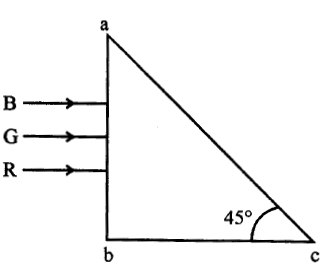
Three light rays red (R), green (G) and blue (B) are incident on a right-angled prism ‘abc’ at face ‘ab’. The refractive indices of the material of the prism for red, green and blue wavelengths are 1.39, 1.44 and 1.47 respectively. Out of the three which colour ray will emerge out of face ‘ac’? Justify your answer. Trace the path of these rays after passing through face ‘ab’.
Define the term work function of a metal. The threshold frequency of a metal is $2 f_0$. When the light of frequency $2 f_0$ is incident on the metal plate, the maximum velocity of electrons emitted is $\mathrm{v}_1$ When the frequency of the incident radiation is increased to $5 f_0$ the maximum velocity of electrons emitted is $v_2$. Find the ratio of $v_1$ to $v_2$.
There are energy bands in a solid. Do we have really continuous energy variation in a band or do we have very closely spaced but still discrete energy levels?
A person looks at different trees in an open space with the following details. Arrange the trees in decreasing order of their apparent sizes.
Tree Height(m) Distance form the eye(m)
A 2.8 50
B 2.5 80
C 1.8 70
D 2.8 100
A ball of mass 0.50kg moving at a speed of 5.0m/s collides with another ball of mass 1.0kg. After the collision the balls stick together and remain motionless. What was the velocity of the 1.0kg block before the collision?
Two narrow slits emitting iight in phase are separated by a distance of 1.0cm. The wavelength of the light is $5.0 \times 10^{-7}m.$ The interference pattern is observed on a screen placed at a distance of 1.0m.
  1. Find the separation between the consecutive maxima. Can you expect to distinguish between these maxima?
  2. Find the separation between the sources which will give a separation of 1.0mm between the consecutive maxima.
A simple pendulum consists of a 50cm long string connected to a 100g ball. The ball is pulled aside so that the string makes an angle of 37° with the vertical and is then released. Find the tension in the string when the bob is at its lowest position.
You have learnt in the text how Huygens’ principle leads to the laws of reflection and refraction. Use the same principle to deduce directly that a point object placed in front of a plane mirror produces a virtual image whose distance from the mirror is equal to the object distance from the mirror.
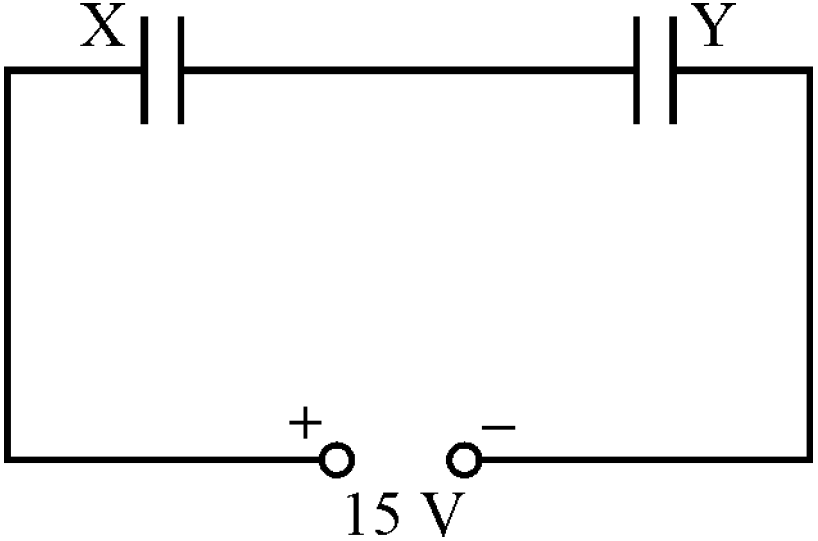
Two parallel plate capacitors X and Y have the same area of plates and same separation between them. X has air between the plates while Y contains a dielectric medium of $\varepsilon_{\text{r}} = 4.$
  1. Calculate capacitance of each capacitor if equivalent capacitance of the combination is $4\mu\text{f}.$
  2. Calculate the potential difference between the plates of X and Y.
  3. Estimate the ratio of electrostatic energy stored in X and Y.