Question
A monoenergetic (18 keV) electron beam initially in the horizontal direction is subjected to a horizontal magnetic field of 0.04 G normal to the initial direction. Estimate the up or down deflection of the beam over a distance of 30 cm (me = 9.11 × 10⁻¹⁹ C).
[Note: Data in this exercise are so chosen that the answer will give you an idea of the effect of earth’s magnetic field on the motion of the electron beam from the electron gun to the screen in a TV set.]

Answer

Energy of an electron beam, E = 18 keV = 18 × 103 eV
Charge on an electron, e = 1.6 × 10⁻¹⁹ C
E = 18 × 103 × 1.6 × 10−19 J
Magnetic field, B = 0.04 G
Mass of an electron, me = 9.1 × 10−31 kg
Distance up to which the electron beam travels, d = 30 cm = 0.3 m
We can write the kinetic energy of the electron beam as:
$\text{E}=\frac{1}{2}\text{mv}^2$
$\text{v}=\sqrt{\frac{2\text{E}}{\text{m}}}$
$\text{v}=\sqrt{\frac{2\times18\times10^3\times1.6\times10^{-19}}{9.1\times10^{-31}}}=0.795\times10^{8}\text{m}/\text{s}$
The electron beam deflects along a circular path of radius, r.
The force due to the magnetic field balances the centripetal force of the path.
$\text{B}_e\text{V}=\frac{\text{mv}^2}{\text{r}}$
$\therefore\ \text{r}=\frac{\text{mv}}{\text{Be}}$
$=\frac{9.1\times10^{-31}\times0.795\times10^8}{0.4\times10^{-4}\times1.6\times10^{-19}}=11.3\text{ m}$
Let the up and down deflection of the electron beam be $\text{x}=\text{r}(1-\cos\theta)$
Where, $\theta$ = Angle of declination.
$\sin\theta=\frac{\text{d}}{\text{r}}$
$=\frac{0.3}{11.3}$
$\theta=\sin^{-1}\frac{0.3}{11.3}=1.521^\circ$
And $\text{x}=11.3(1-\cos1.521^\circ)$
$=0.0039\text{ m}=3.9\text{ mm}$
Therefore, the up and down deflection of the beam is 3.9 mm.

Need a full question paper?

Generate a complete, print-ready paper with questions like this in minutes — across 16+ boards, with answer keys.

Start Generating Free

Similar questions

  1.  
  1. State the principle on which a potentiometer works. How can a given potentiometer be made more sensitive?
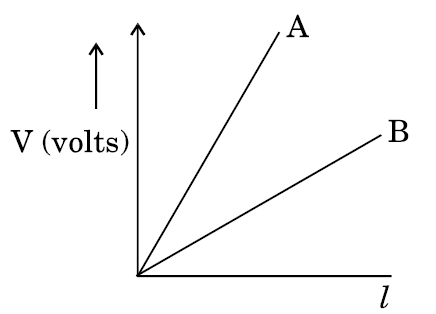
  2. In the graph shown below for two potentiometers, state with reason which of the two potentiometers, A or B, is more sensitive.
  1. Two metallic wires, P1 and P2 of the same material and same length but different cross-sectional areas, A1 and A2 are joined together and connected to a source of emf. Find the ratio of the drift velocities of free electrons in the two wires when they are connected (i) in series, and (ii) in parallel.
Two capacitors of capacitances 20.0pF and 50.0pF are connected in series with a 6.00V battery. Find:
  1. The potential difference across each capacitor.
  2. The energy stored in each capacitor.
A bullet of mass 25g is fired horizontally into a ballistic pendulum of mass 5.0kg and gets embedded in it. If the centre of the pendulum rises by a distance of 10cm, find the speed of the bullet.
Figure shows a cylindrical tube with adiabatic walls and fitted with an adiabatic separator. The separator can be slid into the tube by an external mechanism. An ideal gas $(\gamma=1.5)$ is injected in the two sides at equal pressures and temperatures. The separator remains in equilibrium at the middle. It is now slid to a position where it divides the tube in the ratio 1 : 3. Find the ratio of the temperatures in the two parts of the vessel.

Write in detail the important results related to conductive electrostatics.
Monochromatic light of wavelength 632.8 nm is produced by a helium-neon laser. The power emitted is 9.42 mW.
(a) Find the energy and momentum of each photon in the light beam.
(b) How many photons per second on the average arrive at a target irradiated by this beam? (Assume the beam to have uniform cross-section which is less than target area), and
(c) How fast does a hydrogen atom have to travel in order to have the same momentum as that of the photon?
  1. Derive the expression for the torque on a rectangular current carrying loop suspended in a uniform magnetic field.
  2. A proton and a deuteron having equal momenta enter in a region of uniform magnetic field at right angle to the direction of the field. Depict their trajectories in the field.
What is the difference between cathode rays and beta rays? When the two are travelling in space, can you make out which is the cathode ray and which is the beta ray?
The friction coefficient between a road and the tyre of a vehicle is $\frac{4}{3}.$ Find the maximum incline the road may have so that once hard brakes are applied and the wheel starts skidding, the vehicle going down at a speed of 36km/hr is stopped within 5m.
Ten positively charged particles are kept fixed on the x-axis at points x = 10cm, 20cm, 30cm, ..., 100cm. The first particle has a charge 1.0 × 10-8C, the second 8 × 10-8C, the third 27 × 10-8C and so on. The tenth particle has a charge 1000 × 10-8C. Find the magnitude of the electric force acting on a 1C charge placed at the origin.