Question types

Magnetism And Matter question types

444 questions across 8 question groups — pick any mix to generate a Physics paper with step-by-step answer keys.

444
Questions
8
Question groups
5
Question types
Sample Questions

Magnetism And Matter questions

One sample from each question group in this chapter. Select any group above to see the full set with answer keys.

Q 1M.C.Q [1M]1 Mark
The perfect pairs for a superconductor substance is-
  • A
    $\chi=1$ व $\mu_r=0$
  • B
    $\chi=0$ व $\mu_r=1$
  • $\chi=-1$ व $\mu_r=0$
  • D
    $\chi=0$ व $\mu_r=-1$

Answer: C.

View full solution
Q 2M.C.Q [1M]1 Mark
The hysteresis cycle for the material of permanent magnet is:
  • A
    Short and wide.
  • B
    Tall and narrow.
  • C
    Tall and wide.
  • D
    Short and narrow.
View full solution
Q 4M.C.Q [1M]1 Mark
At Curie temperature the ferromagnetic materials get converted into.
  • A
    Non-magnetic material.
  • B
    Para magnetic material.
  • C
    Dia magnetic material.
  • D
    All of the above.
View full solution
Q 5M.C.Q [1M]1 Mark
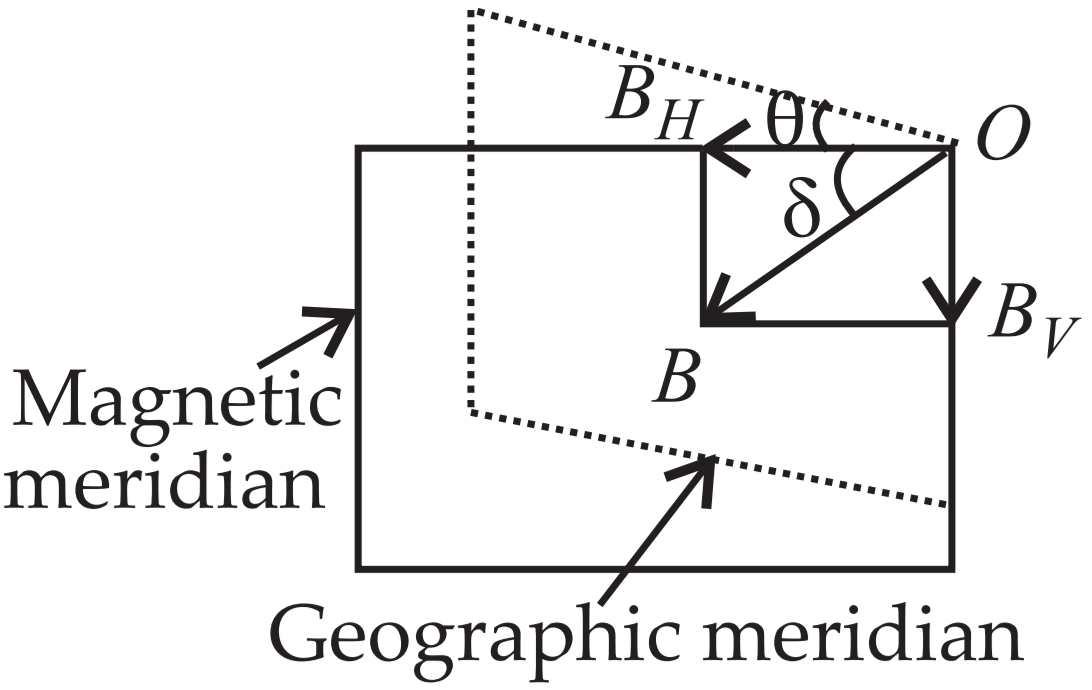
Which among the following is denoted by $\delta$?
  • A
    Horizontal component.
  • B
    Magnetic meridian.
  • C
    Magnetic declination.
  • D
    Magnetic inclination.
View full solution
Two statements are given-one labelled Assertion(A) and the other labelled Reason (R). Select the correct answer to these questions from the codes(a), (b), (c) and (d) as given below.
  1. Both A and R are true and R is the correct explanation of A.
  2. Both A and R are true but R is NOT the correct explanation of A.
  3. A is true but R is false.
  4. A is false and R is also false.
Assertion (A): Magnetic moment is measured in joule/ tesla or amp m2.
Reason (R): Joule/ tesla is equivalent to amp m2.
View full solution
Two statements are given-one labelled Assertion(A) and the other labelled Reason (R). Select the correct answer to these questions from the codes(a), (b), (c) and (d) as given below.
  1. Both A and R are true and R is the correct explanation of A.
  2. Both A and R are true but R is NOT the correct explanation of A.
  3. A is true but R is false.
  4. A is false and R is also false.
Assertion (A): The ends of a magnet suspended freely point out always along north south.
Reason (R): Earth behaves as a huge magnet.
View full solution
Two statements are given-one labelled Assertion(A) and the other labelled Reason (R). Select the correct answer to these questions from the codes(a), (b), (c) and (d) as given below.
  1. Both A and R are true and R is the correct explanation of A.
  2. Both A and R are true but R is NOT the correct explanation of A.
  3. A is true but R is false.
  4. A is false and R is also false.
Assertion (A): Earth's magnetic field does not affect the working of a moving coil galvanometer.
Reason (R): The earth's magnetic field is quite weak as compared to magnetic field produced in the moving coil galvanometer.
View full solution
Directions: In the following questions, the Assertions (A) and Reason(s) (R) have been put forward. Read both the statements carefully and choose the correct alternative from the following:
Assertion: To protect any instrument from external magnetic field, it is put inside an iron box
Reason: Iron is a ferromagnetic substance
  1. Both A and R are true and R is the correct explanation of A.
  2. Both A and R are true and R is not correct explanation of A.
  3. A is true, But R is false.
  4. A is false, But R is true.
View full solution
Directions: In the following questions, the Assertions (A) and Reason(s) (R) have been put forward. Read both the statements carefully and choose the correct alternative from the following:
Assertion: Basic difference between an electric lines of force and magnetic lines of force is that former is discontinuous and the latter is continuous or endless.
Reason: No electric lines of force exist inside a charged body but magnetic lines do exist inside a magnet.
  1. Both Assertion and Reason are correct and Reason is the correct explanation for Assertion.
  2. Both Assertion and Reason are correct but Reason is not the correct explanation for Assertion.
  3. Assertion is correct but Reason is incorrect.
  4. Both Assertion and Reason are incorrect.
View full solution
Answer the following questions:
The earth’s magnetic field varies from point to point in space. Does it also change with time? If so, on what time scale does it change appreciably?
View full solution
Answer the following questions regarding earth’s magnetism:
If you made a map of magnetic field lines at Melbourne in Australia, would the lines seem to go into the ground or come out of the ground?
View full solution
Answer the following questions:
The earth may have even reversed the direction of its field several times during its history of 4 to 5 billion years. How can geologists know about the earth’s field in such distant past?
View full solution
Answer the following questions:
If a toroid uses bismuth for its core, will the field in the core be (slightly) greater or (slightly) less than when the core is empty?
View full solution
A magnetic needle free to rotate in a vertical plane parallel to the magnetic meridian has its north tip pointing down at 22° with the horizontal. The horizontal component of the earth’s magnetic field at the place is known to be 0.35 G. Determine the magnitude of the earth’s magnetic field at the place.
View full solution
If the solenoid in Exercise 5.5 is free to turn about the vertical direction and a uniform horizontal magnetic field of 0.25 T is applied, what is the magnitude of torque on the solenoid when its axis makes an angle of 30° with the direction of applied field?
View full solution
A short bar magnet of magnetic moment m = 0.32 JT–1 is placed in a uniform magnetic field of 0.15 T. If the bar is free to rotate in the plane of the field, which orientation would correspond to its (a) stable, and (b) unstable equilibrium? What is the potential energy of the magnet in each case?
View full solution
Q 213 Marks Question3 Marks
A closely wound solenoid of 2000 turns and area of cross-section 1.6 × 10–4 m2, carrying a current of 4.0 A, is suspended through its centre allowing it to turn in a horizontal plane.
  1. What is the magnetic moment associated with the solenoid?
  2. What is the force and torque on the solenoid if a uniform horizontal magnetic field of 7.5 × 10–2 T is set up at an angle of 30º with the axis of the solenoid?
View full solution
Q 223 Marks Question3 Marks
A sample of paramagnetic salt contains 2.0 × 1024 atomic dipoles each of dipole moment 1.5 × 10⁻²³ J T–1. The sample is placed under a homogeneous magnetic field of 0.64 T, and cooled to a temperature of 4.2 K. The degree of magnetic saturation achieved is equal to 15%. What is the total dipole moment of the sample for a magnetic field of 0.98 T and a temperature of 2.8 K? (Assume Curie’s law)
View full solution
Q 233 Marks Question3 Marks
A short bar magnet of magnetic moment 5.25 × 10⁻²J T–1 is placed with its axis perpendicular to the earth’s field direction. At what distance from the centre of the magnet, the resultant field is inclined at 45° with earth’s field on (a) its normal bisector and (b) its axis. Magnitude of the earth’s field at the place is given to be 0.42 G. Ignore the length of the magnet in comparison to the distances involved.
View full solution
Q 243 Marks Question3 Marks
A short bar magnet placed in a horizontal plane has its axis aligned along the magnetic north-south direction. Null points are found on the axis of the magnet at 14 cm from the centre of the magnet. The earth’s magnetic field at the place is 0.36 G and the angle of dip is zero. What is the total magnetic field on the normal bisector of the magnet at the same distance as the null–point (i.e., 14 cm) from the centre of the magnet? (At null points, field due to a magnet is equal and opposite to the horizontal component of earth’s magnetic field.)
View full solution
Q 253 Marks Question3 Marks
A bar magnet of magnetic moment 1.5 J T–1 lies aligned with the direction of a uniform magnetic field of 0.22 T.
  1. What is the amount of work required by an external torque to turn the magnet so as to align its magnetic moment: (i) normal to the field direction, (ii) opposite to the field direction?
  2. What is the torque on the magnet in cases (i) and (ii)?
View full solution
Deduce the expression for the torque $\overrightarrow{\tau}$  acting on a planar loop of area $\overrightarrow{\text{A}}$ and carrying current I placed in a uniform magnetic field $\overrightarrow{\text{B}}.$ 
If the loop is free to rotate, what would be its orientation in stable equilibrium?
View full solution
Out of the two magnetic materials, 'A' has relative permeability slightly greater than unity while oB' has less than unity. Identify the nature of the materials 'A' and 'B'. Will their susceptibilities be positive or negative?
View full solution
Out of the two magnetic materials, 'A' has relative permeability slightly greater than unity while 'B' has less than unity. Identify the nature of the materials 'A' and 'B'. Will their susceptibilities be positive or negative?
View full solution
Out of the two magnetic materials, 'A' has relative permeability slightly greater than unity while 'B' has less than unity. Identify the nature of the materials 'A' and 'B'. Will their susceptibilities be positive or negative?
View full solution

'Tile earth's magnetic field at a point on its surface is usually characterised by three quantities: (a) declination (bl inclination or dip and (cl horizontal component of the field. These are known as the elements of the earth's magnetic field. At a place, angle between geographic meridian and magnetic meridian is defined as magnetic declination, whereas angle made by the earth's magnetic field with the horizontal in magnetic meridian is known as magnetic dip.

  1. In a certain place, the horizontal component of magnetic field is $\frac{1}{\sqrt{3}}$ times the vertical component. 'Tile angle of dip at this place is:
  1. $\text{Zero}$

  2. $\frac{\pi}{3}$

  3. $\frac{\pi}{2}$

  4. $\frac{\pi}{6}$

  1. The angle between the true geographic north and the north shown by a compass needle is called as:
  1. Inclination.
  2. Magnetic declination.
  3. Angle of meridian.
  4. Magnetic pole.
  1. Tile angles of dip at the poles and the equator respectively are
  1. 30º, 30º
  2. 0º, 90º
  3. 45º, 90º
  4. 90º, 0º 
  1. A compass needle which is allowed to move in a horizontal plane is taken to a geomagnetic pole. It
  1. Will become rigid showing no movement.
  2. Will stay in any position.
  3. Will stay in north-south direction only.
  4. Will stay in east-west direction only. 
  1. Select the correct statement from the following.
  1. The magnetic dip is zero at the centre of the earth.
  2. Magnetic dip decreases as we move away from the equator towards the magnetic pole.
  3. Magnetic dip increases as we move away from the equator towards the magnetic pole.
  4. Magnetic dip does not vary from place to place. 
View full solution
A long straight horizontal cable carries a current of 2.5 A in the direction 10° south of west to 10° north of east. The magnetic meridian of the place happens to be 10° west of the geographic meridian. The earth’s magnetic field at the location is 0.33 G, and the angle of dip is zero. Locate the line of neutral points (ignore the thickness of the cable). (At neutral points, magnetic field due to a current-carrying cable is equal and opposite to the horizontal component of earth’s magnetic field.)
View full solution
A monoenergetic (18 keV) electron beam initially in the horizontal direction is subjected to a horizontal magnetic field of 0.04 G normal to the initial direction. Estimate the up or down deflection of the beam over a distance of 30 cm (me = 9.11 × 10⁻¹⁹ C).
[Note: Data in this exercise are so chosen that the answer will give you an idea of the effect of earth’s magnetic field on the motion of the electron beam from the electron gun to the screen in a TV set.]
View full solution
A telephone cable at a place has four long straight horizontal wires carrying a current of 1.0 A in the same direction east to west. The earth’s magnetic field at the place is 0.39 G, and the angle of dip is 35º. The magnetic declination is nearly zero. What are the resultant magnetic fields at points 4.0 cm below the cable?
View full solution
Answer the following questions:
  1. Explain qualitatively on the basis of domain picture the irreversibility in the magnetisation curve of a ferromagnet.
  2. The hysteresis loop of a soft iron piece has a much smaller area than that of a carbon steel piece. If the material is to go through repeated cycles of magnetisation, which piece will dissipate greater heat energy?
  3. ‘A system displaying a hysteresis loop such as a ferromagnet, is a device for storing memory?’ Explain the meaning of this statement.
  4. What kind of ferromagnetic material is used for coating magnetic tapes in a cassette player, or for building ‘memory stores’ in a modern computer?
  5. A certain region of space is to be shielded from magnetic fields. Suggest a method.
View full solution
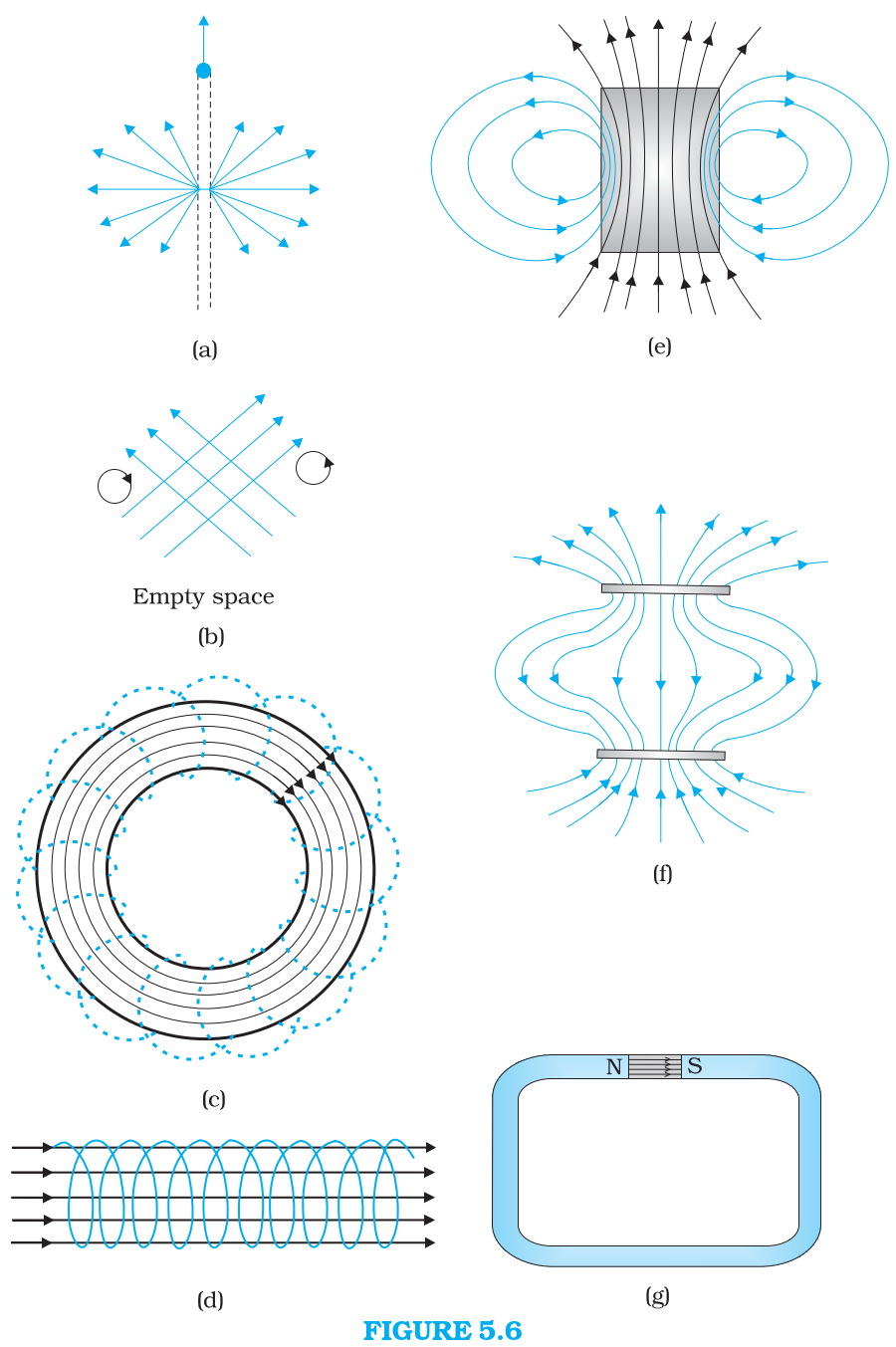
Many of the diagrams given in Fig. 5.7 show magnetic field lines (thick lines in the figure) wrongly. Point out what is wrong with them. Some of them may describe electrostatic field lines correctly. Point out which ones.
Image
View full solution

Generate a Magnetism And Matter paper free

Pick question groups from the list above, set marks and difficulty, and export a branded PDF with step-by-step answer keys. First 3 chapters free — no signup.
Download App