Question
A narrow slit S transmitting light of wavelength $\lambda$ is placed a distance d above a large plane mirror as shown in figure (17-E1). The light coming directly from the slit and that coming after the reflection interfere at a screen $\sum$ placed at a distance D from the slit.
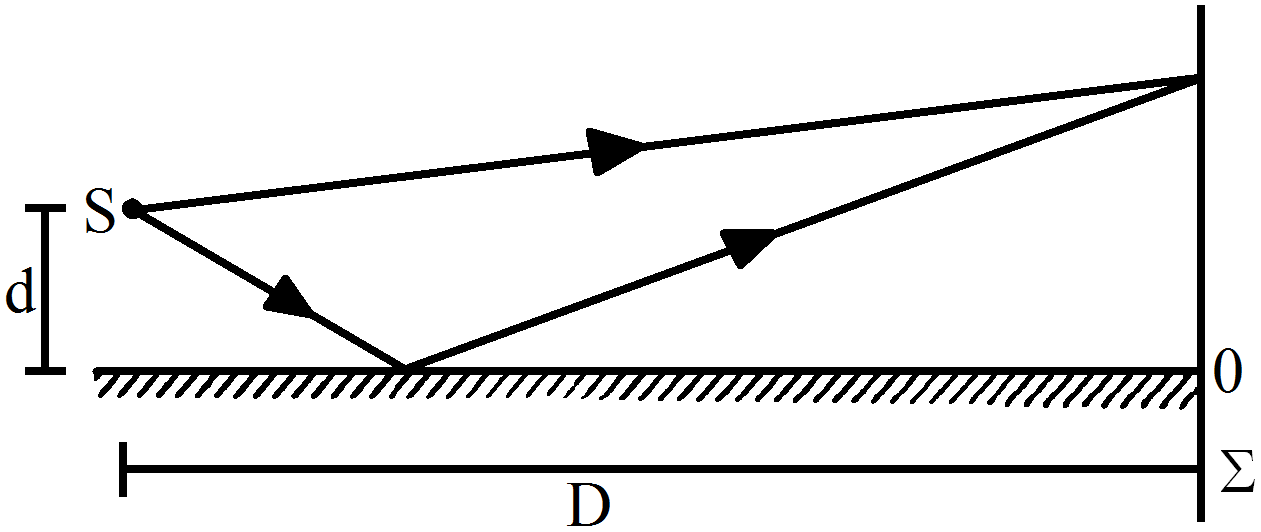
  1. What will be the intensity at a point just above the mirror, i.e., just above O?
  2. At what distance from 0 does the first maximum occur?
Answer

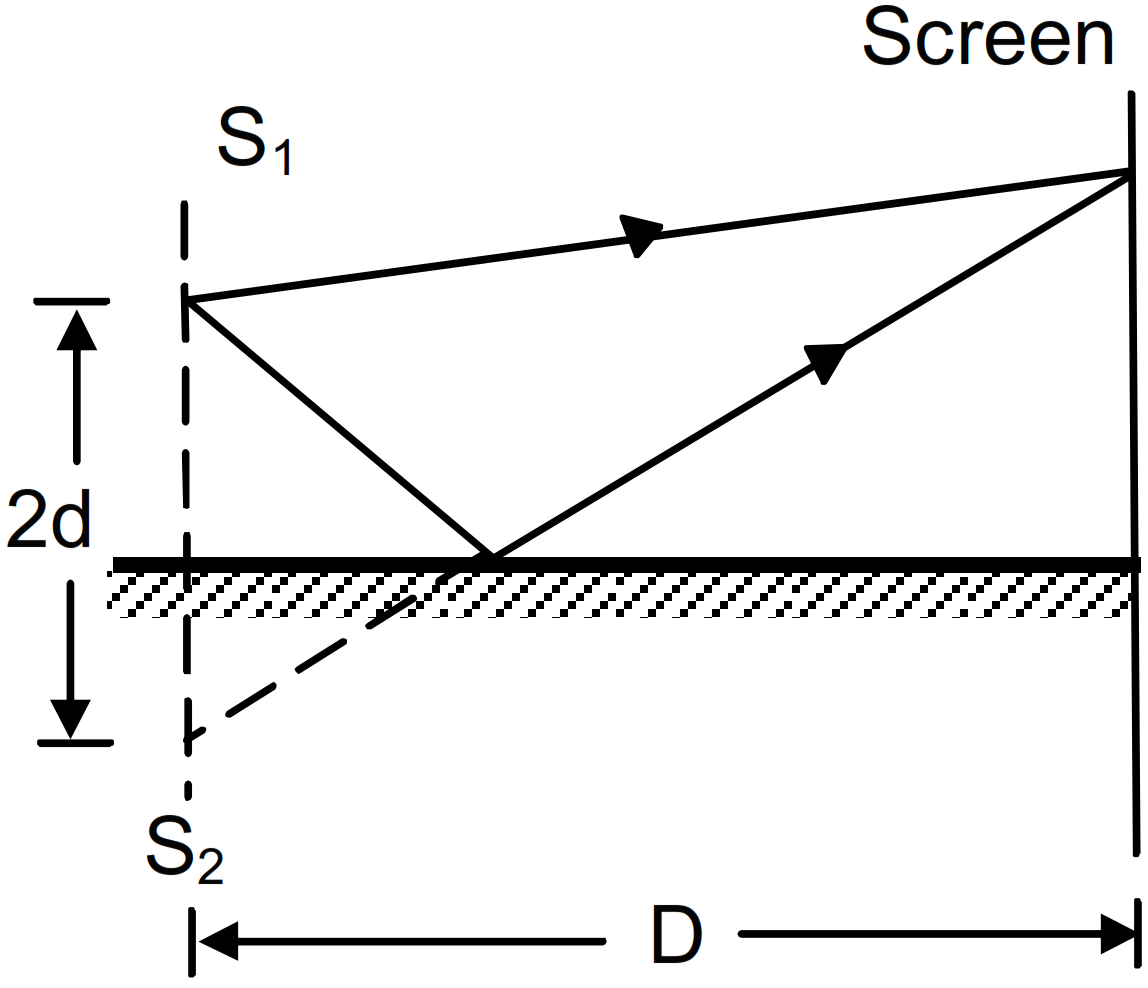
  1. Since, there is a phase difference of $\pi$ between direct light and reflecting light, the intensity just above the mirror will be zero.
  2. Here, 2d = equivalent slit separation

D = Distance between slit and screen.
We know for bright fringe, $\Delta\text{x}=\frac{\text{y}\times2\text{d}}{\text{D}}=\text{n}\lambda$
But as there is a phase reversal of $\frac{\lambda}{2}.$
$\Rightarrow\frac{\text{y}\times2\text{d}}{\text{D}}+\frac{\lambda}{2}=\text{n}\lambda$
$\Rightarrow\frac{\text{y}\times2\text{d}}{\text{D}}=\text{n}\lambda-\frac{\lambda}{2}\Rightarrow\text{y}=\frac{\lambda\text{D}}{4\text{d}}$

Need a full question paper?

Generate a complete, print-ready paper with questions like this in minutes — across 16+ boards, with answer keys.

Start Generating Free

Similar questions

The magnetic field $B$ inside a long solenoid, carrying a current of $5.00A,$ is $3.14 \times 10^{-2}T$. Find the number of turns per unit length of the solenoid.
If mercury and glass had equal coefficient of volume expansion, could we make a mercury thermometer in a glass tube?
A circular hole of diameter $2.00\ cm$ is made in an aluminium plate at $0^\circ C$. What will be the diameter at $100^\circ C$? $\alpha$ for aluminium $= 2.3 \times 10^{-5 }{}^{\circ} C^{-1}.$
  1. Define ‘activity’ of a radioactive substance.
  2. Two different radioactive elements with half lives $T_1$ and $T_2$ have $N_1$ and $N_2$ undecayed atoms respectively present at a given instant. Derive an expression for the ratio of their activities at this instant in terms of $N_1$ and $N_2.$
Explain the shortcomings of Bohr's Theory.
From molecular view point, discuss the temperature dependence of susceptibility for diamagnetism, paramagnetism and ferromagnetism.
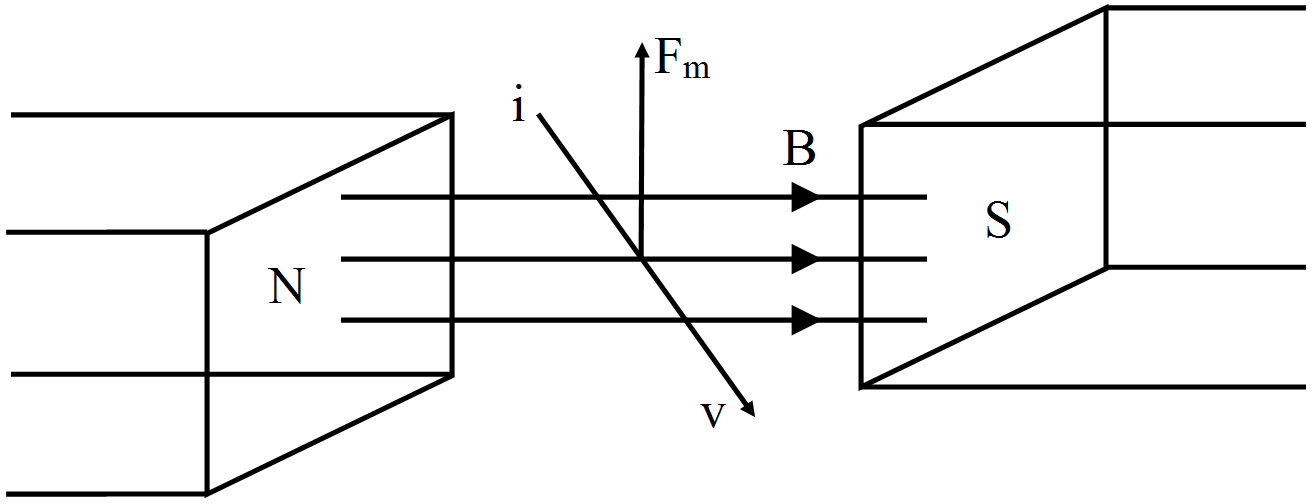
A charged particle enters into a uniform magnetic field and experiences an upward force as indicated in the figure. What is the charge sign on the particle?
(a) In relation with phenomenon of photo electric effect define:
(i) Work function (ii) Stopping & cut-off potential.
(b) Calculate the energy of photon of wavelength 3.31 Å.
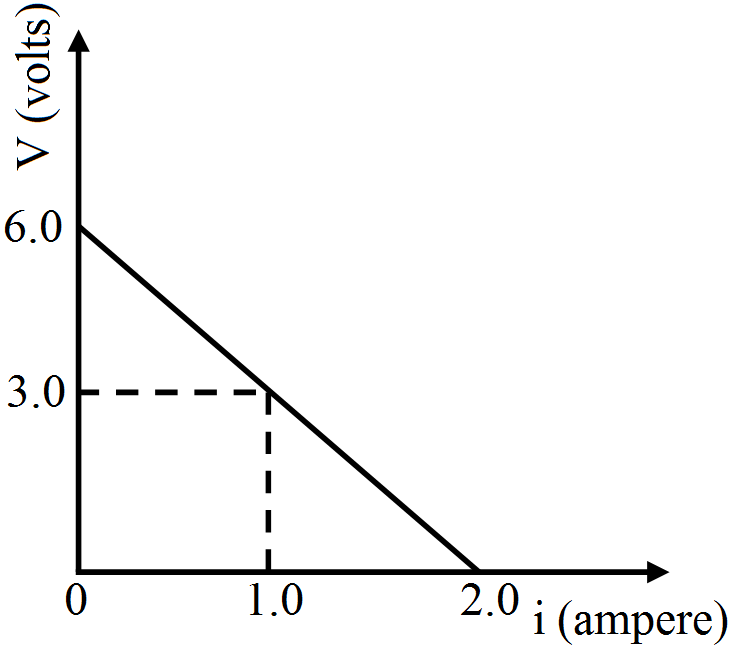
The graph shown here shows the variation of terminal potential difference V, across a combination of three cells in series to a resistor, versus current i:
  1. Calculate the emf of each cell.
  2. For what current i, will the power dissipation of the circuit be maximum?
Two identically charged particles are fastened to the two ends of a spring of spring constant $100Nm^{-1}$ and natural length $10\ cm.$ The system rests on a smooth horizontal table. If the charge on each particle is $2.0 \times 10^{-8}C$, find the extension in the length of the spring. Assume that the extension is small as compared to the natural length. Justify this assumption after you solve the problem.