Question
A narrow slit $S$ transmitting light of wavelength $\lambda$ is placed a distance d above a large plane mirror as shown in figure $(17-E1).$ The light coming directly from the slit and that coming after the reflection interfere at a screen $\sum$ placed at a distance $D$ from the slit.
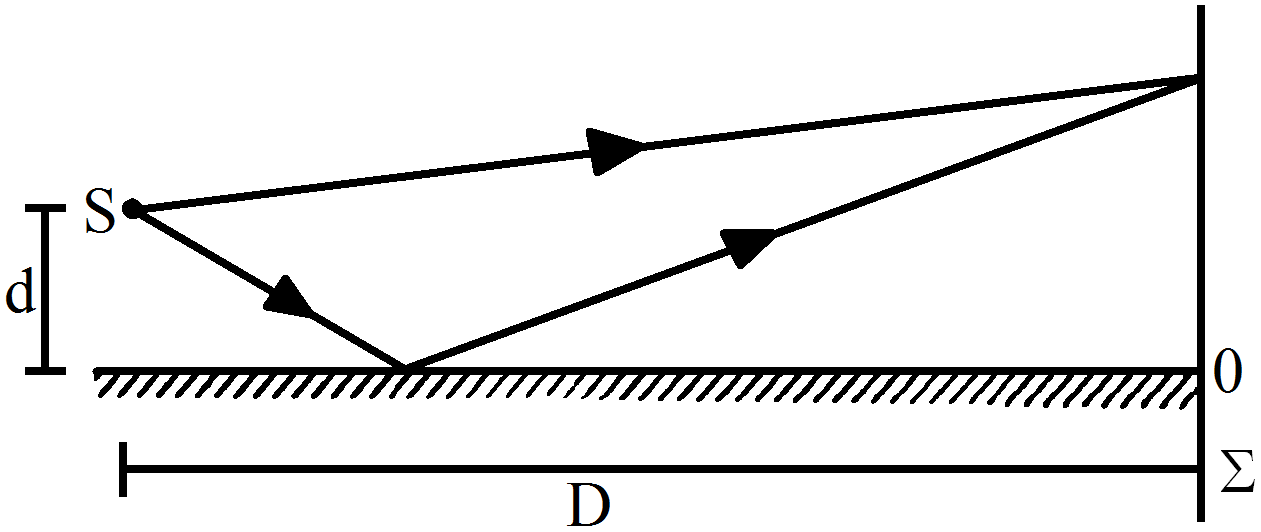
  1. What will be the intensity at a point just above the mirror, i.e., just above $O?$
  2. At what distance from $0$ does the first maximum occur?
Answer

  1. Since, there is a phase difference of $\pi$ between direct light and reflecting light, the intensity just above the mirror will be zero.
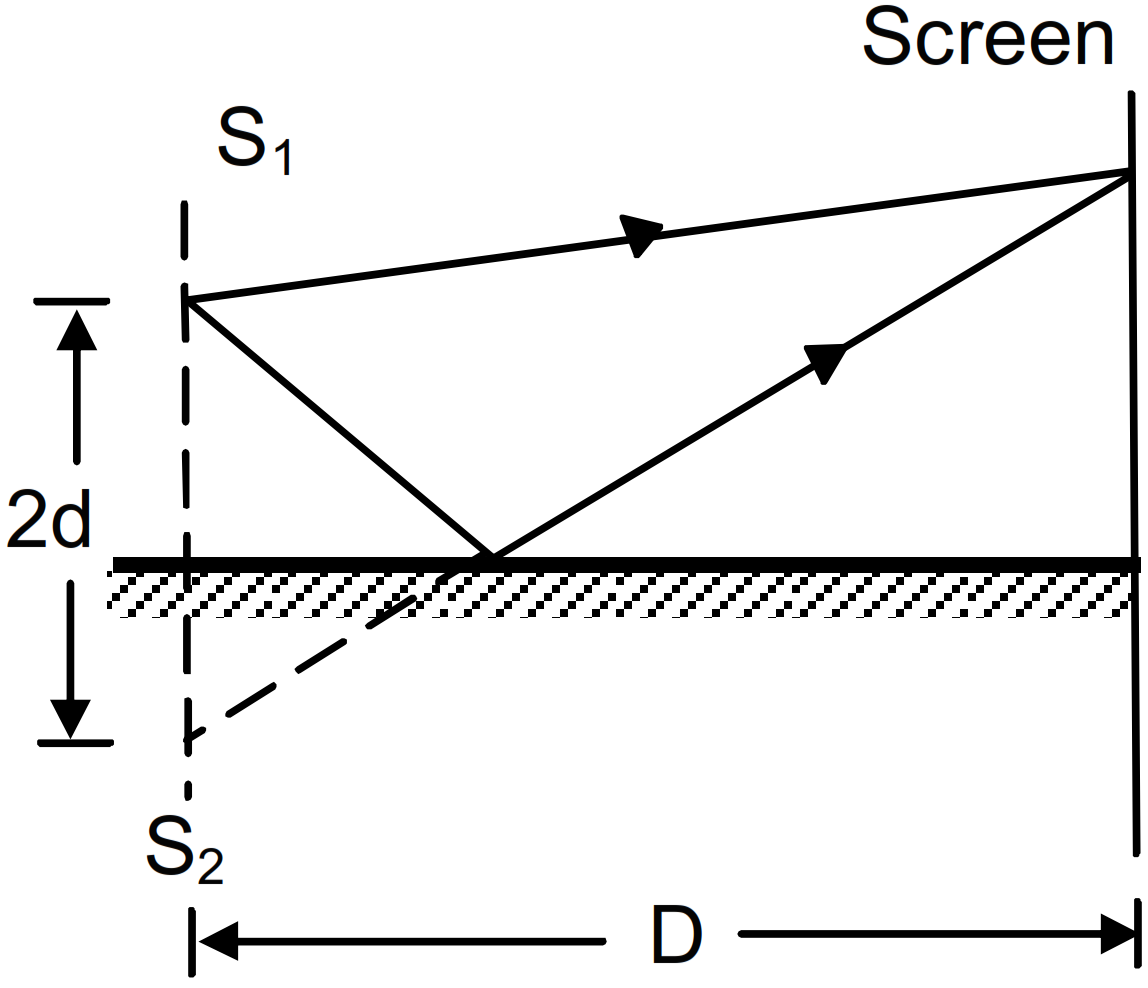
  2. Here, $2d =$ equivalent slit separation


$D =$ Distance between slit and screen.
We know for bright fringe, $\Delta\text{x}=\frac{\text{y}\times2\text{d}}{\text{D}}=\text{n}\lambda$
But as there is a phase reversal of $\frac{\lambda}{2}.$
$\Rightarrow\frac{\text{y}\times2\text{d}}{\text{D}}+\frac{\lambda}{2}=\text{n}\lambda$
$\Rightarrow\frac{\text{y}\times2\text{d}}{\text{D}}=\text{n}\lambda-\frac{\lambda}{2}$
$\Rightarrow\text{y}=\frac{\lambda\text{D}}{4\text{d}}$

Need a full question paper?

Generate a complete, print-ready paper with questions like this in minutes — across 16+ boards, with answer keys.

Start Generating Free

Similar questions

What is the direction of areal velocity of the earth around the sun?
Planet Mars has two moons-phobos and deimos.Phobos has a period of $7$ hours $39$ minutes and orbital radius of $9.4 \times 10^3km$. Calculate the mass of Mars. $(G = 6.67 \times 10^{-11} Nm^2kg^3)$
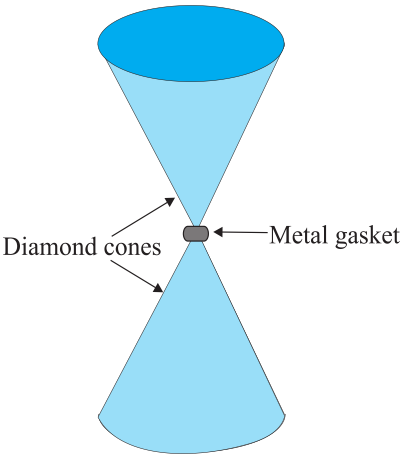
Anvils made of single crystals of diamond, with the shape as shown in Fig., are used to investigate behaviour of materials under very high pressures. Flat faces at the narrow end of the anvil have a diameter of $0.50mm$, and the wide ends are subjected to a compressional force of $50,000N$. What is the pressure at the tip of the anvil?
A liquid is kept in a cylindrical container which is being rotated around its axis. The support of the walls will rise higher. If the radius of the container is 0.05 m and speed of rotation is 2 revolutions per second then find the difference in height of the container between the center and the side of the container.
Prove that the pressure at a depth h from the free surface of a liquid (P) in a container is $\text{P}=\text{P}_2+\text{h}\rho\text{g},$ where P, is the atmospheric pressure.
A cubical block of mass m and edge a slides down a rough inclined plane of inclination $\theta$ with a uniform speed. Find the torque of the normal force acting on the block about its centre.
A particle executes the motion described by $\text{x}(\text{t})=\text{x}_0(1-\text{e}^{-\gamma\text{t}});\text{t}\ge0,\text{x}_0>0.$ Where does the particle start and with what velocity?
A uniform square plate of mass 2.0kg and edge 10cm rotates about one of its diagonals under the action of a constant torque of 0.10N-m. Calculate the angular momentum and the kinetic energy of the plate at the end of the fifth second after the start.
A block of mass 5.0kg is suspended from the end of a vertical spring which is stretched by 10cm under the load of the block. The block is given a sharp impulse from below so that it acquires an upward speed of 2.0m/s. How high will it rise? Take g = $10m/s^2.$
In a $p-n$ junction, the depletion region is $400\ nm$ wide and an electric field of $5 \times 10^5V/m$ exists in it.
  1. Find the height of the potential barrier.
  2. What should be the minimum kinetic energy of a conduction electron which can diffuse from the $n-$side to the $p-$side?