Where in the diagram will the electron have the greatest change in potential energy before hitting the one of the plates?
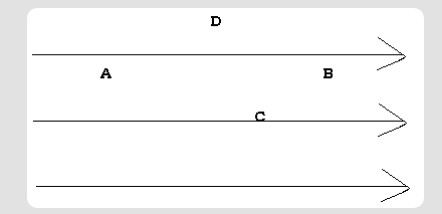
- AA
- BB
- CC
- DD

Explanation:
A charged species tends to move from place of higher potential energy to that of lower potential energy.
The direction of electric field is from left to right. This means that there is a positively charged plate on the left side, closest to A and farthest from B.
An electron being negatively charged plate always moves towards left here.
Generate a complete, print-ready paper with questions like this in minutes — across 16+ boards, with answer keys.
When light of wavelength λ is incident on an equilateral prism kept in its minimum deviation position, it is found that the angle of deviation equals the angle of the prism itself. The refractive index of the material of the prism for the wavelength λ is, then
|
(a) |
(b) |
(c) 2 |
(d) |
The internal resistance of a cell depends on
|
(a) The distance between the plates |
(b) The area of the plates immersed |
|
(c) The concentration of the electrolyte |
(d) All the above |
Light energy emitted by stars is due to
|
(a) Breaking of nuclei |
(b) Joining of nuclei |
|
(c) Burning of nuclei |
(d) Reflection of solar light |
When a point source of light is at a distance of one metre from a photo cell, the cut off voltage is found to be V. If the same source is placed at 2 m distance from photo cell, the cut off voltage will be
|
(a) V |
(b) V/2 |
(c) V/4 |
(d) V/ |
What type of modulation is employed in India for radio transmission
|
(a) Amplitude modulation |
(b) Frequency modulation |
|
(c) Pulse modulation |
(d) None of these |