Question
A nuclear reaction with positive Q value is:

Answer

  1. Exothermic
Explanation:
An exothermic reaction is that in which heat is released.
An exothermic reaction is that in which heat is absorbed.
In a nuclear reaction, if the mass of the product nucleus and outgoing particle is less than the mass of the target nucleus and bombarding particle, then energy is released (exothermic reaction), and Q-value is +ve.

Need a full question paper?

Generate a complete, print-ready paper with questions like this in minutes — across 16+ boards, with answer keys.
Start Generating Free

Similar questions

If the work function of a photometal is $6.825\ eV.$ Its threshold wavelength will be $\left(c=3 \times 10^8 \mathrm{~m} / \mathrm{s}\right)$
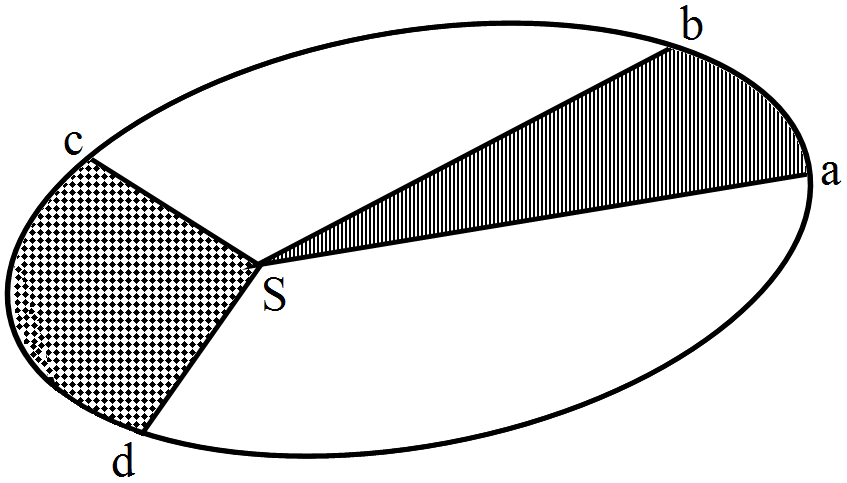
Shows the elliptical path of a planet about the sun. The two shaded parts have equal area. If $t_1$ and $t_2$ be the time taken by the planet to go from $a$ to $ b$ and from $c$ to $d$ respectively$:$
A vertical straight conductor carries a current vertically upwards. A point P lies to the east of it at a small distance and another point Q lies to the west at the same distance. The magnetic field at P is(a) Greater than at Q(b) Same as at Q(c) Less than at Q(d) Greater or less than at Q depending upon the strength of the current


An electron is travelling horizontally towards east. A magnetic field in vertically downward direction exerts a force on the electron along(a) East   (b) West(c) North(d) South
       
Unpolarized light falls first on polarizer (P) and then on analyzer (A). If the intensity of the transmitted light from the analyser is $\frac{1}{8}\text{th}$ of the incident unpolarized light. What will be the angle between optic axes of P and A?
The magnetic field produced by a current - carrying wire at a given point depends on:
Electric charges of $+10\ \mu C ,+5\ \mu C ,-3\ \mu C$ and $+8\ \mu C$ are placed at the corners of a square of side $\sqrt{2} m$. the potential at the centre of the square is
Two thin lenses whose powers are +2D and –4D respectively combine, then the power of combination is(a) – 2D(b) + 2D(c) – 4D    (d) + 4D
       
The temperature at which thermal electric power of a thermo couple becomes zero is called(a) Inversion temperature(b) Neutral temperature(c) Junction temperature(d) Null temperature
   
   
Which of the following series in the spectrum of hydrogen atom lies in the visible region of the electromagnetic spectrum?