MCQ
A nucleus represented by the symbol ${ }_{Z}^{ A } X$ has
  • A
    $Z$ protons and $A$ neutrons
  • B
    $A$ protons and $Z-A$ neutrons
  • $Z$ protons and $A - Z$ neutrons
  • D
    $Z$ neutrons and $A -Z$ protons

Answer

Correct option: C.
$Z$ protons and $A - Z$ neutrons
c
The no. of protons in the nucleus of the atom is equal to the atomic number (Z)

The no. of the neutrons is equal to the difference between the mass no. of the atom (A) and the Atomic no. (Z)

The mass no. of the atom (A) is equal to the sum of the no. of protons and neutrons in the nucleus.

$A \rightarrow$ Mass number $=$ Protons $+$ neutrons

$Z=$ Atomic no. $=$ No. of protons

$\therefore Z =$ Protons,

Neutrons $= A - Z$

Need a full question paper?

Generate a complete, print-ready paper with questions like this in minutes — across 16+ boards, with answer keys.
Start Generating Free

Similar questions

Consider two masses with $m_1 > m_2$ connected by a light inextensible string that passes over a pulley of radius $R$ and moment of inertia $I$ about its axis of rotation. The string does not slip on the pulley and  the pulley turns without friction. The two masses are released from rest separated by a vertical distance $2 h$. When the two masses pass each other, the speed of the masses is proportional to
If a vector $\vec A$ is parallel to another vector $\vec B$ then the resultant of the vector $\vec A \times \vec B$ will be equal to
The maximum possible acceleration of a train moving on a straight track is $10\  m/s^2$ and maximum possible retardation is $5 \ m/s^2.$ If maximum achievable speed of train is $10\ m/s$ then minimum time in which train can complete a journey of $135\ m$ starting from rest and ending at rest, is.........$s$
A cubical block of wood of specific gravity $0.5$ and a chunk of concrete of specific gravity $2.5$ are fastened together. The ratio of the mass of wood to the mass of concrete which makes the combination to float with its entire volume submerged under water is
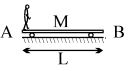
The figure shows a man of mass $m$ standing at the end $A$ of a trolley of mass $M$ placed at rest on a smooth horizontal surface. The man starts moving towards the end $B$ with a velocity $u_{rel}$ with respect to the trolley. The length of the trolley is $L$. The distance moved by the man with respect to ground is
Two parallel plate capacitors of capacity $C$ and $3\,C$ are connected in parallel combination and charged to a potential difference $18\,V$. The battery is then disconnected and the space between the plates of the capacitor of capacity $C$ is completely filled with a material of dielectric constant $9$. The final potential difference across the combination of capacitors will be $V$
A projectile has the same range $R$ for two angles of projection. If $T_1$ and $T_2$ be the times of flight in the two cases, then $R$ is
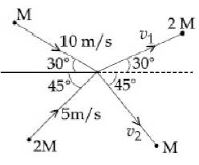
Two particles, of masses $M$ and $2M$, moving as shown, with speeds of $10\, m/s$ and $5\, m/s$, collide elastically at the origin. After the collision, they move along the indicated directions with speeds $v_1$ and $v_2$ respectively. The value of $v_1$ and $v_2$ are nearly
When a pressure of $100$ atmosphere is applied on a spherical ball, then its volume reduces to $0.01\%$. The bulk modulus of the material of the rubber in $dyne/c{m^2}$ is
A charged particle $q$ is shot towards another charged particle $Q$ which is fixed, with a speed $v$. It approaches $Q$ upto a closest distance $r$ and then returns. If $q$ were given a speed $2v$, the closest distances of approach would be
