Question
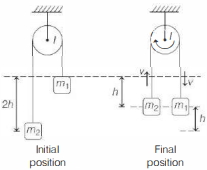
Consider two masses with $m_1 > m_2$ connected by a light inextensible string that passes over a pulley of radius $R$ and moment of inertia $I$ about its axis of rotation. The string does not slip on the pulley and  the pulley turns without friction. The two masses are released from rest separated by a vertical distance $2 h$. When the two masses pass each other, the speed of the masses is proportional to
Answer

(a) Loss of potential energy of $m_1$ appears as kinetic energies of $m_1, m_2$ and pulley and also as potential energies of $m_1$ and $m_2$. So, by energy conservation, we get

$m_1 g h=\frac{1}{2} m_1 v^2+\frac{1}{2} m_2 v^2+\frac{1}{2} I \omega^2+m_2 g h$

Here, $m_1$ falls by distance $h, m_2$ rises by distance $h , v=$ speed of $m_1=$ speed of $m_2$ as they passes each other and $\omega=$ angular speed of pulley $=\frac{v}{R}$.

$\text { So, }\left(m_1-m_2\right) g h=\frac{v^2}{2}\left(m_1+m_2+\frac{I}{R^2}\right)$

$\therefore \quad v=\frac{2 g h\left(m_1-m_2\right)}{\left(m_1+m_2+\frac{I}{R^2}\right)}$

$\text { or } \quad v \propto \sqrt{\left(\frac{m_1-m_2}{m_1+m_2}+\frac{I}{R^2}\right)}$

Need a full question paper?

Generate a complete, print-ready paper with questions like this in minutes — across 16+ boards, with answer keys.

Start Generating Free

Similar questions

An electric bulb rated as $200\, {W}$ at $100 \,{V}$ is used in a circuit having $200\, {V}$ supply. The resistance $'R'$ that must be put in series with the bulb so that the bulb delivers the same power is $.....\,\Omega$
The equation of the propagating wave is $y = 25\sin (20t + 5x),$ where $y$ is displacement. Which of the following statement is not true
Two beams, $A$ and $B$, of plane polarized light with mutually perpendicular planes of polarization are seen through a polaroid. From the position when the beam $A$ has maximum intensity ( and beam $B$ has zero intensity), a rotation of polaroid through $30 ^o $ makes the two beams appear equally bright. If the initial intensities of the two beams are $I_A$ and $I_B$  respectively, then $\frac{{{I_A}}}{{{I_B}}}$=
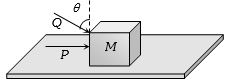
A block of mass $m$ lying on a rough horizontal plane is acted upon by a horizontal force $P$ and another force $Q$ inclined at an angle $\theta $ to the vertical. The block will remain in equilibrium, if the coefficient of friction between it and the surface is
The total mechanical energy of a particle in $SHM$ is
A plane mirror makes an angle of $30^\circ $ with horizontal. If a vertical ray strikes the mirror, find the angle between mirror and reflected ray.....$^o$
Curie is a unit of
A radio transmitter operates at a frequency of $880 \,kHz$ and a power of $10\,kW$. The number of photons emitted per second are
Two moles of ideal helium gas are in a rubber balloon at $30^{\circ} C$. The balloon is fully expandable and can be assumed to require no energy in its expansion. The temperature of the gas in the balloon is slowly changed to $35^{\circ} C$. The amount of heat required in raising the temperature is nearly (take $R =8.31 J / mol$. $K$)
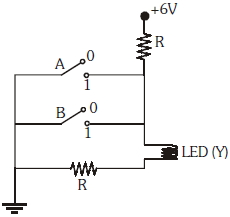
The circuit diagram shown here corresponds to the logic gate,