Question
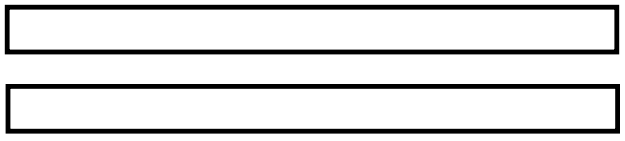
A parallel-plate capacitor having plate area $25cm^2$ and separation 1.00mm is connected to a battery of 6.0V. Calculate the charge flown through the battery. How much work has been done by the battery during the process?
Answer


$\text{A}=25\text{cm}^2=2.5\times10^{-3}\text{cm}^2$
$\text{d}=1\text{mm}=0.01\text{m}$
$\text{V}=\text{6V},\ \text{Q}=1$
$\text{C}=\frac{\in_0\text{A}}{\text{d}}=\frac{8.854\times10^{-12}\times2.5\times10^{-3}}{0.01}$
$\text{Q}=\text{CV}=\frac{8.854\times10^{-12}\times2.5\times10^{-3}}{0.01}\times6$
$=1.32810\times10^{-10}\text{C}$
$\text{W}=\text{Q}\times\text{V}=1.32810\times10^{-10}\text{C}\times6$
$=8\times10^{-10}\text{J}.$

Need a full question paper?

Generate a complete, print-ready paper with questions like this in minutes — across 16+ boards, with answer keys.
Start Generating Free

Similar questions

The force of surface tension acts tangentially to the surface whereas the force due to air pressure acts perpendicularly on the surface. How is then the force due to excess pressure inside a bubble balanced by the force due to the surface tension?
At what temperature the mean speed of the molecules of hydrogen gas equals the escape epeed from the earth?
Define the term ‘mutual inductance’ between the two coils.
Obtain the expression for mutual inductance of a pair of long coaxial solenoids each of length I and radii $r_1$ and $r_2\left(r_2 \gg r_1\right)$.
Total number of turns in the two solenoids are $\mathrm{N}_1$ and $\mathrm{N}_2$ respectively.
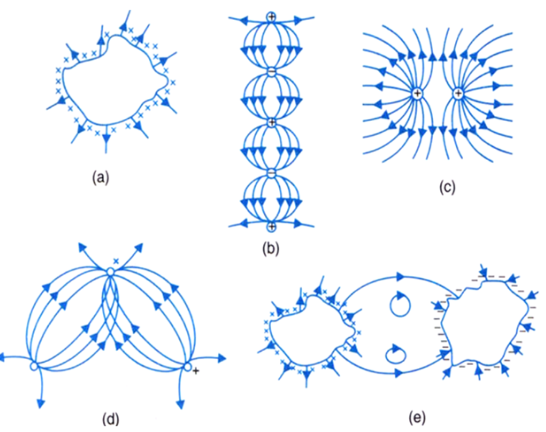
Which among the curves shown in Fig. 1.35 cannot possibly represent electrostatic field lines?
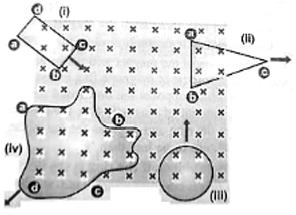
The figure below shows planer loops of different shapes moving out of or into a region of the magnetic field which is directed normal to the plane of the loops away from the reader. Determine the direction of induced current in each loop using Lenz's law. Check if you would obtain the same answers by considering the magnetic force on the charge inside the moving loops.

Image
A long, straight wire of radius r carries a current i and is placed horizontally in a uniform magnetic field B pointing vertically upward. The current is uniformly distributed over its cross-section.
  1. At what points will the resultant magnetic field have maximum magnitude? What will be the maximum magnitude?
  2. What will be the minimum magnitude of the resultant magnetic field?
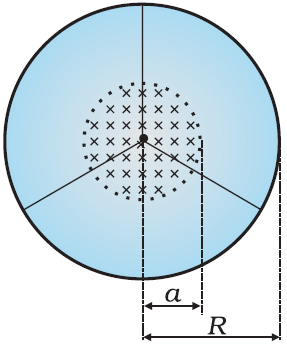
A line charge $\lambda$ per unit length is lodged uniformly onto the rim of a wheel of mass M and radius R. The wheel has light non-conducting spokes and is free to rotate without friction about its axis (Fig.). A uniform magnetic field extends over a circular region within the rim. It is given by,
$B = – B_0k (r ≤ a; a < R)$
= 0 (otherwise)
What is the angular velocity of the wheel after the field is suddenly switched off?
Four point charges $q_A = 2 \mu\ C, q_B = –5 \mu\ C, q_C = 2 \mu\ C,$ and $q_D = –5 \mu\ C$ are located at the corners of a square ABCD of side 10 cm. What is the force on a charge of 1 μC placed at the centre of the square?
Get the electric field due to a uniformly charged infinite plane sheet.
A simple microscope has a magnifying power of 3.0 when the image is formed at the near point (25cm) of a normal eye.
  1. What is its focal length?
  2. What will be its magnifying power if the image is formed at infinity?