Question
A parallel plate capacitor is to be designed with a voltage rating 1kV, using a material of dielectric constant 3 and dielectric strength about $10^7Vm^{–1}$. (Dielectric strength is the maximum electric field a material can tolerate without breakdown, i.e., without starting to conduct electricity through partial ionisation.) For safety, we should like the field never to exceed, say 10% of the dielectric strength. What minimum area of the plates is required to have a capacitance of 50pF?
Answer

Potential rating of a parallel plate capacitor, V = 1kV= 1000V
Dielectric constant of a matertal, $\in_{\text{r}}={3}$
Dielectric strength $={10}^{7}\frac{\text{V}}{\text{m}}$
For safety, the field intensity never exceeds 10% of the dielectric strength.
Hence, electric field intensity, E = 10% of $10^7 = 10^6$ $\frac{\text{V}}{\text{m}}$
Capacitance of the parallel plate capacitor, $C = 50pf = 50 \times 10^{-12}F$
Distance between the plates is given by,
$\text{d}=\frac{\text{V}}{\text{E}}$
$=\frac{1000}{{10}^{6}}={10}^{-3}\text{m}$
Capacitance i given by the relation,
$\text{C}=\frac{\in_{0}\in_{\text{r}\text{A}}}{\text{d}}$
where, A = Area of each plate$\in_{0}$= Permittivity of free space $= 8.85 \times 10^{-12} N^{-1} C^2 m^{-2}$​​​​​​​
$\therefore\ \text{A}=\frac{\text{Cd}}{\in_{0}\in_{\text{r}}}$ $=\frac{{50}\times{10}^{-12}\times{10}^{-3}}{{8.85}\times{10}^{-12}\times{3}}\approx{19}\text{cm}^{2}$
 Hence, the area of each plate is about $19cm^2.$

Need a full question paper?

Generate a complete, print-ready paper with questions like this in minutes — across 16+ boards, with answer keys.

Start Generating Free

Similar questions

Explain the function of base region of a transistor. Why is this region made thin and lightly doped? Draw a circuit diagram to study the input and output characteristics of n-p-n transistor in a common emitter (CE) configuration. Show these characteristics graphically. Explain how current amplification factor of the transistor is calculated using output characteristics.
A capacitor of capacitance C is given a charge Q. At t = 0, it is connected to an uncharged capacitor of equal capacitance through a resistance R. Find the charge on the second capacitor as a function of time.
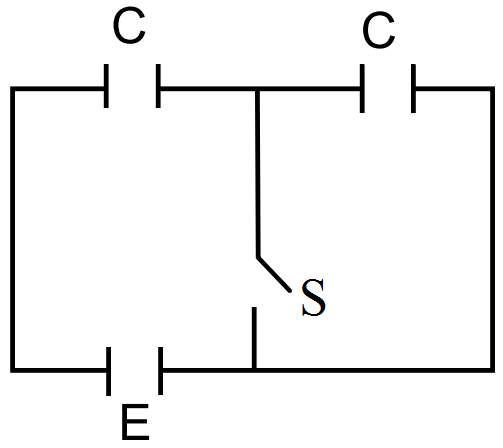
Consider the situation shown in figure. The switch S is open for a long time and then closed:
  1. Find the charge flown through the battery when the switch S is closed.
  2. Find the work done by the battery.
  3. Find the change in energy stored in the capacitors.
  4. Find the heat developed in the system.
  1. State Kirchhoff’s rules for an electric network. Using Kirchhoff’s rules, obtain the balance condition in terms of the resistances of four arms of Wheat sone bridge.
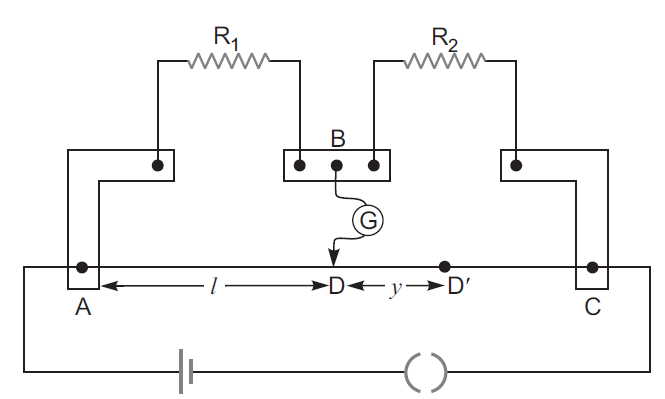
  2. In the meter bridge experimental set up, shown in the figure, the null point ‘D’ is obtained at a distance of 40 cm from end A ofthe meter bridge wire. If a resistance of 10 Ω is connected in series with $R_1$, null point is obtained at AD = 60 cm. Calculate the value of $R_1$ and $R_2.$
Estimating the following two numbers should be interesting. The first number will tell you why radio engineers do not need to worry much about photons! The second number tells you why our eye can never ‘count photons’, even in barely detectable light.
  1. The number of photons emitted per second by a Medium wave transmitter of 10 kW power, emitting radiowaves of wavelength 500 m.
  2. The number of photons entering the pupil of our eye per second corresponding to the minimum intensity of white light that we humans can perceive $(\sim 10^{–10} W m^{–2}).$ Take the area of the pupil to be about $0.4 cm^2,$ and the average frequency of white light to be about $6 \times 10^{14} Hz.$
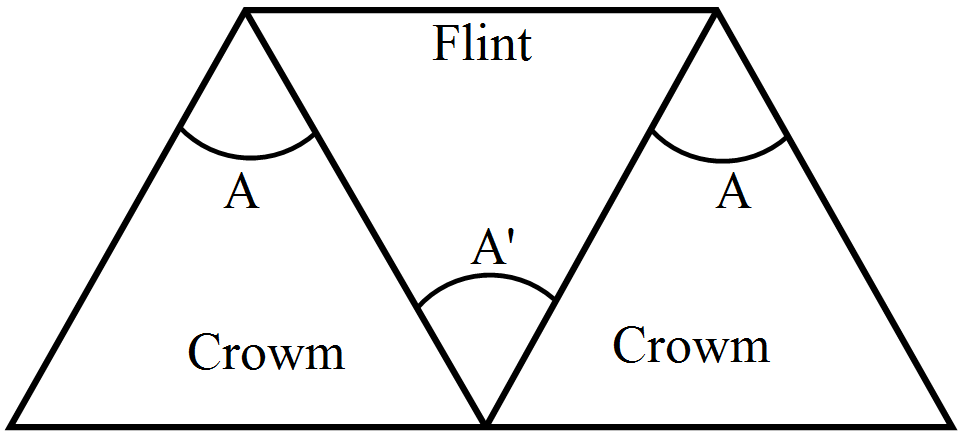
Three thin prisms are combined as shown in figure. The refractive indices of the crown glass for red, yellow and violet rays are $\mu_\text{r},\mu_\text{y}$ and $\mu_\text{v}$ respectively and those for the flint glass are $\mu'_\text{r},\mu'_\text{y}$ and $\mu'_\text{v}$ respectively. Find the ratio $\frac{\text{A}'}{\text{A}}$ for which.
  1. There is no net angular dispersion.
  2. There is no net deviation in the yellow ray.
What is the focal length of a convex lens of focal length 30cm in contact with a concave lens of focal length 20 cm? Is the system a converging or a diverging lens? Ignore thickness of the lenses.
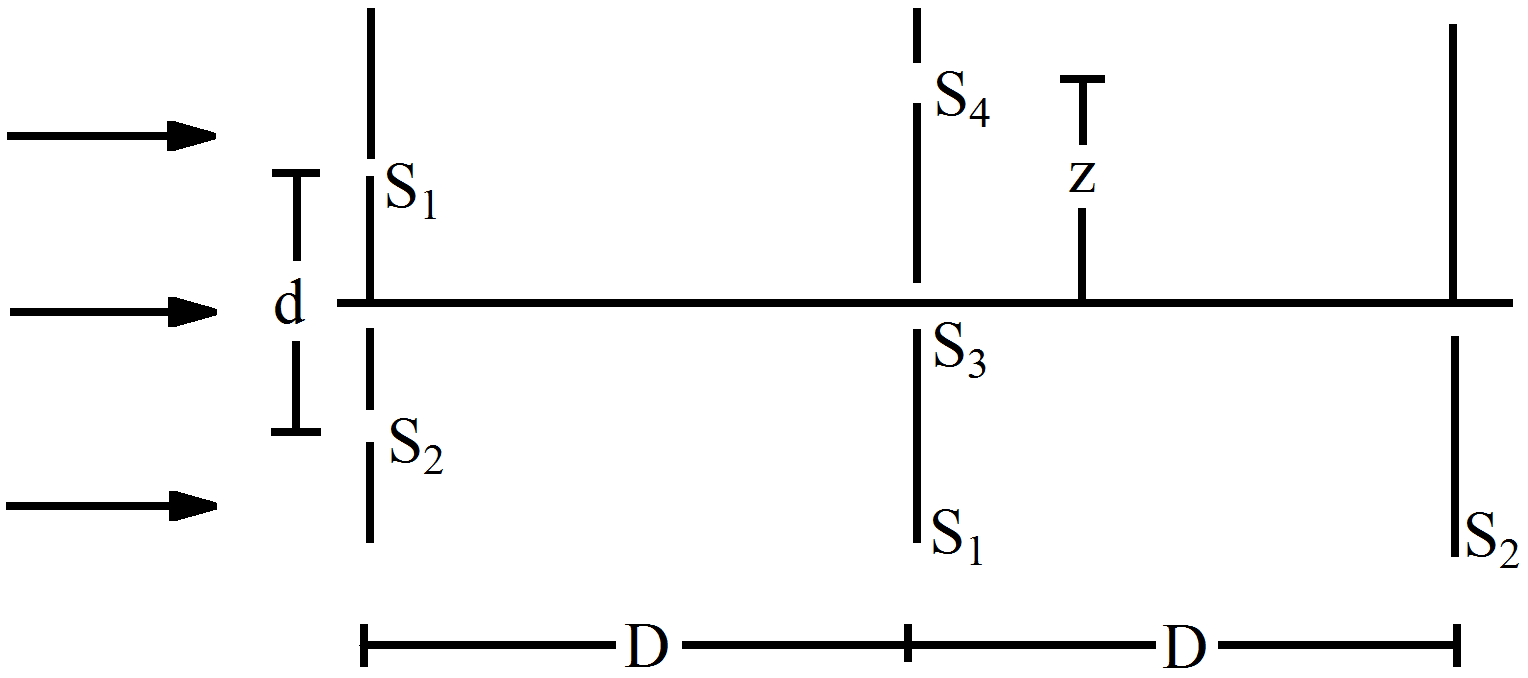
Consider the situation shown in figure (17-E6). The two slits $S_1$ and $S_2$ p laced symmetrically around the central line are illuminated by a monochromatic light of wavelength $\lambda$. The separation between the slits is d . The light transmitted by the slits falls on a screen $E_1$ placed at a distance $D$ from the slits. The slit $S_3$ is at the central line and the slit $S_4$ is at a distance $z$ from $S_3$. Another
screen $\sum_2$ is placed a further distance D away from $\sum_1$. Find the ratio of the maximum to minimum intensity observed on $\sum_2$, if z is equal to,
  1. $\text{z}=\frac{\lambda\text{D}}{2\text{d}}$
  2. $\frac{\lambda\text{D}}{\text{d}}$
  3. $\frac{\lambda\text{D}}{4\text{d}}$
A bullet of mass 25g is fired horizontally into a ballistic pendulum of mass 5.0kg and gets embedded in it. If the centre of the pendulum rises by a distance of 10cm, find the speed of the bullet.
A rectangular loop of sides 20cm and 10cm carries a current of 5.0A. A uniform magnetic field of magnitude 0.20T exists parallel to the longer side of the loop.
  1. What is the force acting on the loop?
  2. What is the torque acting on the loop?