MCQ
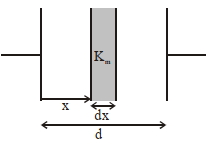
A parallel plate capacitor of capacitance $C$ has spacing $d$ between two plates having area $A$. The region between the plates is filled with $N$ dielectric layers, parallel to its plates, each with thickness $\delta=\frac{ d }{ N }$. The dielectric constant of the $m ^{\text {th }}$ layer is $K _{ m }= K \left(1+\frac{ m }{ N }\right)$. For a very large $N \left(>10^3\right)$, the capacitance $C$ is $\alpha\left(\frac{ K \varepsilon_0 A }{ d \;ln 2}\right)$. The value of $\alpha$ will be. . . . . . . .

[ $\epsilon_0$ is the permittivity of free space]

  • $1$
  • B
    $3$
  • C
    $5$
  • D
    $6$

Answer

Correct option: A.
$1$
a
$\delta=d x=\frac{d}{N} \& \frac{m}{N}=\frac{x}{d}$

$K_m=K\left(1+\frac{m}{N}\right)$

$\Rightarrow K_m=K\left(1+\frac{x}{d}\right)$

$C^{\prime}=\frac{K_m A \epsilon_0}{d x}$

$\frac{1}{C_{e q}}=\int_0^d \frac{d x}{K_m A \epsilon_0}=\frac{1}{K A \epsilon_0} \int_0^d \frac{d x}{\left(1+\frac{x}{d}\right)}$

$\Rightarrow \frac{1}{C_{e q}}=\frac{d}{K A \epsilon_0}\left[\ln \left(1+\frac{x}{d}\right)\right]_0^d$

$\Rightarrow \frac{1}{ C _{ eq }}=\frac{ d }{ KA \epsilon_0}[\ln 2-\ell n (1)]$

$\Rightarrow C _{ eq }=\frac{ KA \epsilon_0}{ d \ell n 2} \Rightarrow \alpha=1$

Need a full question paper?

Generate a complete, print-ready paper with questions like this in minutes — across 16+ boards, with answer keys.

Start Generating Free

Similar questions

A wire of density $9 \times 10^{-3} \,kg\, cm ^{-3}$ is stretched between two clamps $1\, m$ apart. The resulting strain in the wire is $4.9 \times 10^{-4}$. The lowest frequency of the transverse vibrations in the wire is......$HZ$

(Young's modulus of wire $Y =9 \times 10^{10}\, Nm ^{-2}$ ), (to the nearest integer),

The adiabatic elasticity of a diatomic gas at $NTP$ is ........ $N / m ^2$
A screw gauge gives the following readings when used to measure the diameter of a wire

Main scale reading : $0 \,\mathrm{~mm}$

Circular scale reading $: 52$ $divisions$

Given that $1\, \mathrm{~mm}$ on main scale corresponds to $100\, divisions$ on the circular scale. The diameter of the wire from the above data is ...... $cm$

A bullet of mass $2\, gm$ is having a charge of $2\,\mu C$. Through what potential difference must it be accelerated, starting from rest, to acquire a speed of $10\,m/s$
A vector $\overrightarrow{ A }$ points vertically upward and $\overrightarrow{ B }$ points towards north. The vector product $\overrightarrow{ A } \times \overrightarrow{ B }$ is
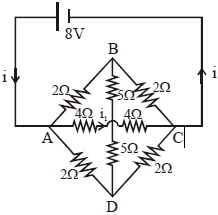
The value of current $i_{1}$ flowing from $A$ to $C$ in the circuit diagram is$.......A$
Assertion : A charge, whether stationary or in motion produces a magnetic field around it.

Reason : Moving charges produce only electric field in the surrounding space.

In comparison to a half wave rectifier, the full wave rectifier gives lower
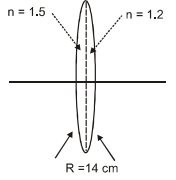
A bi-convex lens is formed with two thin plano-convex lenses as shown in the figure. Refractive index $n$ of the first lens is $1.5$ and that of the second lens is $1.2$. Both the curved surfaces are of the same radius of curvature $R=$ $14 \ cm$. For this bi-convex lens, for an object distance of $40 \ cm$, the image distance will be
A heating element has a resistance of  $100\,\Omega $ at room temperature. When it is connected to a supply of  $220\,V,$  a steady current of $2\,A$  passes in it and temperature is $500\,^oC$ more than room temperature. What is the temperature coefficient resistance of the heating element?