MCQ
A vector $\overrightarrow{ A }$ points vertically upward and $\overrightarrow{ B }$ points towards north. The vector product $\overrightarrow{ A } \times \overrightarrow{ B }$ is
  • A
    null vector
  • along west
  • C
    along east
  • D
    verticaly downward

Answer

Correct option: B.
along west
b
Here $z$-axis is vertically upward means normal to plane of paper as shown in figure.

Thus, $\vec{A}=A \hat{k}$ and $\vec{B}=B \hat{j}$

So, $\overrightarrow{ A } \times \overrightarrow{ B }= A \hat{ k } \times \overrightarrow{ Bj }=- AB \hat{ i }$

Thus, it is along negative $x$-axis means along west.

Need a full question paper?

Generate a complete, print-ready paper with questions like this in minutes — across 16+ boards, with answer keys.
Start Generating Free

Similar questions

The bulk modulus of rubber is $9.1\times 10^8\,N/m^2$. To ......... $m$ depth a rubber ball be taken in a lake so that its volume is decreased by $0.1\,\%$ .
A uniform spherical planet (Radius $R$) has acceleration due to gravity at its surface $g.$ Points $P$ and $Q$ located inside and outside the planet have acceleration due to gravity $\frac{g}{4} .$ Maximum possible separation between $P$ and $Q$ is
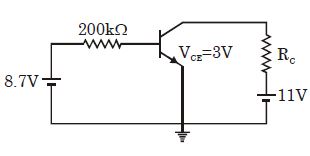
In the shown common emitter amplifier circuit, $\beta = 80$ , $V_{BE} = 0.7\,volt $ . The value of $R_C$ is 
A gun is aimed at a target in a line of its barrel. The target is released and allowed to fall under gravity at the same instant the gun is fired. The bullet will
A wire length $2\,m$ carrying a current of $1\,A$ is bent to form a circle. The magnetic moment of the coil is
Two masses ${m_A}$and ${m_B}$moving with velocities ${v_A}$and ${v_B}$in opposite directions collide elastically. After that the masses ${m_A}$and ${m_B}$move with velocity ${v_B}$and ${v_A}$respectively. The ratio $ \frac{m_A}{m_B} =$
If a thin prism of glass is dipped into water then minimum deviation (with respect to air) of light produced by prism will be left $\left( {_a{\mu _g} = \frac{3}{2}{\rm{ and}}{\,_a}{\mu _w}\, = \,\frac{4}{3}} \right)$
Two point white dots are $1mm$ apart on a black paper. They are viewed by eye of pupil diameter $3\ mm$. Approximately, what is the maximum distance at which dots can be resolved by the eye ?.....$m$ [Take wavelength of light $= 500 nm$]
A particle executes simple harmonic motion (amplitude $= A$) between $x = - A$ and $x = + A$. The time taken for it to go from $0$ to $A/2$ is ${T_1}$ and to go from $A/2$ to $A$ is ${T_2}$. Then
Light wave travel in vacuum along the $x$-axis, which of the-following may represent the wave front