Question
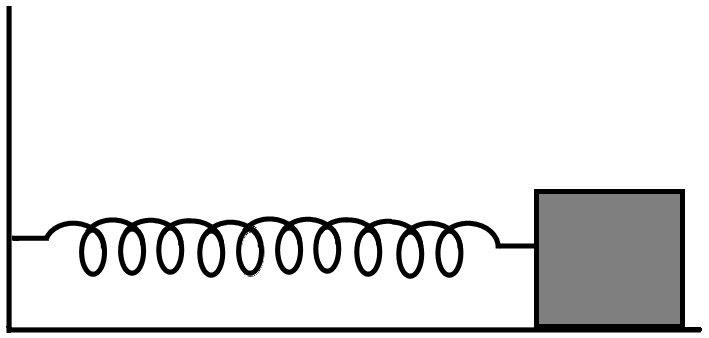
For three situations, the initial and final positions respectively, along x-axis for the block in Fig are (a) - 3cm, 2cm. (b) 2cm, 3 cm and (c) -2cm, 2cm. In each situation, is the work done by the spring force on the block positive, negative or zero?
Answer

  1. Since $\text{U}=\frac{1}{2}\text{k}\Big(\text{x}_2^2-\text{x}_2^1\Big),$ energy decreases, so work done by external force is negative. Therefore, work done by spring force is positive.

  2. Since, $\text{U}=\frac{1}{2}\text{k}\Big(\text{x}_2^2-\text{x}_1^2\Big)$ energy increases, so work done by external force is positive. Therefore, work done by spring force is negative.

  3. Since, $\text{U}=\frac{1}{2}\text{k}\Big(\text{x}_2^2-\text{x}_1^2\Big),$ there is no change in K.E., so work done is zero.

Need a full question paper?

Generate a complete, print-ready paper with questions like this in minutes — across 16+ boards, with answer keys.

Start Generating Free

Similar questions

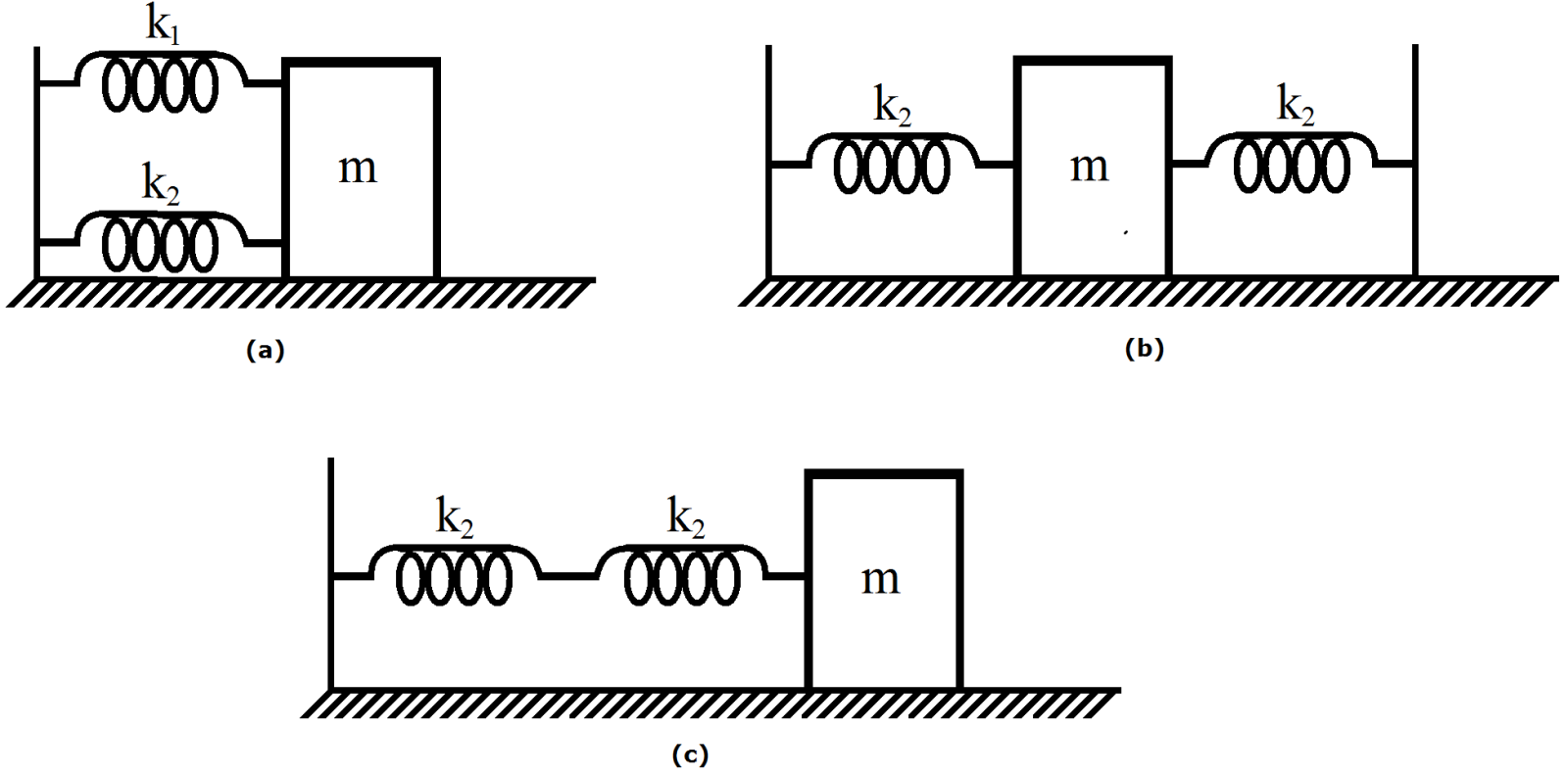
Find the time period of the oscillation of mass m in figure What is the equivalent spring constant of the pair of springs in each case?

Repeat part (a) of problem 6 if the push is applied horizontally and not parallel to the incline.
Given below are densities of some solids and liquids. Give rough estimates of the size of their atoms:
Substance
Atomic Mass(u)
Density (103kgm-3)
Carbon (diamond)
Gold
Nitrogen (liquid)
Lithium
Fluorine (liquid)
12.01
197.00
14.01
6.94
19.00
2.22
19.32
1.00
0.53
1.14
$\big[$Hint: Assume the atoms to be ‘tightly packed’ in a solid or liquid phase, and use the known value of Avogadro’s number. You should, however, not take the actual numbers you obtain for various atomic sizes too literally. Because of the crudeness of the tight packing approximation, the results only indicate that atomic sizes are in the range of a few $\mathring{\text{A}}\big].$
A rocket is launched vertically from the surface of the earth with an initial speed of 10km/s. How far above the surface of the earth would it go? Ignore the atmospheric resistance. Radius of the earth = 6400km.
A batsman deflects a ball by an angle of 45° without changing its initial speed which is equal to 54km/h. What is the impulse imparted to the ball? (Mass of the ball is 0.15 kg)
What is the excess pressure inside a bubble of soap solution of radius 5.00mm, given that the surface tension of soap solution at the temperature (20°C) is 2.50 × 10⁻² Nm–1? If an air bubble of the same dimension were formed at depth of 40.0cm inside a container containing the soap solution (of relative density 1.20), what would be the pressure inside the bubble? (1 atmospheric pressure is 1.01 × 10⁵Pa).
A train, standing in a station-yard, blows a whistle of frequency 400Hz in still air. The wind starts blowing in the direction from the yard to the station with a speed of 10m s–1. What are the frequency, wavelength, and speed of sound for an observer standing on the station’s platform? Is the situation exactly identical to the case when the air is still and the observer runs towards the yard at a speed of 10m s–1? The speed of sound in still air can be taken as 340m s–1.
Find the expression for kinetic energy, potential energy and total energy of a particle executing SHM.
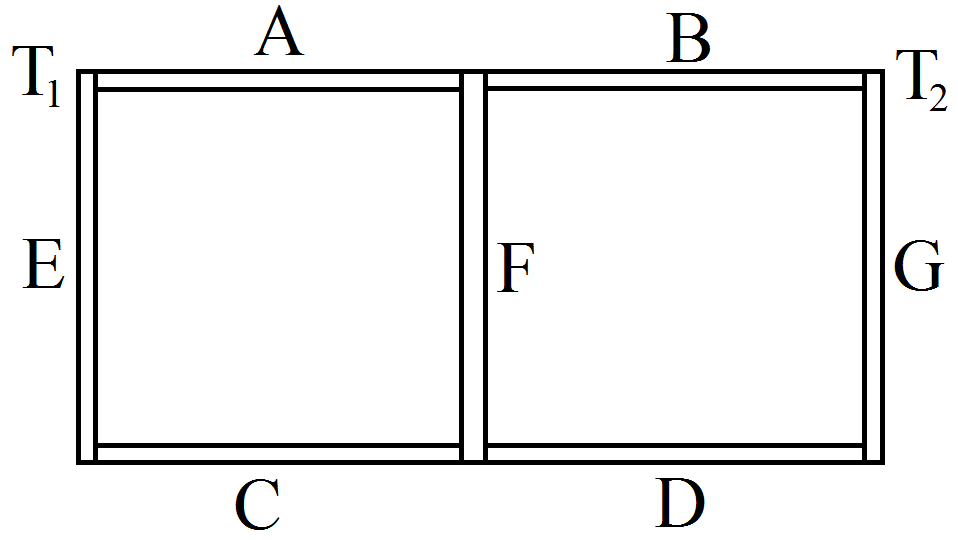
Seven rods A, B, C, D, E, F and G are joined as shown in figure. All the rods have equal cross-sectional area A and length l. The thermal conductivities of the rods are KA = Kc = K0, KB = KD = 2K0, K= 3K0, KF = 4K0, and KG = 5K0. The rod E is kept at a constant temperature T2 and the rod G is kept at a constant temperature T2(T2 > T1).

  1. Show that the rod F has a uniform temperature $\text{T}=\frac{(\text{T}_1+2\text{T}_2)}{3}.$
  2. Find the rate of heat flowing from the source which maintains the temperature T2.

A ballon has 5.0g mole of helium at 7°C. Calculate.
  1. The number of atoms of helium in the balloon,
  2. The total internal energy of the system.