Question
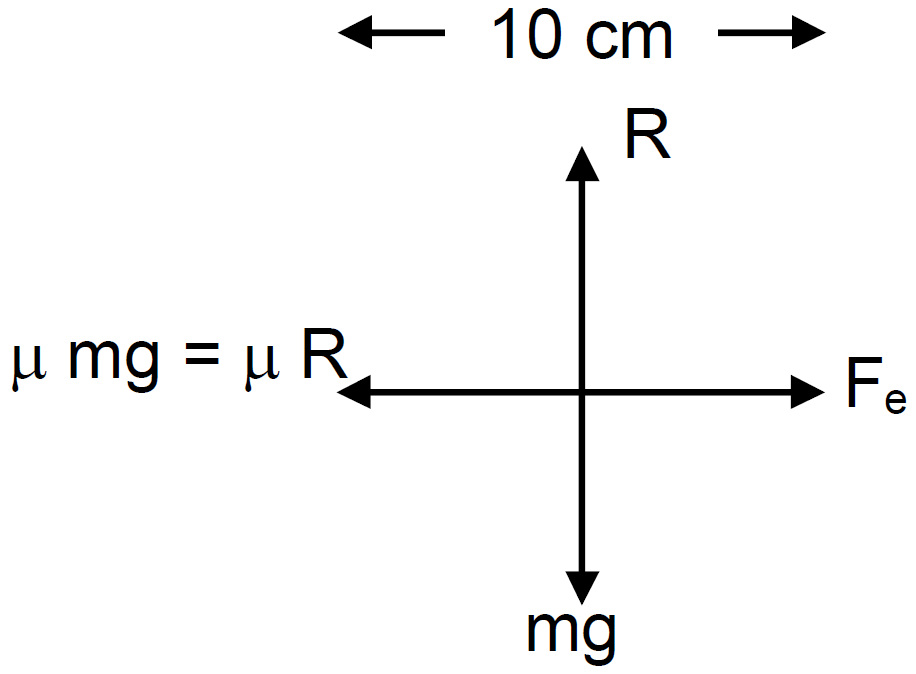
A particle A having a charge of $2.0 \times 10^{-6}C$ is held fixed on a horizontal table. A second charged particle of mass 80g stays in equilibrium on the table at a distance of 10cm from the first charge. The coefficient of friction between the table and this second particle is $\mu=0.2.$ Find the range within which the charge of this second particle may lie.
Answer


$\text{q}_\text{A}=2\times10^{-6}\text{C},\ \text{M}_\text{b}=80\text{g},\ \mu=0.2$
Since B is at equilibrium,
So, $\text{Fe}=\mu\text{R}$
$\Rightarrow\frac{\text{Kq}_\text{A}\text{q}_\text{B}}{\text{r}^2}=\mu\text{R}=\mu\text{m}\times\text{g}$
$\Rightarrow\frac{9\times10^9\times2\times10^{-6}\times\text{q}_\text{B}}{0.01}=0.2\times0.08\times9.8$
$\Rightarrow\text{q}_\text{B}=\frac{0.2\times0.08\times9.8\times0.01}{9\times10^9\times2\times10^{-6}}$
$=8.7\times10^{-8}\text{C}$
Range $=\pm8.7\times10^{-8}\text{C}$

Need a full question paper?

Generate a complete, print-ready paper with questions like this in minutes — across 16+ boards, with answer keys.

Start Generating Free

Similar questions

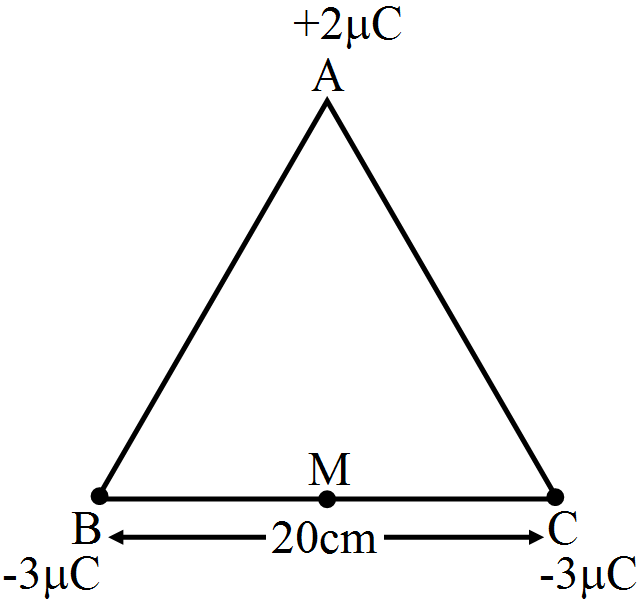
Three point charges of $+2\mu\text{C}, -3\mu\text{C}$ and $-3\mu\text{C}$ are kept at the vertices A, B and C respectively of an equilateral triangle of side 20cm as shown in figure. What should be the sign and magnitude of charge to be placed at the midpoint M of side BC so that charge at A remains in equilibrium?
A torsional pendulum consists of a solid disc connected to a thin wire$\Big(\alpha=2.4\times10^{-5}\ ^\circ\text{C}^{-1}\Big)$at its centre. Find the percentage change in the time period between peak winter $(5^\circ C)$ and peak summer $(45^\circ C)$.
Can $\text{L}_\alpha$ X-ray of one material have shorter wavelength than $\text{K}_\alpha$ X-ray of another?
Define common potential. Find the expression for redistribution of charges and energy loss when capacitors are connected together.
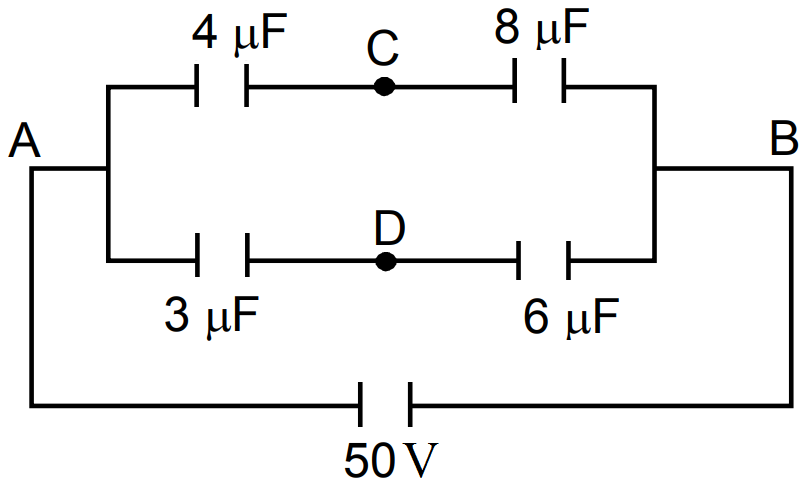
Take the potential of the point B in figure to be zero:
  1. Find the potentials at the points C and D.
  2. If a capacitor is connected between C and D, what charge will appear on this capacitor?
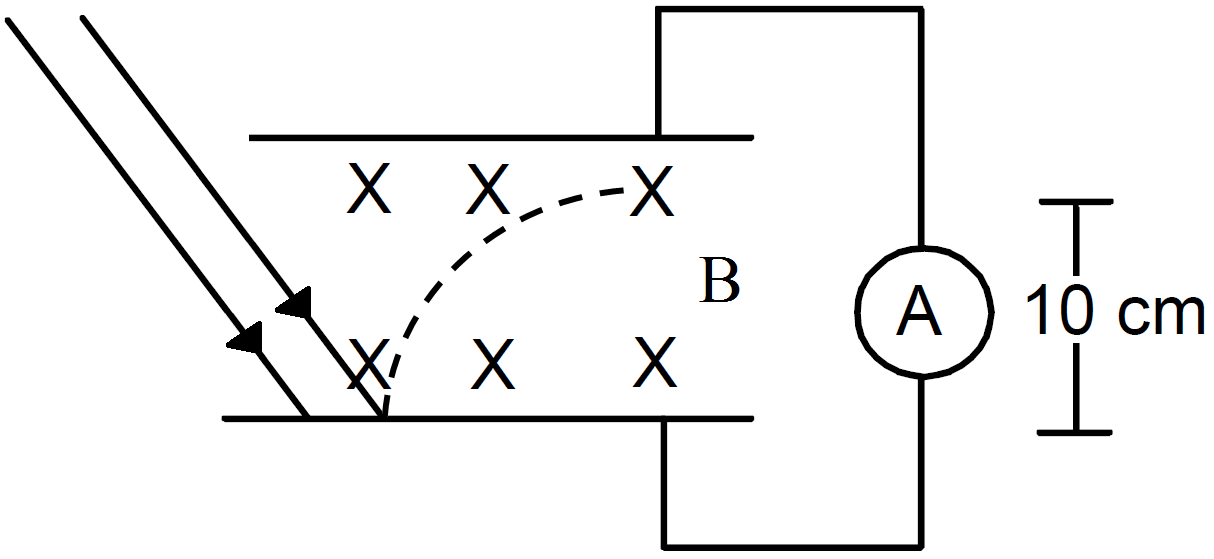
In an experiment on photoelectric effect, the emitter and the collector plates are placed et a separation of 10cm and are connected through en ammeter without any cell A magnetic field B exists parallel to the plates. The work function of the emitter is 2.39eV and the light incident on it has wavelengths between 400nm and 600nm. Find the minimum value of B for which the current registered by the ammeter is zero. Neglect any effect of space charge.
Consider the situation of the previous problem:
  1. Find the tension in the string in equilibrium.
  2. Suppose the ball is slightly pushed aside and released. Find the time period of the small oscillations.
A solenoid of length 20cm, area of cross-section $4.0cm^2$ and having 4000 turns is placed inside another solenoid of 2000 turns having a cross-sectional area $8.0cm^2$ and length 10cm. Find the mutual inductance between the solenoids.
By defining electric dipole and dipole moment, find the necessary formula for the field intensity at any point located on the neutral (equatorial plane) of the dipole.
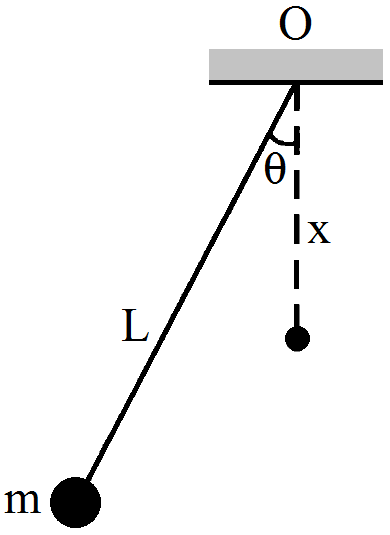
A simple pendulum of length L having a bob of mass m is deflected from its rest position by an angle $\theta$ and released (figure). The string hits a peg which is fixed at a distance x below the point of suspension and the bob starts going in a circle centred at the peg.
  1. Assuming that initially the bob has a height less than the peg, show that the maximum height reached by the bob equals its initial height.
  2. If the pendulum is released with $\theta=90^\circ$ and $\text{x}=\frac{\text{L}}{2}$ find the maximum height reached by the bob above its lowest position before the string becomes slack.
  3. Find the minimum value of $\frac{\text{x}}{\text{L}}$ for which the bob goes in a complete circle about the peg when the pendulum is released from $\theta=90^\circ.$