Question
A torsional pendulum consists of a solid disc connected to a thin wire$\Big(\alpha=2.4\times10^{-5}\ ^\circ\text{C}^{-1}\Big)$at its centre. Find the percentage change in the time period between peak winter $(5^\circ C)$ and peak summer $(45^\circ C)$.
Answer

Let the initial m.I. at 0°C be $\text{I}_0$
$\text{T}=2\pi\sqrt\frac{\text{I}}{\text{K}}$
$\text{I}=\text{I}_0(1+2\alpha\Delta\theta)$ (from above question)
At 5°C, $\text{T}_1=2\pi\sqrt\frac{\text{I}_0(1+2\alpha\Delta\theta)}{\text{K}}$
$=2\pi\sqrt\frac{\text{I}_0(1+2\alpha\Delta5)}{\text{k}}$
$=2\pi\sqrt\frac{\text{I}_0(1+10\alpha)}{\text{K}}$
At $45^\circ$ C, $\text{T}_2=2\pi\sqrt\frac{\text{I}_0(1+2\alpha45)}{\text{K}}$
$2\pi\sqrt\frac{\text{I}_0(1+90\alpha)}{\text{K}}$
$\frac{\text{T}_2}{\text{T}_1}=\sqrt\frac{1+90\alpha}{1+10\alpha}$
$=\sqrt\frac{1+90\times2.4\times10^{-5}}{1+10\times2.4\times10^{-5}}\sqrt\frac{1.00216}{1.00024}$
% change $=\Big(\frac{\text{T}_2}{\text{T}_1}-1\Big)\times100$
$=0.0959\%=9.6\times10^{-2}\%$

Need a full question paper?

Generate a complete, print-ready paper with questions like this in minutes — across 16+ boards, with answer keys.

Start Generating Free

Similar questions

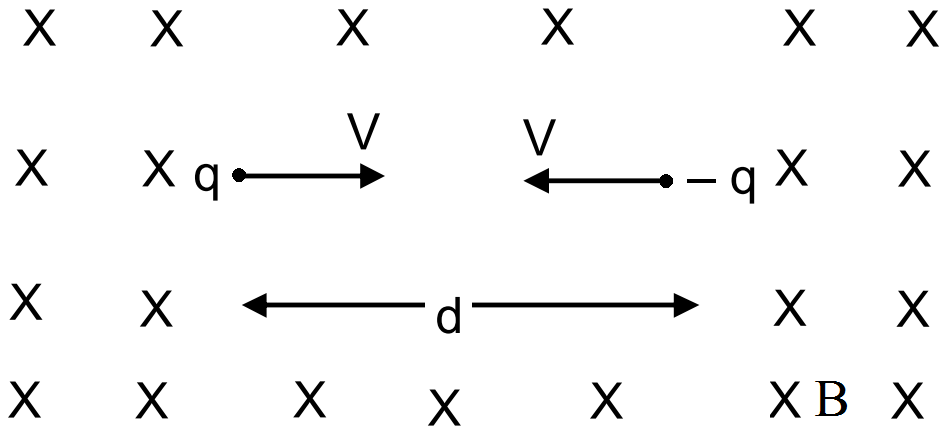
Two particles, each with mass m are placed at a separation d in a uniform magnetic field B, as shown in the figure. They have opposite charges of equal magnitude q. At time t = 0, the particles are projected towards each other, each with a speed v. Suppose the Coulomb force between the charges is switched off.
  1. Find the maximum value $v_m$ of the projection speed, so that the two particles do not collide.
  2. What would be the minimum and maximum separation between the particles if $\text{v}=\text{v}_{\text{m}}\sqrt{2}?$
  3. At what instant will a collision occur between the particles if $v = 2v_m?$
  4. Suppose $v = 2v_m$ and the collision between the particles is completely inelastic. Describe the motion after the collision.
An electrical technician requires a capacitance of 2μF in a circuitacross a potential difference of 1kV. A large number of 1μF capacitors are available to him each of which can withstand a potential difference of not more than 400V. Suggest a possible arrangement that requires the minimum number of capacitors.
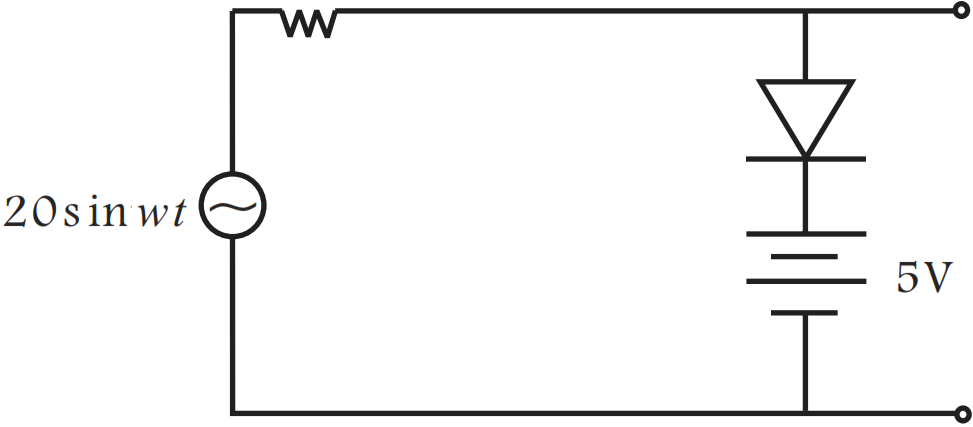
Assuming the ideal diode, draw the output waveform for the circuit given in Fig. Explain the waveform.
A bullet of mass 10g moving horizontally at a speed of 5017m/s strikes a block of mass 490g kept on a frictionless track as shown in figure. The bullet remains inside the block and the system proceeds towards the semicircular track of radius 0.2m. Where will the block strike the horizontal part after leaving the semicircular track ?
In a plane electromagnetic wave, the electric field oscillates sinusoidally at a frequency of $2.0 \times 10^{10} $Hz and amplitude $48\ V\ m^{-1}.$
  1. What is the wavelength of the wave?
  2. What is the amplitude of the oscillating magnetic field?
  3. Show that the average energy density of the E field equals the average energy density of the B field. $[c = 3 \times 10^8\ m\ s^{-1}.]$
Two monochromatic beams A and B of equal intensity I, hit a screen. The number of photons hitting the screen by beam A is twice that by beam B. Then what inference can you make about their frequencies?
State Biot-Savart statement. Obtain an expression for produced magnetic field due to a straight and limited length of current carrying conductor wire. Write its similarities and differences with coulomb's law of electrostatics.
A particle is fired vertically upward with a speed of 15km/s. With what speed will it move in intersteller space. Assume only earth's gravitational field.
Two balls having masses m and 2m are fastened to two light strings of same length (l). The other ends of the strings are fixed at O. The strings are kept in the same horizontal line and the system is released from rest. The collision between the balls is elastic.
  1. Find the velocities of the balls just after their collision.
  2. How high will the balls rise after the collision?
A faulty barometer contains certain amount of air and saturated water vapour. It reads 74.0cm when the atmospheric pressure is 76.0cm of mercury and reads 72.10cm when the atmospheric pressure is 74.0cm of mercury. Saturation vapour pressure at the air temperature = 1.0cm of mercury. Find the length of the barometer tube above the mercury level in the reservoir