MCQ
A particle covers $50\, m$ distance when projected with an initial speed. On the same surface it will cover a distance, when projected with double the initial speed ......... $m$
  • A
    $100$
  • B
    $150 $
  • $200 $
  • D
    $250 $

Answer

Correct option: C.
$200 $
c
(c) $R = \frac{{{u^2}\sin 2\theta }}{g} = R \propto {u^2}.$ So if the speed of projection doubled, the range will becomes four times,

i.e., $4 \times 50 = 200\,m$

Need a full question paper?

Generate a complete, print-ready paper with questions like this in minutes — across 16+ boards, with answer keys.
Start Generating Free

Similar questions

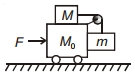
Two blocks of mass $M$ and $m$ are kept on the trolley whose all surfaces are smooth select the correct statement
In daily life, intake of a human adult is $10^7J,$ then average human consumption in a day is:
If both the mass and the radius of the earth decreases by $1\%$
A person standing on the floor of an elevator drops a coin. The coin reaches the floor in time $t_{1}$ if the elevator is at rest and in time $t_{2}$ if the elevator is moving uniformly. Then
The resultant of $\overrightarrow P $ and $\overrightarrow Q $ is perpendicular to $\overrightarrow P $. What is the angle between $\overrightarrow P $ and $\overrightarrow Q $
A black coloured solid sphere of radius $R$ and mass $M$ is inside a cavity with vacuum inside. The walls of the cavity are maintained at temperature $T_0$. The initial temperature of the sphere is $3T_0$. If the specific heat of the material of the sphere varies as $\alpha T^3$ per unit mass with the temperature $T$ of the sphere, where $\alpha $ is a constant, then the time taken for the sphere to cool down to temperature $2T_0$ will be ( $\sigma $ is Stefan Boltzmann constant)
The pressure of an ideal gas is written as $E = \frac{3PV}{2}$ . Here $E$ stands for
A gas is enclosed in a closed pot. On keeping this pot in a train moving with high speed, the temperature of the gas
A solid cylinder rolls down an inclined plane from a height $h$. At any moment the ratio of rotational kinetic energy to the total kinetic energy would be 
An observer moves with a constant speed along the line joining two stationary objects. He will observe that the two objects