A particle executes a simple harmonic motion of time period $T$. Find the time taken by the particle to go directly from its mean position to half the amplitude
Medium


Download our appand get started for free
Experience the future of education. Simply download our apps or reach out to us for more information. Let's shape the future of learning together!No signup needed.*
Similar Questions
- 1One end of a long metallic wire of length $L$ is tied to the ceiling. The other end is tied to massless spring of spring constant $K$. A mass $ m$ hangs freely from the free end of the spring. The area of cross-section and Young's modulus of the wire are $A$ and $Y$ respectively. If the mass is slightly pulled down and released, it will oscillate with a time period $T$ equal toView Solution
- 2There is a simple pendulum hanging from the ceiling of a lift. When the lift is stand still, the time period of the pendulum is $T$. If the resultant acceleration becomes $g/4,$ then the new time period of the pendulum isView Solution
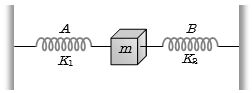
- 3View SolutionIn arrangement given in figure, if the block of mass m is displaced, the frequency is given by
- 4A particle of mass $m$ executes simple harmonic motion with amplitude $a$ and frequency $v$. The average kinetic energy during its motion from the position of equilibrium to the end isView Solution
- 5A block of mass $1 \,kg$ attached to a spring is made to oscillate with an initial amplitude of $12\, cm$. After $2\, minutes$ the amplitude decreases to $6\, cm$. Determine the value of the damping constant for this motion. (take In $2=0.693$ )View Solution
- 6View SolutionIn case of damped oscillation frequency of oscillation is ............
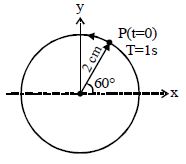
- 7Figure shows the circular motion of a particle. The radius of the circle, the period, sense of revolution and the initial position are indicated in the figure. The simple harmonic motion of the $x-$ projection of the radius vector of the rotating particle $P$ isView Solution
- 8For a simple pendulum, a graph is plotted between its kinetic energy $(KE)$ and potential energy $(PE)$ against its displacement $d$. Which one of the following represents these correctly? (graphs are schematic and not drawn to scale)View Solution
- 9A simple pendulum performs simple harmonic motion about $X = 0$ with an amplitude $A$ and time period $T$. The speed of the pendulum at $X = \frac{A}{2}$ will beView Solution
- 10The displacement $x$ (in metre) of a particle in, simple harmonic motion is related to time t (in seconds) asView Solution
$x = 0.01\cos \left( {\pi \,t + \frac{\pi }{4}} \right)$
The frequency of the motion will be