A particle executes $SHM.$ Its velocities are $v_1$and $v_2$ at displacement $x_1$ and $x_2$ from mean position respectively. The frequency of oscillation will be
Diffcult


Download our appand get started for free
Experience the future of education. Simply download our apps or reach out to us for more information. Let's shape the future of learning together!No signup needed.*
Similar Questions
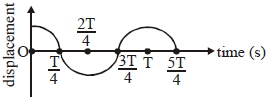
- 1The displacement time graph of a particle executing $S.H.M.$ is given in figure: (sketch is schematic and not to scale) Which of the following statements is are true for this motion?View Solution
$(A)$ The force is zero $t=\frac{3 T}{4}$
$(B)$ The acceleration is maximum at $t=T$
$(C)$ The speed is maximum at $t =\frac{ T }{4}$
$(D)$ The $P.E.$ is equal to $K.E.$ of the oscillation at $t=\frac{T}{2}$
- 2For a particle showing motion under the force $F=-5(x-2)^2$, the motion is .......View Solution
- 3A damped harmonic oscillator has a frequency of $5$ oscillations per second. The amplitude drops to half its value for every $10$ oscillations. The time it will take to drop to $\frac{1}{1000}$ of the original amplitude is close to .... $s$View Solution
- 4A particle of mass $10$ grams is executing simple harmonic motion with an amplitude of $0.5\, m$ and periodic time of $(\pi /5)$ seconds. The maximum value of the force acting on the particle is ... $N$View Solution
- 5Two pendulum have time periods $T$ and $5T/4$. They start $SHM$ at the same time from the mean position. After how many oscillations of the smaller pendulum they will be again in the same phaseView Solution
- 6A particle at the end of a spring executes simple harmonic motion with a period ${t_1}$, while the corresponding period for another spring is ${t_2}$. If the period of oscillation with the two springs in series is $T$, thenView Solution
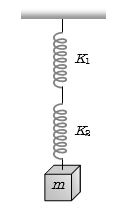
- 7A mass $M$ is suspended by two springs of force constants $K_1$ and $K_2$ respectively as shown in the diagram. The total elongation (stretch) of the two springs isView Solution
- 8A particle executes $S.H.M$ between $x =\, -A$ to $x =\, +A$ . The time taken for it in going from $0$ to $A/2$ is $T_1$ and from $A/2$ to $A$ is $T_2$. ThenView Solution
- 9The period of simple pendulum is measured as $T$ in a stationary lift. If the lift moves upwards with an acceleration of $5\, g$, the period will beView Solution
- 10The displacement of a particle varies with time as $x = 12\sin \omega t - 16{\sin ^3}\omega t$ (in $cm$). If its motion is $S.H.M.$, then its maximum acceleration isView Solution