Question
A particle executes simple harmonic motion. If you are told that its velocity at this instant is zero, can you say what is its displacement? If you are told that its velocity at this instant is maximum, can you say what is its displacement?

Answer

No, to know the displacement we should know the initial position of the particle. If it is said that initial position is mean position then we can answer the above question.

Need a full question paper?

Generate a complete, print-ready paper with questions like this in minutes — across 16+ boards, with answer keys.
Start Generating Free

Similar questions

Give a brief explanation about Radioactivity.
The total energy of electron is negative. What do you mean by this fact? It is positive then what is the indication?
Write the formula for the force per unit length between two parallel current carrying wires. Using it, write the definition of Ampere and Coulomb.
Electric potential at a point $P , V (x, y, z)=$ $6 x-8 x y^2-8 y+6 y z-4 z^2$. Find the electric force on a 4 coulomb point charge located at the origin.
Discuss the intensity of transmitted light when a polaroid sheet is rotated between two crossed polaroids.
Explain the formation of potential barrier and depletion region in a p-n junction diode. What is effect of applying forward bias on the width of depletion region?
A transmission wire carries a current of 100A. What would be the magnetic field B at a point on the road if the wire is 8m above the road?
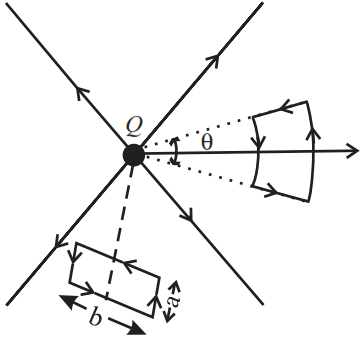
A test charge q is made to move in the electric field of a point charge Q along two different closed paths Fig. First path has sections along and perpendicular to lines of electric field. Second path is a rectangular loop of the same area as the first loop. How does the work done compare in the two cases?
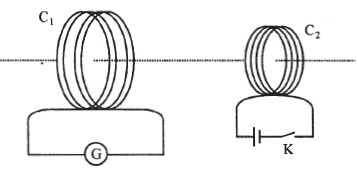
A current is induced in coil $C_1$ due to the motion of current carrying coil $C_2. (a)$ Write any two ways by which a large deflection can be obtained in the galvanometer $G. (b)$ Suggest an alternative device to demonstrate the induced current in place of a galvanometer.
Using the formula $\overrightarrow{\text{F}}=\text{q}\overrightarrow{\text{v}}\times\overrightarrow{\text{B}}$ and $\text{B}=\frac{\mu_0\text{i}}{2\pi\text{r}},$ show that the $SI$ units of the magnetic field $B$ and the permeability constant $\mu_0$ may be written as $N/A-m$ and $NA^2$ respectively.