MCQ
A particle executes simple harmonic motion represented by displacement function as $x(t)=A \sin (\omega t+\phi)$

If the position and velocity of the particle at $t=0\, {s}$ are $2\, {cm}$ and $2\, \omega \,{cm} \,{s}^{-1}$ respectively, then its amplitude is $x \sqrt{2} \,{cm}$ where the value of $x$ is ..... .

  • A
    $3$
  • B
    $1$
  • $2$
  • D
    $6$

Answer

Correct option: C.
$2$
c
As given

$v(t)=A \omega \cos (\omega t+\phi)$

$2=A \sin \phi.....(1)$

$2 \omega=A \omega \cos \phi.....(2)$

From $(1)$ and $(2)$

$\tan \phi=1$

$\phi=45^{\circ}$

Putting value of $\phi$ in equation $(1)$

$2=A\left\{\frac{1}{\sqrt{2}}\right\}$

$A=2 \sqrt{2}$

$x=2$

Need a full question paper?

Generate a complete, print-ready paper with questions like this in minutes — across 16+ boards, with answer keys.

Start Generating Free

Similar questions

The ratio of the adiabatic to isothermal elasticities of a triatomic gas is
Along capillary tyube of radius $ ‘r’$ is initially just vertically completely imerged inside a liquid of angle of contact $0^o $. If the tube is slowly raised then relation between radius of curvature of of miniscus inside the capillary tube and displacement $(h)$ of tube can be represented by
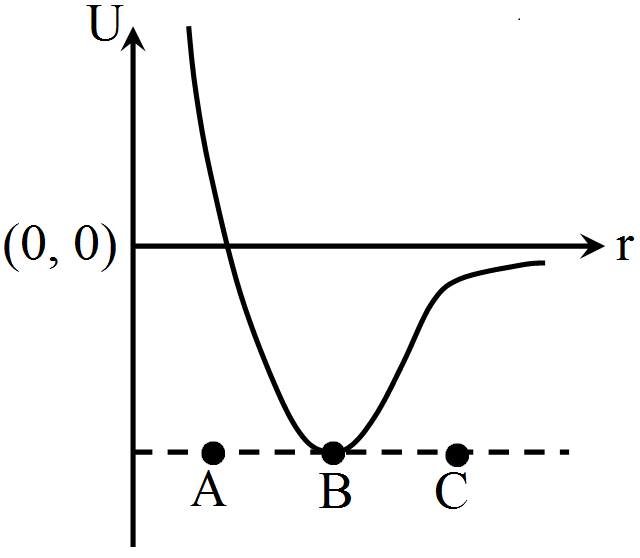
The potential energy $U$ between two molecules as a function of the distance $r$ between them has been shown in the adjoining figure. The two molecules are:
If the work done in blowing a bubble of volume $V$ is $W$, then the work done in blowing the bubble of volume $2V$ from the same soap solution will be
One end of a metal rod of length $1.0 m$ and area of cross section $100c{m^2}$ is maintained at ${100^o}C.$If the other end of the rod is maintained at ${0^o}C$, the quantity of heat transmitted through the rod per minute is (Coefficient of thermal conductivity of material of rod =$100W/m-K$)
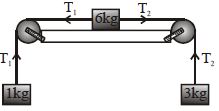
Three masses of $1\, kg$, $6\, kg$ and $3\, kg$ are connected to each other with threads and are placed on a tabel as shown in figure. ....... $ms^{-2}$ is the acceleration with which the block is moving. (Take $g = 10\, ms^2$)
The process in which no heat enters or leaves the system is termed as
If the position vector of a particle is

$\vec r =  - \cos \,t\hat i + \sin \,t\hat j - 18\,t\hat k$

then what is the magnitude of its acceleration ?

An elastic spring under tension of $3 \mathrm{~N}$ has a lengtha. Its length is $b$ under tension $2 \mathrm{~N}$. For its length$(3 a-2 b)$, the value of tension will be_______. $\mathrm{N}$.
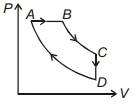
For $P-V$ diagram of a thermodynamic cycle as shown in figure, process $B C$ and $D A$ are isothermal. Which of the corresponding graphs is correct?