MCQ
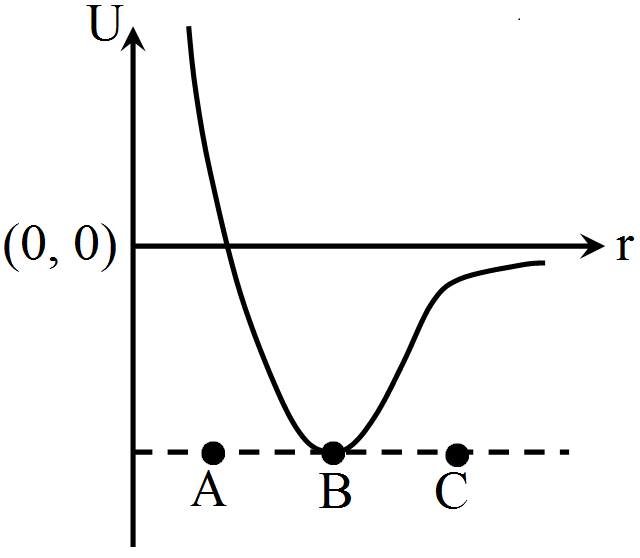
The potential energy $U$ between two molecules as a function of the distance $r$ between them has been shown in the adjoining figure. The two molecules are:
  • A
    Attracted when $r$ lies between $A$ and $B$ and repelled when $r$ lies between $B$ and $C.$
  • Attracted when $r$ lies between $B$ and $C$ and repelled when $r$ lies between $A$ and $B.$
  • C
    Attracted when they reach $B.$
  • D
    Repelled when they reach $B.$

Answer

Correct option: B.
Attracted when $r$ lies between $B$ and $C$ and repelled when $r$ lies between $A$ and $B.$

Need a full question paper?

Generate a complete, print-ready paper with questions like this in minutes — across 16+ boards, with answer keys.

Start Generating Free

Similar questions

The energy density in the electric field created by a point charge falls off with the distance from the point charge as:
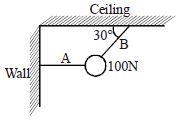
A $100$ $Newton$ weight is suspended in a corner of a room by two cords $A$ and $B$ as shown in the figure below. The tension in the horizontal cord $A$ is ............ $N$
When $1\, gm$ of water at ${0^o}C$ and $1 \times {10^5}\;N/{m^2}$ pressure is converted into ice of volume $1.091\;c{m^2}$, the external work done will be
The average energy in one time period in simple harmonic motion is:
A particle is tied to $20\,cm$ long string. It performs circular motion in vertical plane. What is the angular velocity of string when the tension in the string at the top is zero .......... $rad/sec$
Match List $I$ with List $II$

LIST$-I$ LIST$-II$
$(A)$  Torque $(I)$    $ML ^{-2} T ^{-2}$
$(B)$   Stress $(II)$   $ML ^2 T ^{-2}$
$(C)$   Pressure of gradient $(III)$   $ML ^{-1} T ^{-1}$
$(D)$   Coefficient of viscosity $(IV)$   $ML ^{-1} T ^{-2}$

Choose the correct answer from the options given below

The angular acceleration of a body, moving along the circumference of a circle, is :
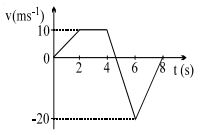
The figure shows a velocity-time graph of a particle moving along a straight line  Identify the region in which the rate of change of velocity $\left| {\frac{{\Delta \vec v}}{{\Delta t}}} \right|$ of the particle is maximum
If force $(F),$ velocity $(V)$ and time $(T)$ are taken as fundamental units, then the dimensions of mass are 
A fighter jet is flying horizontally at a certain altitude with a speed of $200 \; ms ^{-1}$. When it passes directly overhead an anti-aircraft gun, bullet is fired from the gun, at an angle $\theta$ with the horizontal, to hit the jet. If the bullet speed is $400 \; m / s$, the value of $\theta$ will be $\dots \; {}^o$