MCQ
A particle executes simple harmonic motion under the restoring force provided by a spring. The time period is $T.$ If the spring is divided in two equal parts and one part is used to continue the simple harmonic motion, the time period will:
  • A
    Remain $T$
  • B
    Become $2T$
  • C
    Become $\frac{\text{T}}{2}$
  • Become $\frac{\text{T}}{\sqrt{2}}$

Answer

Correct option: D.
Become $\frac{\text{T}}{\sqrt{2}}$
Time period $(T)$ is given by,
$\text{T}=2\pi\sqrt{\frac{\text{m}}{\text{k}}}$
where m is the mass, and $k$ is spring constant.
When the spring is divided into two parts, the new spring constant $\text{k}_1$ is given as,
$\text{k}_1=2\text{k}$
New time period $\text{T}_1$:
$\text{T}_1=2\pi\sqrt{\frac{\text{m}}{2\text{k}}}=\frac{1}{\sqrt{2}}2\pi\sqrt{\frac{\text{m}}{\text{k}}}=\frac{1}{\sqrt{2}}\text{T}$

Need a full question paper?

Generate a complete, print-ready paper with questions like this in minutes — across 16+ boards, with answer keys.

Start Generating Free

Similar questions

A proton of mass $ 1.6  \times 10^{-27} kg$ goes round in a circular orbit of radius $0.10\, m$ under a centripetal force of $4  \times 10^{-13}\, N$. then the frequency of revolution of the proton is about 
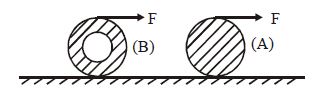
Disc $A$ and disc $B$ with a hole have equal mass and radius and a string is wrapped around them as shown. Equal force $F$ is applied on the string of each body. Friction is sufficient for rolling. After time $t$ velocity of $A$ is $v_A$ and that of $B$ is $v_B$ and kinetic energy $k_A$ & $k_B$ , then
A student performed the experiment to measure the speed of sound in air using resonance air-column method. Two resonances in the air-column were obtained by lowering the water level. The resonance with the shorter air-column is the first resonance and that with the longer air-column is the second resonance. Then,

$(A)$ the intensity of the sound heard at the first resonance was more than that at the second resonance

$(B)$ the prongs of the tuning fork were kept in a horizontal plane above the resonance tube

$(C)$ the amplitude of vibration of the ends of the prongs is typically around $1 \mathrm{~cm}$

$(D)$ the length of the air-column at the first resonance was somewhat shorter than $1 / 4$ th of the wavelength of the sound in air

A particle is moving with velocity $\vec v = K(y\hat i + x\hat j)$ where $K$ is a constant. The general equation for its path is
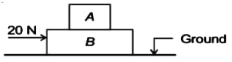
Blocks shown in figure moves with constant velocity $10 \,m / s$ towards right. All surfaces in contact are rough. The friction force applied by $B$ on $A$ is ...........$N$
In steel, the Young's modulus and the strain at the breaking point are $2 \times 10^{11}\ Nm^{-2}$ and $0.15,$ respectively. The stress at the breaking point for steel is therefore:
A tennis ball is dropped on a horizontal smooth surface. It bounces back to its original position after hitting the surface. The force on the ball during the collision is proportional to the length of compression of the ball. Which one of the following sketches describes the variation of its kinetic energy $K$ with time $t$ most appropriately? The figures are only illustrative and not to the scale.
A group of people watch a ice show which is held in closed area . Skaters perform a . music show whose level is $60\ db$ . Spectator can yell at $40.0 \ dB$ . Which one of the them represent approx combine sound level
A particle of mass $m$ is moving in a circular path of constant radius $I$ such that its centripetal acceleration $(a)$ is varying with time $t$ as $a=k^{2} rt^{2}$. where $k$ is a constant. The power delivered to the particle by the force acting on it is given as
An athletic coach told his team that muscle times speed equals power. What dimensions does he view for muscle