Question
A particle executes simple harmonic motion with a frequency v. The frequency with which the kinetic energy oscillates is:
  1. $\frac{\text{v}}{2}$
  2. v
  3. 2v
  4. zero

Answer

  1. 2v

Explanation:

Because in one complete oscillation, the kinetic energy changes its value from zero to maximum, twice.

Need a full question paper?

Generate a complete, print-ready paper with questions like this in minutes — across 16+ boards, with answer keys.
Start Generating Free

Similar questions

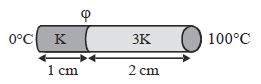
Two bars of thermal conductivities $K$ and $3K$ and lengths $1\,\, cm$ and $2\,\, cm$ respectively have equal cross-sectional area, they are joined lengths wise as shown in the figure. If the temperature at the ends of this composite bar is $0\,^oC$ and $100\,^oC$ respectively (see figure), then the temperature $\varphi $ of the interface is......... $^oC$
A Spherical ball of radius $1 mm$ and density $10.5 g / cc$ is dropped in glycerine of coefficient of viscosity $9.8$ poise and density $1.5 g / cc$. Viscous force on the ball when it attains constant velocity is $3696 \times 10^{-x} N$. The value of $x$ is $\text { (Given, } g =9.8 m / s ^2 \text { and } \pi=\frac{22}{7} \text { ) }$
What are conservative forces? Distinguish the conservative and non-conservative forces among the following:
A particle moves such that its position vector $\overrightarrow{\mathrm{r}}(\mathrm{t})=\cos \omega \mathrm{t} \hat{\mathrm{i}}+\sin \omega \mathrm{t} \hat{\mathrm{j}}$ where $\omega$ is a constant and $t$ is time. Then which of the following statements is true for the velocity $\overrightarrow{\mathrm{v}}(\mathrm{t})$ and acceleration $\overrightarrow{\mathrm{a}}(\mathrm{t})$ of the particle
Following operations can be performed on a capacitor:
X - connect the capacitor to a battery of emf $\in.$
Y - disconnect the battery.
Z - reconnect the battery with polarity reversed.
W - insert a dielectric slab in the capacitor.
  1. In XYZ (perform X, then Y, then Z) the stored electric energy remains unchanged and no thermal energy is developed.
  2. The charge appearing on the capacitor is greater after the action XWY than after the action XYW.
  3. The electric energy stored in the capacitor is greater after the action WXY than after the action XYW.
  4. The electric field in the capacitor after the action XW is the same as that after WX.
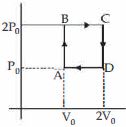
Helium gas goes through a cycle $ABCDA$ ( consisting of two isochoric and isobaric lines) as shown in figure Efficiency of this cycle is nearly ....... $\%$ (Assume the gas to be close to ideal gas)
From a tower of height $H$, a particle is thrown vertically upwards with a speed $ u$. The time taken by the particle, to hit the ground, is $n$ times that taken by it to reach the highest point of its path. The relation between $H, u$ and $n$ is:
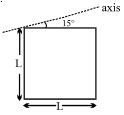
A square plate of mass $M$ and edge $L$ is shown in figure. The moment of inertia of the plate about the axis in the plane of plate passing through one of its vertex making an angle $15^o$ from horizontal is. 
A particle is tied to one end of a light inextensible string and is moved in a vertical circle, the other end of the string is fixed at the centre. Then for a complete motion in a circle, which is correct.
(air resistance is negligible).
A ball is projected from ground with a velocity $V$ at an angle $\theta$ to the vertical. On its path it makes an elastic collison with a vertical wall and returns to ground. The total time of flight of the ball is