MCQ
What are conservative forces? Distinguish the conservative and non-conservative forces among the following:
  • A
    Gravitational force.
  • B
    Frictional force.
  • C
    Air resistance.
  • D
    Electrostatic force.

Answer

Conservative forces are those forces in which work done (i) in a closed path is zero and (ii) is independent of path.

  1. Conservative forces: Gravitational and Electrostatic force.

  2. Non-conservative forces: Frictional force and air resistance. 

Need a full question paper?

Generate a complete, print-ready paper with questions like this in minutes — across 16+ boards, with answer keys.
Start Generating Free

Similar questions

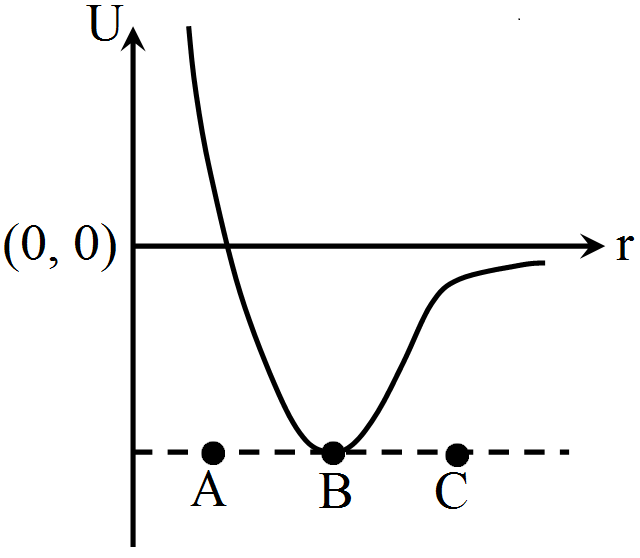
The potential energy U between two molecules as a function of the distance r between them has been shown in the adjoining figure. The two molecules are:

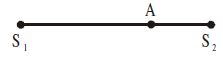
If $y_1 = 5 (mm)\ \sin\pi t$ is equation of oscillation of source $S_1$ and $y_2$ $=$ $5$ $(mm)$ $sin(\pi t + \pi /6)$ be that of $S_2$ and it takes $1$ $sec$ and $\frac{1}{2}\ sec$ for the transverse waves to reach point $A$ from sources $S_1$ and $S_2$ respectively then the resulting amplitude at point $A$, is .... $mm$
A $1 \,kg$ stone at the end of $1 \,m$ long string is whirled in a vertical circle at constant speed of $4\, m/sec$. The tension in the string is $6 \,N$, when the stone is at
A man is sitting with folded hands on a revolving table. Suddenly, he stretches his arms. Angular speed of the table would:
Number of particles is given by $n = - D\frac{{{n_2} - {n_1}}}{{{x_2} - {x_1}}}$ crossing a unit area perpendicular to X-axis in unit time, where ${n_1}$ and ${n_2}$ are number of particles per unit volume for the value of $x$ meant to ${x_2}$ and ${x_1}$. Find dimensions of $D$ called as diffusion constant
In the gas equation $\Big(\text{p}+\frac{\text{a}}{\text{V}^2}\Big)(\text{V}-\text{b})=\text{RT}$ the dimensions of a are:
The unit of potential energy is
A couple produces a:
A mass of $2.0\, kg$ is put on a flat pan attached to a vertical spring fixed on the ground as shown in the figure. The mass of the spring and the pan is negligible.  When pressed slightly and released the mass executes a simple harmonic motion. The spring constant is $200\, N/m.$ What should be the minimum amplitude of the motion so that the mass gets detached from the pan (take $g = 10 m/s^2$). 
A ball is dropped vertically from a height $d$ above the ground. It hits the ground and bounces up vertically to a height $d/2$. Neglecting subsequent motion and air resistance, its velocity $v$ varies with the height $h$ above the ground is